


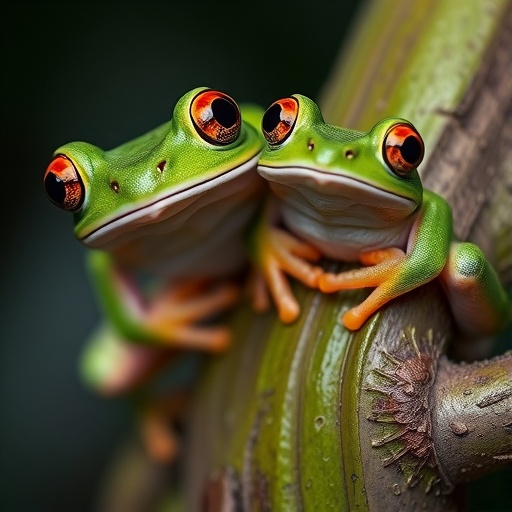
Female Cope’s gray treefrogs appear to suffer from the same problem that confronts humans in crowded stores, overflowing streaming menus and dating apps: too many choices can make a decision harder, slower and less successful. New research from the Smithsonian Tropical Research Institute and the University of Tennessee shows that female frogs become less effective at selecting a mate when they must evaluate a large number of male calls simultaneously. The study, published in iScience, suggests that cognitive limits can shape reproduction even in animals with relatively simple nervous systems, adding a surprising biological dimension to the familiar phenomenon known as choice overload.
During the breeding season, Cope’s gray treefrogs gather in wetlands and forests across eastern North America. Males call from the surrounding vegetation or from the edges of ponds, producing loud, repetitive vocalizations intended to attract females. A chorus may contain dozens of calling males, creating an acoustic environment in which individual signals overlap. Females must locate the source of a preferred call, travel toward it and ultimately choose a mate. Because reproduction depends on completing this sequence successfully, the ability to separate and evaluate competing signals is central to the frogs’ biology.
Scientists have traditionally explained the difficulty of finding a mate in a frog chorus through a process called energetic masking. When multiple calls overlap, the combined sound energy can obscure the timing, frequency or intensity of an individual male’s signal. In practical terms, a female may be unable to hear one call clearly because other calls create a wall of noise. The new research examined a different possibility: that females may sometimes hear the available calls but become overwhelmed by the number of alternatives. Distinguishing these mechanisms is important because sensory interference and decision-making overload place different constraints on animal behavior.
To separate the effects, the researchers conducted controlled laboratory experiments using recorded mating calls broadcast through speakers. Female Cope’s gray treefrogs were presented with one target call accompanied by different numbers of competing calls. The researchers also varied the amount of background noise, allowing them to compare conditions involving many choices, acoustic interference or both at the same time. They then measured whether a female initiated a response, whether she moved toward the target call and how long she required to make the decision. This design enabled the team to test not only whether females could hear a signal, but also how the complexity of the choice environment affected the entire behavioral process.
The results showed a clear decline in performance as the number of available calls increased. When females were presented with only two calls, they pursued a mate in 97% of trials. When the number of calls rose to eight, the proportion of successful approaches fell to 82%. The frogs that did respond also became less accurate. With two calls, females selected the target call in 76% of trials and reached it in an average of 114 seconds. When eight calls were presented, target selection dropped to 25%, while the average decision time increased to 183 seconds. The pattern indicates that the frogs were not simply failing to hear; they were also struggling to evaluate competing alternatives and commit to one.
Importantly, the effect persisted whether or not additional background noise was present. That finding allowed the researchers to distinguish choice overload from energetic masking. If overlapping calls alone had caused the decline, adding or removing background noise would have been expected to produce the dominant effect. Instead, the number of potential mates independently influenced the females’ probability of responding, their accuracy and the time required to choose. The study therefore identifies decision complexity as a separate factor in mate selection, rather than treating all performance failures as consequences of poor signal detection.
Claire Hemingway, a research associate at the Smithsonian Tropical Research Institute and an assistant professor at the University of Tennessee, said the study was designed to determine whether female frogs were experiencing a problem comparable to entering a noisy bar or browsing a dating application with too many possible partners. Jessie Tanner, an assistant professor at the University of Tennessee and the paper’s senior author, said the results were striking because the decline appeared consistently across several measures of performance. Together, the researchers argue that the frogs’ responses resemble a general information-processing limitation: as the number of alternatives increases, the mental and sensory demands of comparison rise until decision quality begins to deteriorate.
The findings could influence how biologists understand sexual selection in environments where animals must make choices under pressure. Female frogs do not evaluate males using a single feature. They may use call properties such as dominant frequency, pulse rate, call duration, repetition pattern and intensity, characteristics that can provide information about a male’s body size, condition or species identity. In a natural chorus, these variables may be difficult to compare because signals arrive at different times and from different locations. A female that spends too long assessing alternatives risks losing the opportunity to reproduce, while a rushed decision may lead her toward a less-preferred or unsuitable mate. Choice overload could therefore alter which males successfully reproduce and, over generations, influence the evolution of mating signals.
The research also highlights a broader issue in animal cognition: limits on behavior may arise not only from what an animal can sense, but from how many pieces of information it can process at once. Complex habitats, dense social groups and changing environmental conditions can all force animals to make decisions with incomplete or competing information. In frogs, the consequences may be especially visible because mating depends on rapid acoustic communication, but similar constraints could affect mate choice, foraging, predator avoidance and social behavior in many species. By showing that the number of alternatives can independently reduce decision accuracy, the study offers a new way to investigate how cognitive limits shape evolution in the real world.
The authors emphasize that female treefrogs remain capable of making choices even in crowded acoustic conditions; the issue is that success declines as the decision environment becomes more complex. Their results suggest that the reproductive consequences of noisy breeding choruses may be caused by two interacting but distinct pressures: energetic masking, which makes calls harder to detect, and choice overload, which makes detected calls harder to evaluate. Understanding both processes may help explain why animal communication systems evolve particular call structures, spacing patterns and preferences. For Cope’s gray treefrogs, a chorus that sounds like a spectacular display of reproductive competition may also be a cognitive bottleneck—one in which having more potential mates does not necessarily improve a female’s chances of finding the right one.
News Publication Date: 12-Aug-2026
Web References: https://doi.org/10.1016/j.isci.2026.117086
References: iScience, DOI: 10.1016/j.isci.2026.117086
Cite Scienmag News
Drew Townsend. (August 13, 2026). Sensory overload impairs female treefrogs’ ability to choose mates. Scienmag. https://scienmag.com/sensory-overload-impairs-female-treefrogs-ability-to-choose-mates/
Drew Townsend. "Sensory overload impairs female treefrogs’ ability to choose mates." Scienmag, 13 August 2026, https://scienmag.com/sensory-overload-impairs-female-treefrogs-ability-to-choose-mates/. Accessed 3 September 2026.
Drew Townsend. "Sensory overload impairs female treefrogs’ ability to choose mates." Scienmag. August 13, 2026. https://scienmag.com/sensory-overload-impairs-female-treefrogs-ability-to-choose-mates/


