


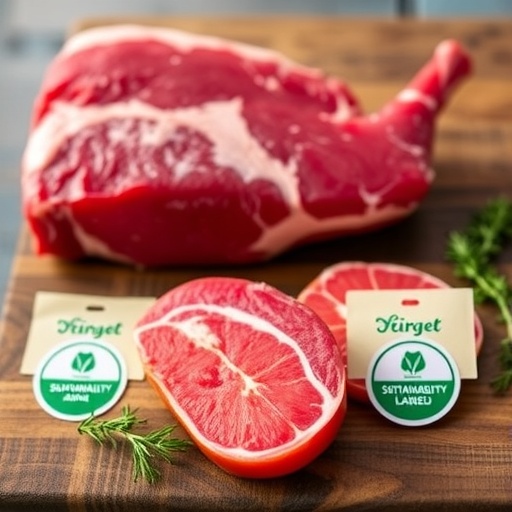
A new study published in PLOS One reports that sustainability labels on meat products are associated with substantially higher prices in the United States, but the size of the premium varies sharply according to the product and the claim displayed on its packaging. The largest difference identified in the study was linked to beef carrying a “grass-fed” label, which sold for an average of 33 percent more than comparable products without that designation. By contrast, chicken marked “organic” carried an average premium of approximately 7 percent. The findings suggest that shoppers are not paying one uniform price for the idea of sustainable meat. Instead, the market assigns different economic values to different production claims, reflecting variations in consumer demand, perceived environmental benefits, production costs and the credibility or familiarity of each label.
The research, titled “Price premiums for meat products with sustainability labels,” examines how sustainability-related information is reflected in retail meat prices. Labels can function as a form of market communication: they tell consumers that a product was produced under particular conditions, such as restrictions on feed, production methods or the use of certain agricultural inputs. In economic terms, the label may reduce information asymmetry, a situation in which sellers know more about a product’s origins than buyers do. A certification or production claim gives shoppers a signal they can use when comparing otherwise similar packages. The price difference associated with that signal is known as a price premium. Although a premium can indicate strong consumer willingness to pay, it does not automatically measure the product’s full environmental benefit or prove that the label alone caused the higher price.
The contrast between chicken and beef highlights how complicated this market has become. An average 7 percent increase for organic-labelled chicken is relatively modest compared with the 33 percent increase associated with grass-fed beef. Such differences may arise from several interacting mechanisms. Organic production can require more expensive feed, certification and compliance procedures, while grass-fed beef may involve longer growth periods, greater land requirements and different herd-management practices. Retail prices also incorporate transportation, processing, packaging, retailer margins and regional supply conditions. At the same time, consumers may attach a particularly strong value to grass-fed beef because the claim evokes images of natural grazing, animal welfare or lower-impact farming. The study’s results therefore show the combined outcome of production economics and consumer perception rather than a simple ranking of which label is “most sustainable.”
Technically, studies of this kind compare the prices of labelled and unlabelled products while accounting for characteristics that can otherwise distort the comparison. Meat prices depend on more than sustainability claims: cut, weight, brand, fat content, freshness, packaging format, store type and geographic location can all influence the amount shoppers pay. A price-premium analysis attempts to isolate the association between a label and the final retail price after considering these product attributes. The resulting percentage is an average market difference, not a guaranteed markup on every package. Some labelled products may sell for far more or less than the average, and the premium can change with promotions, shortages, changes in consumer demand or shifts in certification standards.
The findings arrive as consumers, food companies and policymakers debate whether sustainability labels make environmental information more accessible or simply make responsible choices more expensive. Labels can encourage producers to adopt practices that reduce reliance on synthetic inputs, alter animal diets or change land-management systems, but they can also divide the market according to consumers’ ability to pay. If products with environmental or welfare claims consistently cost more, lower-income households may be less able to participate in those markets. That creates a tension at the heart of sustainable food policy: labels may reward improved production practices, yet the price signal can limit who benefits from them and who can afford to support them.
The study also underscores why consumers should avoid treating sustainability labels as interchangeable. “Organic,” “grass-fed” and other claims refer to different production systems and are governed by different standards. A label may address feed, chemical inputs, livestock access to pasture, animal-management practices or a combination of factors, but it may not provide a complete account of greenhouse-gas emissions, biodiversity, water use or farm economics. For example, a production method that reduces one environmental pressure could increase another depending on climate, land availability and management. The observed price premiums therefore cannot be translated directly into a single environmental score. They reveal how the marketplace responds to particular claims, not a definitive measure of the overall sustainability of each product.
The authors’ conclusions are especially relevant for retailers and food manufacturers deciding how to communicate production practices. A substantial premium may signal that a label has strong consumer appeal, giving producers an incentive to pursue certification or adopt systems that qualify for the claim. Yet a premium can also encourage “label proliferation,” in which packages carry numerous environmental messages that are difficult for shoppers to compare. Clear definitions, transparent verification and consistent standards are essential if price differences are to reflect meaningful distinctions rather than marketing power. For researchers, the results provide evidence that the economic value of sustainability information is product-specific. Further work will be needed to determine how premiums change over time, whether they reflect actual production costs, and how much of the additional price reaches farmers rather than intermediaries.
The research was supported in part by the U.S. Department of Agriculture’s National Institute of Food and Agriculture through Hatch Project 7007883 and by the Economic Research Service through Cooperative Agreement 58-3000-1-0097. The authors are based in the United States and the Republic of Korea. They caution that the findings and conclusions are those of the researchers and should not be interpreted as an official determination or policy of the USDA or the U.S. government. Published in PLOS One on 12 August 2026, the study offers a vivid snapshot of a rapidly changing food market: sustainability claims are no longer merely statements on a package, but measurable economic signals capable of shifting the price of dinner by single digits for some products and by one-third for others.
News Publication Date: 12-Aug-2026
Web References: https://doi.org/10.1371/journal.pone.0353190
References: “Price premiums for meat products with sustainability labels,” PLOS One, DOI: 10.1371/journal.pone.0353190
Cite Scienmag News
Sloane Callahan. (August 12, 2026). Sustainability-labeled US meats cost more, with premiums ranging from 7% to 33%. Scienmag. https://scienmag.com/sustainability-labeled-us-meats-cost-more-with-premiums-ranging-from-7-to-33/
Sloane Callahan. "Sustainability-labeled US meats cost more, with premiums ranging from 7% to 33%." Scienmag, 12 August 2026, https://scienmag.com/sustainability-labeled-us-meats-cost-more-with-premiums-ranging-from-7-to-33/. Accessed 3 September 2026.
Sloane Callahan. "Sustainability-labeled US meats cost more, with premiums ranging from 7% to 33%." Scienmag. August 12, 2026. https://scienmag.com/sustainability-labeled-us-meats-cost-more-with-premiums-ranging-from-7-to-33/


