


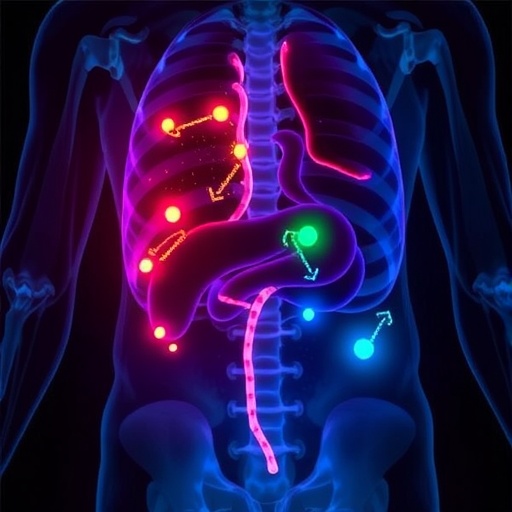
A new radiotracer particle designed to make the journey through the entire human digestive system visible could give researchers a clearer picture of how food, medicines, and medical materials move through the gastrointestinal tract. In a study published in Scientific Reports, Wong, Kasbollah, Abdullah and colleagues describe the development of polystyrene particles loaded with samarium-153 oxide for use in gamma scintigraphy, an imaging technique that tracks radioactive signals as they pass through the body.
The concept combines two carefully selected components: a polymer particle that can travel through the digestive tract and a radioactive substance capable of producing detectable gamma radiation. Polystyrene provides a stable, compact material that can be engineered into particles with controlled physical properties. Samarium-153 oxide supplies the radioactive signal. When the particles are monitored with a gamma camera, their location can be mapped over time, allowing researchers to follow gastrointestinal transit from the stomach through the small intestine and into the colon.
Gastrointestinal transit studies are essential because the digestive tract is not simply a passive tube. Its movement is governed by coordinated muscle contractions, fluid secretion, pressure changes, microbial activity, and interactions with food and medication. The time required for material to leave the stomach, cross the small intestine, and pass through the large intestine can vary substantially between individuals. Delayed or accelerated transit may be associated with conditions such as gastroparesis, constipation, diarrhoeal disorders, irritable bowel syndrome, and inflammatory disease. It can also influence how efficiently orally administered drugs are released and absorbed.
Traditional methods for studying transit often involve radiopaque markers, magnetic tracking, breath tests, scintigraphic meals, or imaging techniques that capture only part of the digestive process. A radiolabelled particle offers a different strategy: instead of estimating movement indirectly, researchers can observe the changing position of a defined tracer as it travels through the gastrointestinal system. Gamma scintigraphy is particularly valuable because gamma rays can pass through tissue and be detected externally, creating a non-invasive record of the tracer’s progression.
Samarium-153 is suitable for this type of work because it emits both beta particles and gamma photons. Its beta radiation has therapeutic applications in other medical contexts, while its gamma emission can be detected for imaging. The isotope has a physical half-life of roughly 46 hours, long enough to support extended observation of gastrointestinal movement but short enough to limit the duration of radioactivity after the study. In a radiotracer design, the radioactive material must remain associated with the particle during transit so that the recorded signal represents the movement of the particle rather than the diffusion of free radioactive compounds.
That requirement makes the particle architecture central to the research. Loading samarium-153 oxide into a polystyrene matrix can help create a discrete radioactive object with a defined physical identity. The particle’s size, shape, surface characteristics, density, and resistance to chemical breakdown may all affect how it moves through the digestive tract. A particle that is too small could behave differently from food residues or might interact strongly with intestinal contents. A particle that is too large could travel irregularly or fail to pass through certain regions. The development process therefore sits at the intersection of radiochemistry, polymer science, nuclear medicine, and gastrointestinal physiology.
The researchers’ approach is also significant because it aims to support whole-transit imaging rather than a snapshot of a single organ. The stomach controls the initial release of material into the duodenum, the small intestine governs much of digestion and nutrient absorption, and the colon manages water recovery and stool formation. These regions have different shapes, contents, microbial environments, and movement patterns. A tracer that remains identifiable across the complete route could help distinguish where transit is delayed and whether a problem is concentrated in the upper or lower gastrointestinal tract.
The study arrives at a moment when non-invasive physiological tracking is becoming increasingly important. Researchers are investigating how the gut responds to new drug formulations, nutritional products, medical devices, and engineered particles. A reliable radiotracer can act as a benchmark for testing whether a material remains in the stomach, reaches a targeted intestinal region, or moves rapidly into the colon. Such information can guide the design of sustained-release medicines, colon-targeted therapies, and diagnostic systems intended to operate inside the digestive tract.
However, the usefulness of a radiotracer depends on more than radioactivity alone. Scientists must evaluate whether the isotope remains securely associated with the carrier, whether the particles retain their intended properties in digestive fluids, and whether the imaging signal is strong enough for accurate localization. They must also consider radiation dose, particle recovery, biological compatibility, and the possibility that the tracer could fragment or release radioactive material. These factors determine whether a material developed in the laboratory can become a dependable tool for animal studies, clinical research, or future medical applications.
By developing samarium-153 oxide-loaded polystyrene particles for gamma scintigraphy, the team has addressed a central challenge in digestive research: creating a visible, trackable marker that can accompany material through the full gastrointestinal pathway. The work does not turn the digestive system into a transparent organ, but it offers researchers a way to reconstruct its hidden movements from radioactive signals recorded outside the body. If further testing confirms stable labelling and reproducible transit behaviour, the platform could become a powerful tool for studying gut motility, evaluating oral medicines, and revealing why the same treatment may move through different people at dramatically different speeds.
Cite Scienmag News
Courtney Benton. (August 12, 2026). Scientists Develop Samarium-153 Polystyrene Tracers to Track Whole-Gut Transit via Gamma Scintigraphy. Scienmag. https://scienmag.com/scientists-develop-samarium-153-polystyrene-tracers-to-track-whole-gut-transit-via-gamma-scintigraphy/
Courtney Benton. "Scientists Develop Samarium-153 Polystyrene Tracers to Track Whole-Gut Transit via Gamma Scintigraphy." Scienmag, 12 August 2026, https://scienmag.com/scientists-develop-samarium-153-polystyrene-tracers-to-track-whole-gut-transit-via-gamma-scintigraphy/. Accessed 3 September 2026.
Courtney Benton. "Scientists Develop Samarium-153 Polystyrene Tracers to Track Whole-Gut Transit via Gamma Scintigraphy." Scienmag. August 12, 2026. https://scienmag.com/scientists-develop-samarium-153-polystyrene-tracers-to-track-whole-gut-transit-via-gamma-scintigraphy/


