


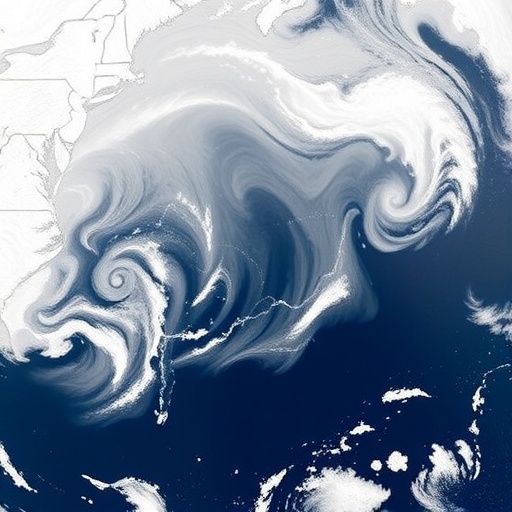
The Southern Ocean is often portrayed as a vast conveyor belt, moving water around Antarctica and helping regulate the climate of the entire planet. Yet beneath its turbulent surface, another transport system has been quietly shifting heat toward the poles. A new study by Liu, Zhai, He and colleagues reports direct observational evidence that mesoscale eddies in the deep Southern Ocean carry heat poleward, revealing a powerful process that has been difficult to measure and may be critical for understanding how the ocean responds to climate change.
Mesoscale eddies are rotating structures in the ocean, typically spanning tens to hundreds of kilometres and lasting from weeks to several months. Some resemble atmospheric storms, with swirling currents that trap and transport water over long distances. In the Southern Ocean, these rotating features form as powerful winds, fronts and large-scale currents interact with the complex seafloor and steep density gradients surrounding Antarctica. Although eddies are smaller than the major ocean currents, their cumulative influence can be enormous because they constantly redistribute heat, salt, nutrients and carbon.
The new research focuses on the deep Southern Ocean, a region far below the surface where the movement of heat is especially important but notoriously challenging to observe. Much of the heat absorbed by the ocean from the atmosphere eventually reaches deeper layers, where it can remain isolated from the atmosphere for years or even centuries. If that heat is transported toward Antarctica, it can influence sea-ice conditions, ice shelves and the stability of the Southern Ocean’s layered structure. The study’s central finding is that this deep heat movement is not driven only by broad, steady currents. Mesoscale eddies make a measurable poleward contribution.
For decades, scientists have recognized that eddies can act as the ocean’s “weather,” stirring and mixing water in ways that are difficult to represent in global climate models. Their effects are often estimated indirectly because the structures evolve rapidly and can be missed by widely spaced observations. By identifying an observed poleward heat transport associated with deep-ocean eddies, the study provides evidence that these features are not merely sources of turbulence. They are organized vehicles that move thermal energy across the Southern Ocean.
The physics behind the process is subtle. Ocean water becomes denser when it is colder or saltier, and differences in density create pressure gradients that drive currents. Earth’s rotation then deflects moving water through the Coriolis effect, helping produce large-scale fronts and rotating eddies. Inside an eddy, water masses can be displaced vertically and horizontally, carrying their temperature properties with them. When warm deep water is shifted poleward, the eddy transports heat across latitude even if the average flow appears to move mainly eastward around Antarctica.
This distinction matters because the Southern Ocean is dominated by the Antarctic Circumpolar Current, the world’s strongest ocean current and the only current that circles the planet without being blocked by continents. The current links the Atlantic, Pacific and Indian oceans, while winds drive a broad eastward flow. Eddies superimposed on that circulation can redirect part of the energy northward or southward, including toward Antarctica. Their heat transport may therefore help connect distant regions of the global ocean and influence how rapidly climate signals propagate into the deep sea.
The discovery also carries implications for Antarctica’s future. The waters surrounding the continent are already experiencing changes in temperature, stratification and circulation. In some regions, relatively warm water at depth can approach the continental shelf and come into contact with the undersides of floating ice shelves. Increased basal melting can weaken these ice shelves, which normally act as buttresses that slow the movement of inland glaciers toward the ocean. The study does not by itself determine how eddy-driven heat transport will affect any particular ice shelf, but it highlights a mechanism that climate projections must capture if they are to simulate Antarctic change accurately.
The findings are equally important for the ocean’s role in regulating atmospheric warming. The ocean has absorbed most of the excess heat associated with human-driven greenhouse-gas emissions, but the timing and location of that uptake are not uniform. Deep transport by eddies can redistribute heat away from the surface, temporarily reducing the amount of warming visible in the atmosphere while increasing the thermal content of the ocean. This does not eliminate global warming; it changes where and when the energy appears. Better measurements of these pathways could help explain short-term variations in the pace of surface warming and improve estimates of Earth’s climate sensitivity.
For climate scientists, the result is a reminder that small-scale processes can shape planetary-scale outcomes. Global models cannot resolve every eddy individually, so they use mathematical parameterizations to approximate the collective effects of unresolved turbulence. If those approximations underestimate the poleward movement of heat in the deep Southern Ocean, projections of ocean warming, sea-ice change and ice-sheet vulnerability could be biased. Continued observations will be needed to determine how the transport varies with seasons, storms, wind patterns and long-term changes in the Antarctic Circumpolar Current.
The study ultimately transforms the image of the deep Southern Ocean from a passive reservoir into an active, highly dynamic heat-distribution network. Mesoscale eddies may be difficult to see from the surface, but their rotating cores and shifting boundaries can influence the fate of heat on a continental scale. As the climate system absorbs more energy, understanding these hidden ocean pathways will become increasingly urgent. The Southern Ocean’s eddies are not just stirring the deep; they are helping decide where the planet’s excess heat goes next.
Cite Scienmag News
Violet Maxwell. (August 12, 2026). Mesoscale Eddies Carry Heat Poleward Through the Deep Southern Ocean. Scienmag. https://scienmag.com/mesoscale-eddies-carry-heat-poleward-through-the-deep-southern-ocean/
Violet Maxwell. "Mesoscale Eddies Carry Heat Poleward Through the Deep Southern Ocean." Scienmag, 12 August 2026, https://scienmag.com/mesoscale-eddies-carry-heat-poleward-through-the-deep-southern-ocean/. Accessed 4 September 2026.
Violet Maxwell. "Mesoscale Eddies Carry Heat Poleward Through the Deep Southern Ocean." Scienmag. August 12, 2026. https://scienmag.com/mesoscale-eddies-carry-heat-poleward-through-the-deep-southern-ocean/


