

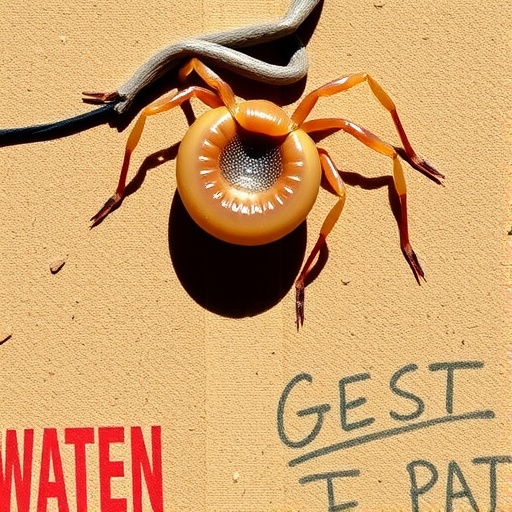
The New World screwworm, a flesh-eating parasite once responsible for tens of millions of dollars in annual livestock losses in the United States, is moving north again. After being eradicated from the country in the mid-20th century and pushed back to Panama, the pest has now reached Texas and New Mexico, raising concern for livestock, wildlife and, in rare cases, human health.
In response, researchers at the University of California San Diego and public health officials from the County of San Diego Health and Human Services Agency have developed a county-level dashboard designed to track and forecast the threat. The tool integrates confirmed screwworm detections, environmental conditions favorable to the fly and its larvae, and information gathered from news reports. Together, these data streams generate regional risk profiles intended to help officials identify where cases may emerge next and how quickly the threat could advance.
New World screwworm is the larval stage of the blowfly Cochliomyia hominivorax. Unlike the larvae of most flies, which feed on dead or decaying material, screwworm larvae invade living tissue. Female flies typically deposit eggs in wounds or natural openings of mammals and other warm-blooded animals. After hatching, the larvae burrow deeper into healthy flesh, enlarging the wound and creating conditions for secondary bacterial infections. Untreated infestations can cause severe injury and death, particularly in livestock, newborn animals and wildlife.
People can also be affected, although human infestations are uncommon and the parasite does not spread directly from person to person. Infection occurs when flies lay eggs in an open wound or near mucous membranes. The resulting larvae must be removed through prompt medical care, since continued feeding can produce extensive tissue damage. Because the screwworm is not a conventional contagious pathogen, its expansion depends largely on the movement of infested animals, suitable climate conditions and the availability of hosts rather than on human-to-human transmission.
The new dashboard is intended to provide an early-warning system before conventional public health reporting is complete. Laboratory confirmation of an animal infestation can take days or weeks, while media reports, veterinary observations and other early signals may reveal a developing problem sooner. By combining these sources with environmental suitability models, the system can estimate whether a county is likely to face increasing risk and help officials determine whether preparations are needed immediately or over a longer planning horizon.
Environmental modeling is central to the tool’s design. The screwworm’s ability to establish itself depends on temperature, humidity, host availability and other ecological factors that influence adult survival, reproduction and larval development. The dashboard uses these conditions to assess how suitable a region may be for the fly and its offspring. It also accounts for the pest’s capacity to travel considerable distances and for its potential transport through livestock, pets, birds and other wildlife. The resulting estimates do not predict individual cases with certainty, but they provide a structured way to compare risk across counties and over time.
Officials in San Diego County say the system is especially valuable because California has extensive livestock, veterinary and wildlife networks that could detect suspicious cases. The county is working with the California Department of Food and Agriculture to connect veterinarians with surveillance resources and guidance. Since screwworm can affect nearly any warm-blooded animal, cooperation among livestock veterinarians, companion-animal practitioners, wildlife specialists and public health agencies will be essential. Early recognition of wounds containing larvae could limit local transmission and improve the chances of rapid containment.
The United States previously eliminated New World screwworm through one of the most successful biological control programs ever attempted. The campaign relied on the sterile insect technique, in which large numbers of radiation-sterilized male flies were released into affected areas. When sterile males mated with wild females, the resulting eggs failed to produce viable offspring, causing populations to collapse over successive generations. Current eradication efforts, led by the U.S. Department of Agriculture, are again using sterile insects alongside pesticides and restrictions on animal movement. Regulators are also considering a genetically modified, all-male strain now undergoing field testing, while UC San Diego researchers are exploring additional genetic technologies that could improve future control strategies.
The dashboard is being developed through Resilient Shield, a UC San Diego initiative and Centers for Disease Control and Prevention-funded center that forms part of the national Insight Net outbreak and disease modeling network. Its model reverses the traditional relationship between researchers and public agencies: instead of developing tools based only on academic priorities, public health organizations submit specific requests, or “tickets,” describing urgent operational needs. Resilient Shield then assembles data systems, simulations, secure computing and other technical resources to create a targeted response. The screwworm project illustrates how epidemiologists, engineers, veterinarians and data scientists can work together to convert fragmented information into an actionable warning system.
The dashboard is currently available only to project partners and public health officials, although its developers hope to release a public version. Its broader significance lies in the architecture behind it. By using an open and modular design, the same infrastructure can potentially be adapted to monitor other threats involving human disease, animal health, environmental change and weather. For communities facing emerging biological hazards, the goal is not simply to document outbreaks after they occur, but to recognize the combination of ecological and social signals that may indicate where the next outbreak is most likely to appear.
Subject of Research: Animals
Article Title: A New World Screwworm Dashboard Helps Public Health Officials
Web References: UC San Diego Resilient Shield; County of San Diego Public Health Services; USDA Stop Screwworm Hub; California Department of Food and Agriculture; Insight Net
Image Credits: Scott Blair/UC San Diego Qualcomm Institute
Keywords: New World screwworm, Cochliomyia hominivorax, epidemiology, parasitology, animal health, public health, disease surveillance, computational modeling, sterile insect technique, livestock disease, environmental risk assessment


