


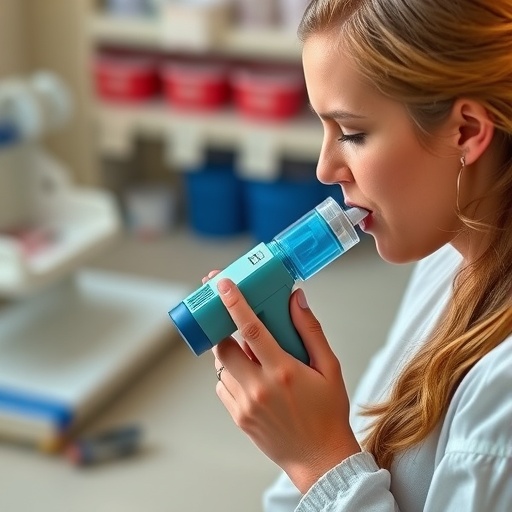
SAN ANTONIO — August 11, 2026 — A Southwest Research Institute project is taking aim at one of the most persistent problems in respiratory medicine: how to deliver enough inhaled medication to the lungs of young children and people who cannot take a strong, deep breath. The multidisciplinary team is combining computational fluid dynamics, particle science and pharmaceutical engineering to develop inhaler designs that could make drug delivery more reliable for patients with limited breathing capacity.
Many inhalers are designed around an idealized user who can inhale forcefully and coordinate breathing with the release of medication. In practice, young children, people with chronic obstructive pulmonary disease (COPD), and patients weakened by serious illness may not generate enough airflow to disperse and transport the drug effectively. Instead of reaching the deeper airways, a substantial portion of the medication can remain in the mouth, throat or inhaler device, creating uncertainty about the dose that ultimately reaches the lungs.
“For children and people with conditions like chronic obstructive pulmonary disease, or COPD, some inhalers don’t reliably get enough medicine into the lungs,” said Dr. Raouf Tajik, a research engineer in SwRI’s Mechanical Engineering Division and leader of the project. “A lot of the medication remains in the mouth and throat or within the device instead of reaching deep in the airways. That wastes medicine and delivers an uncertain dosage.”
The SwRI team is using computational fluid dynamics (CFD) to examine the complex airflow patterns produced during inhalation. CFD allows researchers to model how air accelerates through the mouth and throat, changes direction at branching airways and interacts with particles released by an inhaler. These simulations can reveal where particles are likely to deposit and how inhaler geometry, airflow resistance and breathing strength influence the amount of medicine that travels toward the lungs.
Tajik’s modeling focuses on airflow through a child’s airway and the movement of inhaled particles from the device into progressively smaller respiratory passages. The work is intended to identify designs that reduce deposition in the mouth and throat while improving penetration into the deeper airways. A key challenge is creating an inhaler that can generate effective particle transport even when the user’s inhalation is weak, slow or inconsistent.
To test the computational predictions, SwRI researchers connected a breathing simulator to a three-dimensional printed model of a child’s airway. The simulator reproduces controlled inhalation patterns, allowing the team to measure how particles move through a physical airway structure. The model can be examined under different conditions, including dry and moisture-coated surfaces designed to approximate the difference between an artificial airway and the naturally humid environment of the human respiratory tract.
“We tested both dry and wet surface versions of the airway to mimic real, moist human airways,” said Dr. Imad Khalek, a SwRI Institute Engineer who oversees the organization’s Particle Science and Technology facility. “This helped us to see that moisture changes how deeply inhaled particles penetrate.”
Moisture can affect particle size, surface adhesion and the way particles interact with airway walls. These effects are especially important for dry powder inhalers, which depend on airflow to separate and transport a powdered formulation. If particles collide with a moist surface too early, they may stick in the upper airway rather than continuing toward the lungs. Understanding these interactions could help engineers adjust particle properties and inhaler flow paths to improve delivery under realistic conditions.
The project also examines the formulation of dry powder inhalers, which typically contain a small drug particle attached to or blended with a much larger carrier particle. The carrier helps the powder flow and disperse from the device, while the smaller active pharmaceutical particle is intended to travel into the respiratory system. Particle size must be carefully controlled: particles that are too large may impact the mouth or throat, while particles that are too small may remain suspended and be exhaled before depositing in the lungs.
Researchers in SwRI’s Chemistry and Chemical Engineering Division are contributing expertise on the materials and particles used in the inhaler. Their work complements the mechanical modeling and experimental testing by examining how formulation properties influence powder dispersion, particle transport and deposition. Together, the teams are seeking a design that can deliver a more consistent dose across a wider range of users and breathing patterns.
“The variability with inhalers can be significant and potentially dangerous: overdosing can lead to adverse effects while underdosing can make treatments ineffective,” said Dr. James Oxley, a SwRI Institute Scientist who leads the chemical engineering aspects of the project. “An improved design could deliver potentially more potent drugs that currently aren’t suitable for inhalers because of that variability.”
The internally funded effort brings together SwRI’s Mechanical Engineering, Powertrain Engineering, and Chemistry and Chemical Engineering divisions. Although the Particle Science and Technology facility normally investigates airborne emissions from automobile engines and batteries, its instruments and expertise can also characterize pharmaceutical aerosols and the pathways they follow through an airway. By combining simulation, physical testing and pharmaceutical analysis, the researchers hope to establish design principles for inhalers that are easier to use and more dependable for vulnerable patients. The project is still focused on development and testing, but its findings could eventually support inhaler technologies capable of delivering medication more effectively when a patient cannot produce the strong inhalation demanded by conventional devices.
News Publication Date: August 11, 2026
Web References: https://www.swri.org/markets/electronics-automation/computational-modeling-simulation-tools/computational-fluid-dynamics/fluids-engineering-cfd
Cite Scienmag News
Audrey Campbell. (August 11, 2026). SwRI Evaluates and Improves Inhalers for People with Breathing Difficulties. Scienmag. https://scienmag.com/swri-evaluates-and-improves-inhalers-for-people-with-breathing-difficulties/
Audrey Campbell. "SwRI Evaluates and Improves Inhalers for People with Breathing Difficulties." Scienmag, 11 August 2026, https://scienmag.com/swri-evaluates-and-improves-inhalers-for-people-with-breathing-difficulties/. Accessed 3 September 2026.
Audrey Campbell. "SwRI Evaluates and Improves Inhalers for People with Breathing Difficulties." Scienmag. August 11, 2026. https://scienmag.com/swri-evaluates-and-improves-inhalers-for-people-with-breathing-difficulties/


