


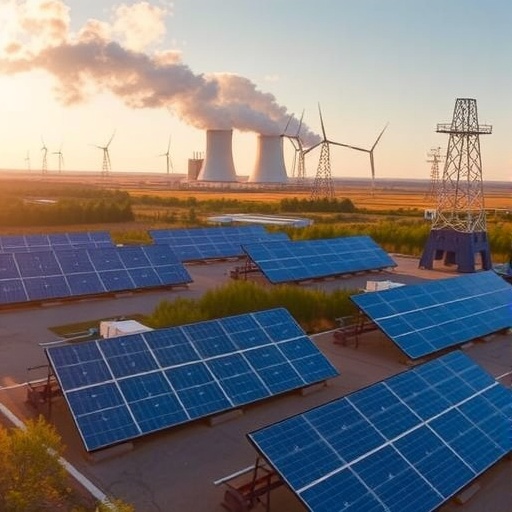
Renewable energy is often portrayed as a solution to both climate change and air pollution. Yet a new study suggests that the transition away from fossil fuels could contain a dangerous vulnerability: prolonged periods when wind and sunlight simultaneously fall below normal levels. During these “renewable energy droughts,” electricity systems may turn more heavily to fossil-fuel power plants, creating episodes in which clean-energy shortages and stagnant atmospheric conditions combine to intensify pollution.
The research, published in Nature Geoscience, examines how this interaction could affect China during the 2050s. Shen, Lu, Li and colleagues linked an electricity-system model with a chemical transport model, allowing them to simulate both the operational response of the power grid and the movement and transformation of pollutants in the atmosphere. Rather than treating energy supply and air quality as separate problems, the approach follows how a shortage of renewable electricity can trigger additional emissions and how weather conditions can determine the severity of their health impacts.
Renewable energy droughts occur when wind speeds and solar irradiance remain unusually low for an extended period. The problem is not simply that less electricity is generated. Wind and solar resources can decline across large regions at the same time, limiting the ability of one area to compensate for another. If storage, transmission and other flexible resources are insufficient, grid operators must increase output from coal- and gas-fired plants to maintain supply. In a highly renewable electricity system, these plants may operate less frequently overall but become especially important during precisely the periods when pollution risks are most acute.
The study projects that, under scenarios with high renewable penetration, emissions from fossil-fuel power stations could raise concentrations of fine particulate matter, known as PM2.5, by approximately 15 to 40 percent during renewable energy shortages, even when the plants use the best pollution-control technologies considered in the analysis. PM2.5 consists of particles small enough to penetrate deep into the lungs and, in some cases, enter the bloodstream. The projected increase is therefore significant not only as a measure of atmospheric degradation but also as a potential public-health concern.
Ozone pollution is also expected to rise. The researchers estimate that ground-level ozone could increase by about 10 to 20 percent during these events. Unlike particulate pollution, ozone is not emitted directly in large quantities by power plants. It forms in the atmosphere through sunlight-driven chemical reactions involving nitrogen oxides and volatile organic compounds. Fossil-fuel combustion supplies important precursors, while hot, stagnant conditions can allow ozone and its precursors to accumulate near the surface. This makes ozone behavior especially sensitive to the combination of emissions, sunlight and atmospheric circulation.
The projected changes are most alarming when measured in terms of extreme pollution. The study finds that the annual frequency of hours classified as severely polluted could increase by roughly 40 to 100 percent during the 2050s under the modeled high-renewable scenarios. The range reflects differences among scenarios and conditions, but the central message is consistent: pollution episodes linked to renewable energy droughts could become both more frequent and more intense if the electricity system relies on fossil-fuel plants as its emergency source of power.
The researchers’ attribution analysis identifies two major contributors to these extreme events. One is the weather itself. Renewable energy droughts tend to coincide with atmospheric patterns that suppress ventilation, producing weaker winds and more stable air. These conditions reduce the dispersal of pollutants and provide more time for chemical reactions to occur. The other contributor is the increase in emissions from fossil-fuel power stations used to replace lost wind and solar generation. According to the study, the effects of stagnant weather and elevated power-plant emissions contribute at roughly comparable levels to the resulting pollution extremes.
This finding complicates the idea that installing more renewable capacity automatically guarantees cleaner air under all circumstances. Expanding wind and solar generation can sharply reduce average fossil-fuel use, but an electricity system designed around annual averages may still be exposed to rare, prolonged shortfalls. The results point toward the importance of planning for the most difficult hours, not only for typical days. Large-scale energy storage, stronger interregional transmission, demand flexibility, low-emission backup generation and improved forecasting could all help reduce the need to ramp up conventional power plants during renewable energy droughts.
The study also evaluates the consequences of incorporating health costs into renewable-capacity planning. When the economic damage associated with additional air pollution is included alongside electricity-system costs, the modeled system reduces its reliance on fossil-fuel generation by approximately 50 percent in China by 2050. That reduction could be achieved by building a more resilient portfolio of clean-energy resources and flexibility options rather than depending on fossil-fuel plants for prolonged emergencies. The broader implication is that the clean-energy transition should be judged not only by carbon emissions and electricity prices, but also by the pollution exposure created during periods of system stress. As climate and energy systems become more tightly connected, the cleanest grid may be the one designed to remain clean even when the wind stops blowing and the skies provide less sunlight.
Cite Scienmag News
Russell Cooper. (August 11, 2026). Renewable Energy Droughts Amplify Power Plant Emissions’ Impacts on Air Quality. Scienmag. https://scienmag.com/renewable-energy-droughts-amplify-power-plant-emissions-impacts-on-air-quality/
Russell Cooper. "Renewable Energy Droughts Amplify Power Plant Emissions’ Impacts on Air Quality." Scienmag, 11 August 2026, https://scienmag.com/renewable-energy-droughts-amplify-power-plant-emissions-impacts-on-air-quality/. Accessed 5 September 2026.
Russell Cooper. "Renewable Energy Droughts Amplify Power Plant Emissions’ Impacts on Air Quality." Scienmag. August 11, 2026. https://scienmag.com/renewable-energy-droughts-amplify-power-plant-emissions-impacts-on-air-quality/


