


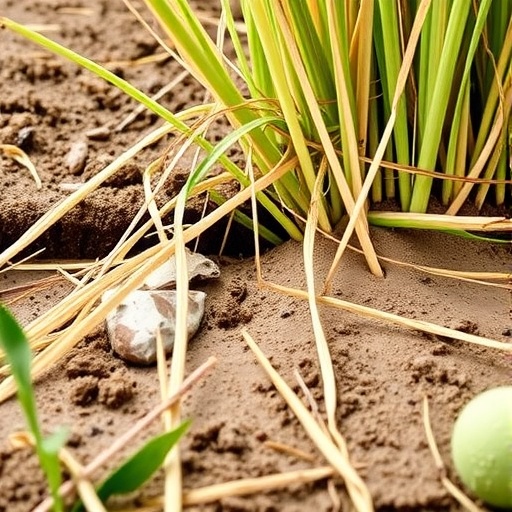
Rice straw, often treated as agricultural waste, may be one of the most powerful tools available for storing carbon in flooded croplands. An 11-year field experiment in China has revealed that returning straw to paddy fields does more than add organic matter to the soil: it transforms the soil’s physical architecture and strengthens chemical bonds that help carbon resist decomposition. The findings show that two distinct processes work together—carbon becomes physically trapped inside stable soil aggregates while also binding to iron oxides at the mineral level.
The study, led by researchers including Yinghua Duan and Minggang Xu of the Chinese Academy of Agricultural Sciences, examined how long-term residue management changes soil organic carbon in a double-cropping rice system. The researchers began the field experiment in 2012 and analyzed soil after 11 consecutive years. Their results, published in Agricultural Ecology and Environment, offer a detailed explanation of why straw incorporation can produce lasting carbon gains rather than a short-lived increase caused simply by adding fresh plant material.
Soil organic carbon is central to the health and productivity of agricultural land. It helps bind soil particles into aggregates, improves water retention, supports nutrient cycling, and provides energy for microorganisms. It also represents a major carbon reservoir that can either store atmospheric carbon or release it as carbon dioxide. Paddy fields are particularly complex carbon environments because cycles of flooding and drainage alter oxygen availability, microbial activity, mineral chemistry, and the breakdown of plant residues.
To separate the effects of different management strategies, the researchers compared four treatments. All plots received nitrogen, phosphorus, and potassium fertilizer, but one group was maintained under winter fallow without straw return. A second group received rice straw, a third was planted with Chinese milk vetch as a winter green manure without straw, and a fourth combined green manure with straw incorporation. The team divided soil into aggregate-size fractions and measured carbon concentrations, aggregate stability, several forms of iron oxide, and the amount of organic carbon chemically associated with iron minerals.
Compared with fertilizer alone, returning straw increased soil organic carbon by 13.6 percent. Green manure by itself produced a more modest 5.3 percent increase, while the combination of green manure and straw generated the largest improvement, raising soil organic carbon by 22.7 percent. These results suggest that the two practices provide complementary sources of organic material and create conditions that allow a greater proportion of carbon to remain in the soil.
One of the most important changes occurred in the soil’s structure. Straw return encouraged the formation of macro-aggregates larger than 2 millimeters, which can physically enclose organic particles and shield them from microbial attack. Mean weight diameter, a standard measure of aggregate stability, increased by 57.2 percent under straw return compared with fertilizer alone. When straw was added to the green-manure system, the increase reached 73.1 percent. More stable aggregates can reduce the exposure of organic matter to oxygen and decomposer enzymes, slowing the conversion of soil carbon into carbon dioxide.
The researchers also found that iron oxides acted as an important chemical bridge between soil minerals and organic carbon. Different forms of iron occupied different soil environments and performed different functions. Complexed iron oxides accumulated mainly in macro-aggregates, while amorphous iron oxides were concentrated in micro-aggregates smaller than 0.25 millimeters. Both forms were associated with greater aggregate stability. Crystalline iron oxides, in contrast, showed inconsistent responses among aggregate fractions and were not significantly linked to aggregate stability.
Iron-bound organic carbon accounted for between 21.2 and 26.7 percent of total soil organic carbon. Most of this fraction was associated with complexed iron, suggesting that iron-mediated stabilization is not a minor side effect but a substantial component of carbon storage in these paddy soils. Straw return increased total iron-bound carbon by 41.0 percent compared with fertilizer alone and by 30.9 percent when added to the green-manure treatment. The results indicate that straw-derived compounds may interact with reactive iron surfaces, creating mineral–organic associations that are more difficult for microbes to dismantle.
Chemical measurements provided further evidence that the stored carbon became more resistant to breakdown. The team used specific ultraviolet absorbance indicators to assess the composition of organic compounds bound to iron. Higher values indicated increased aromaticity, a molecular characteristic often associated with more chemically stable and decomposition-resistant carbon. Straw return increased the aromaticity and apparent stability of carbon linked with both complexed and amorphous iron oxides, suggesting that the treatment changed not only how much carbon remained in the soil but also its chemical quality.
The study presents straw incorporation as a form of soil engineering carried out by plants, minerals, microbes, and farm management together. Rather than simply depositing carbon in the field, returned straw helps construct larger, more stable aggregates while promoting stronger associations between organic molecules and iron oxides. The combination with Chinese milk vetch produced the greatest carbon gains, highlighting the potential of integrated residue and green-manure systems for intensive rice production. By recycling crop residues, improving soil structure, and increasing durable carbon storage, these practices could support fertility and productivity while reducing the climate footprint of rice agriculture. The researchers caution, however, that the benefits depend on long-term management, since the strongest effects emerged only after more than a decade of continuous field treatment.
News Publication Date: 22-Jun-2026
Web References: Agricultural Ecology and Environment, https://www.maxapress.com/aee; DOI: https://doi.org/10.48130/aee-0026-0015
References: 10.48130/aee-0026-0015
Keywords
Rice straw, soil organic carbon, carbon sequestration, paddy fields, iron oxides, soil aggregates, green manure, Chinese milk vetch, sustainable agriculture, climate mitigation
Cite Scienmag News
Alan Morgan. (August 10, 2026). Returning straw helps paddy soils retain more carbon. Scienmag. https://scienmag.com/returning-straw-helps-paddy-soils-retain-more-carbon/
Alan Morgan. "Returning straw helps paddy soils retain more carbon." Scienmag, 10 August 2026, https://scienmag.com/returning-straw-helps-paddy-soils-retain-more-carbon/. Accessed 4 September 2026.
Alan Morgan. "Returning straw helps paddy soils retain more carbon." Scienmag. August 10, 2026. https://scienmag.com/returning-straw-helps-paddy-soils-retain-more-carbon/


