


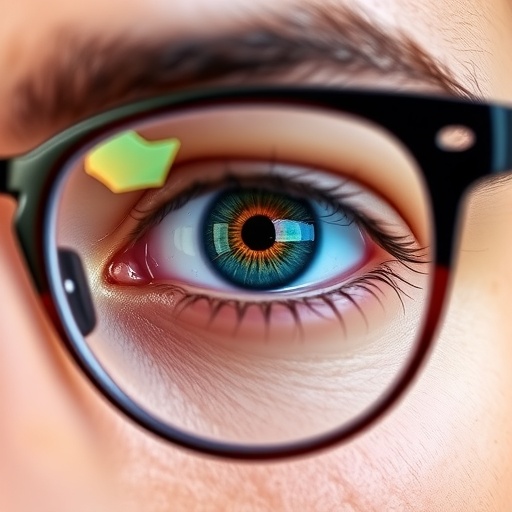
For millions of people, eyeglasses are an everyday interface between the human eye and the outside world. Yet the lenses prescribed by an optometrist are typically designed around a simplified model of how the eye looks through a lens, while the frame itself may sit differently on every wearer’s face. A new study by Chen, Tang, Zhu and colleagues introduces a parametric customization approach intended to make that relationship more natural—potentially changing how prescription glasses are designed, fitted and manufactured.
Published in Communications Engineering, the study focuses on a deceptively complex problem: the optical performance of a spectacle lens depends not only on its prescription, but also on its position relative to the eye. The distance between the back surface of the lens and the cornea, known as vertex distance, can influence the effective power experienced by the wearer. So can pantoscopic tilt, the angle at which the frame slopes downward, and the curvature or wrap of the frame around the face. Even small changes in these parameters can alter how light travels through the lens.
Traditional spectacle design often begins with standard measurements and assumptions. These may include an average eye position, a conventional frame orientation and a fixed optical axis. Such approximations are practical, but they do not fully capture the dynamic interaction between a real eye and a lens that moves with the wearer. When a person looks away from the center of a lens, the eye rotates while the lens remains fixed in the frame, producing off-axis effects that can contribute to blur, distortion or unwanted image movement.
The researchers’ parametric strategy addresses this challenge by treating the optical fit as a customizable geometric system. Instead of designing the lens independently from the frame and wearer, the approach can incorporate parameters describing the eye, lens surface and frame configuration. These variables can then be adjusted together to model how the lens behaves across different gaze directions. In technical terms, the method seeks to connect ocular geometry and spectacle optics within a single design workflow.
This eye-and-lens interaction is particularly important because the eye does not simply look straight ahead. It continuously rotates, shifts focus and changes its line of sight as people read, walk, use digital screens or scan their surroundings. A lens that performs well only at the primary gaze position may still produce optical discrepancies elsewhere. By accounting for the natural relationship between eye rotation and lens geometry, a customized design could aim to preserve image quality over a wider field of view.
The concept could also help explain why two people with identical prescriptions do not always experience identical visual comfort. Prescription values such as sphere, cylinder and axis describe the correction required at a specified reference condition, but they do not completely define the wearer’s real-world optical experience. Frame fit, pupil position, facial anatomy and lens orientation can all influence the final result. A parametric model offers a way to translate these individual differences into design inputs rather than treating them as after-the-fact adjustments.
The potential impact extends beyond comfort. Better alignment between the eye and lens may reduce unwanted prismatic effects, which occur when light passes through a region of the lens away from its intended optical center. It may also support more accurate control of astigmatic power and aberrations across the lens surface. For high prescriptions, progressive lenses or sports eyewear with strong curvature, these issues can become especially significant because the optical system is more sensitive to changes in position and gaze angle.
The approach arrives as eyewear manufacturing is becoming increasingly digital. Modern lens production can use computer-controlled surfacing, three-dimensional facial scanning and individualized frame measurements. These technologies make it possible to produce lenses that differ subtly from conventional rotationally symmetric designs. A parametric customization method could provide the computational bridge between detailed measurements of a wearer and the physical lens produced in a laboratory, bringing mass customization closer to routine clinical practice.
The study’s broader message is that eyeglasses should be understood as wearable optical instruments rather than passive pieces of transparent material. Their performance emerges from the interaction of human anatomy, eye movement, lens geometry and frame placement. By modeling these components together, the researchers point toward a more personalized generation of vision correction—one in which lenses are designed not only to match a prescription, but also to cooperate with the way a particular person actually sees. If validated across wider populations and integrated into commercial workflows, the method could help make clearer, more natural vision a standard feature of everyday eyewear.
Cite Scienmag News
Denise Maddox. (August 10, 2026). Parametric Customization Enables Natural Eye–Lens Interaction in Eyeglasses. Scienmag. https://scienmag.com/parametric-customization-enables-natural-eye-lens-interaction-in-eyeglasses/
Denise Maddox. "Parametric Customization Enables Natural Eye–Lens Interaction in Eyeglasses." Scienmag, 10 August 2026, https://scienmag.com/parametric-customization-enables-natural-eye-lens-interaction-in-eyeglasses/. Accessed 3 September 2026.
Denise Maddox. "Parametric Customization Enables Natural Eye–Lens Interaction in Eyeglasses." Scienmag. August 10, 2026. https://scienmag.com/parametric-customization-enables-natural-eye-lens-interaction-in-eyeglasses/


