


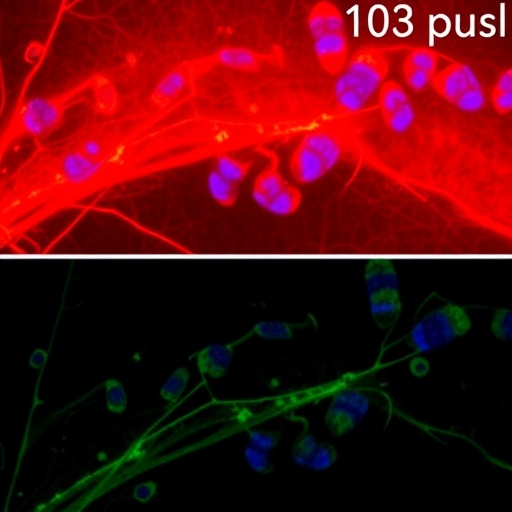
Fuchs endothelial corneal dystrophy, a progressive disorder that can gradually cloud the cornea and impair vision, may be driven by a cellular process more complex than simple cell loss. A new study published in Cell Death Discovery reports that ultraviolet-A light can induce chronic hyperploidization in corneal endothelial cells, triggering changes associated with fibrosis. The findings connect long-term genome abnormalities in post-mitotic cells to the structural deterioration observed in this increasingly recognized eye disease.
The cornea depends on a thin inner layer of endothelial cells to maintain its transparency. These cells regulate the movement of fluid between the cornea and the anterior chamber of the eye, preventing the tissue from becoming waterlogged. Unlike many cell types, human corneal endothelial cells have limited ability to divide and replenish themselves. When they are damaged or lost, neighboring cells may enlarge and stretch to cover the affected area, but this compensation has limits. In Fuchs endothelial corneal dystrophy, the endothelial layer progressively becomes dysfunctional, allowing fluid accumulation and producing corneal swelling, haze and visual distortion.
The study focuses on hyperploidization, a condition in which cells acquire extra sets or copies of chromosomes. In a healthy cell cycle, DNA is replicated and then evenly distributed when a cell divides. Post-mitotic cells, however, are not expected to continue cycling through repeated rounds of DNA replication. If DNA replication occurs without successful cell division, the result can be a cell with an enlarged genome and multiple chromosome sets. This state, known as polyploidy or hyperploidization depending on its extent and context, can alter cell size, metabolism, gene activity and responses to stress.
The researchers investigated how ultraviolet-A, or UVA, light affects cells associated with Fuchs endothelial corneal dystrophy. UVA has a longer wavelength than ultraviolet-B and can penetrate biological tissues more deeply. Although the eye possesses protective mechanisms, persistent or excessive exposure to light-generated stress can damage cellular components, including DNA, proteins and mitochondria. The study indicates that UVA exposure does not merely cause an acute injury that cells either repair or fail to survive. Instead, it can establish a chronic hyperploid state in cells that no longer divide normally.
That distinction is important because a cell can remain alive while becoming increasingly dysfunctional. Hyperploid cells may continue to produce proteins, communicate with neighboring cells and modify their surrounding environment, even as their enlarged genomes disrupt normal regulation. In the corneal endothelium, such persistent abnormalities could interfere with the machinery responsible for maintaining fluid balance and tissue transparency. The research links this long-lasting cellular state to the activation of fibrotic processes, suggesting that damaged endothelial cells may help remodel the cornea rather than simply disappearing.
Fibrosis is the formation or accumulation of excessive connective-tissue components, particularly extracellular matrix proteins such as collagens. During wound healing, matrix production can provide temporary structural support. When the response persists, however, the tissue can stiffen, become disorganized and lose its normal optical properties. In the context of Fuchs endothelial corneal dystrophy, fibrosis may contribute to the loss of corneal clarity and the progression of visual impairment. The study’s central message is that chronic hyperploidization may act as an upstream signal that pushes post-mitotic cells toward this pathological remodeling.
The findings also help explain why a disease affecting a specialized, non-dividing cell population can progress over time. A conventional view of cellular damage often emphasizes apoptosis, necrosis or the gradual depletion of functional cells. The new work highlights another possibility: injured cells may survive in a permanently altered condition and actively influence disease progression. By retaining metabolic activity while carrying abnormal quantities of DNA, these cells could produce signals that encourage inflammation, matrix deposition or changes in the behavior of nearby cells.
The UVA connection raises questions about how environmental stress interacts with inherited susceptibility. Fuchs endothelial corneal dystrophy has genetic and age-related components, and the disease does not arise from a single universal cause. The study does not establish that UVA exposure alone causes the disorder, but it provides a mechanism through which light-associated stress could worsen cellular instability in vulnerable corneal tissue. This may help researchers examine whether cumulative exposure, cellular antioxidant capacity and pre-existing genetic changes combine to determine how rapidly the disease advances.
From a treatment perspective, the work points toward targets beyond replacing lost endothelial cells. Future strategies might seek to prevent abnormal DNA replication, stabilize genome integrity, suppress the fibrotic signals released by hyperploid cells or protect the corneal endothelium from chronic light-induced stress. Such approaches would require careful testing, because polyploidy can serve useful roles in some normal tissues, and broadly blocking cell-cycle or repair pathways could produce harmful effects. The challenge will be to distinguish pathological hyperploidization from adaptive genome changes that help cells survive.
The study ultimately presents Fuchs endothelial corneal dystrophy as a disease of cellular identity as well as cellular survival. UVA-induced chronic hyperploidization appears to place post-mitotic corneal endothelial cells in a persistent state of genomic imbalance, where they can contribute to fibrosis and tissue failure. By connecting light stress, abnormal DNA content and corneal scarring, the research offers a new framework for understanding why the disease can continue even after the initial injury has passed—and provides a potential roadmap for therapies designed to interrupt the process before vision is permanently compromised.
Cite Scienmag News
Ophelia Keating. (August 8, 2026). UVA-Induced Hyperploidization Causes Fibrosis in Post-Mitotic Fuchs Dystrophy Corneal Cells. Scienmag. https://scienmag.com/uva-induced-hyperploidization-causes-fibrosis-in-post-mitotic-fuchs-dystrophy-corneal-cells/
Ophelia Keating. "UVA-Induced Hyperploidization Causes Fibrosis in Post-Mitotic Fuchs Dystrophy Corneal Cells." Scienmag, 8 August 2026, https://scienmag.com/uva-induced-hyperploidization-causes-fibrosis-in-post-mitotic-fuchs-dystrophy-corneal-cells/. Accessed 3 September 2026.
Ophelia Keating. "UVA-Induced Hyperploidization Causes Fibrosis in Post-Mitotic Fuchs Dystrophy Corneal Cells." Scienmag. August 8, 2026. https://scienmag.com/uva-induced-hyperploidization-causes-fibrosis-in-post-mitotic-fuchs-dystrophy-corneal-cells/


