


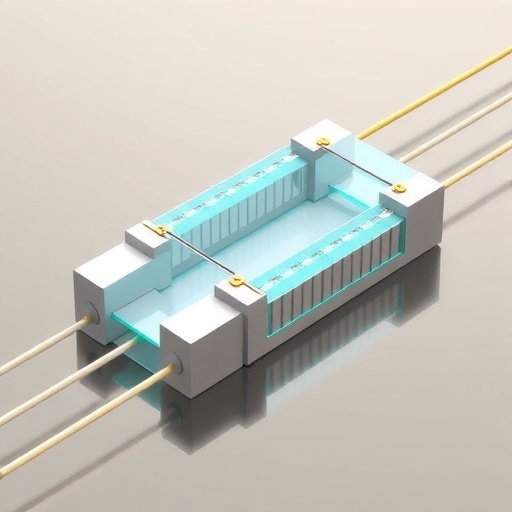
Coupled resonator optical waveguides, or CROWs, are emerging as powerful building blocks for the next generation of optical communications, photonic computing and quantum technologies. By linking a series of microscopic optical resonators, these devices can guide and delay light while precisely shaping its spectrum. Now, a research team from Sun Yat-sen University and Shanghai Jiao Tong University has demonstrated a new way to overcome one of the most persistent limitations of CROW technology: the tradeoff between spectral range and optical bandwidth.
The advance, reported in PhotoniX, relies on replacing conventional evanescent couplers with topological couplers. In a CROW, the 3-decibel bandwidth describes the wavelength range over which the device can operate effectively. It is closely related to two parameters: the free spectral range, or FSR, and the inverse of the finesse. The FSR is the wavelength spacing between neighboring resonant peaks, while finesse describes how sharply defined those resonances are. In simplified terms, the usable bandwidth is approximately the FSR multiplied by the inverse finesse.
For conventional microring CROWs, increasing the FSR has usually come at a cost. Engineers can enlarge the FSR by reducing the size of the optical cavities, but smaller cavities tend to weaken the evanescent coupling between neighboring resonators. As the coupling becomes less effective, the resonance properties change and the inverse finesse decreases. This creates a seesaw effect: improving one parameter undermines the other. The result is a fundamental bottleneck that has restricted the bandwidth of compact integrated photonic devices.
The researchers’ solution draws on topological nanophotonics, a field that applies concepts from topology and symmetry to control how light moves through a structure. Rather than relying only on the physical overlap of electromagnetic fields between adjacent waveguides, the new couplers use a topologically protected design. Their coupling ratio remains comparatively stable even when the coupling length changes. This means the coupler can preserve its optical behavior as the resonator dimensions are adjusted, allowing designers to increase the FSR without severely altering the device’s finesse.
That decoupling is the central achievement of the work. In the new CROW architecture, reducing the cavity size can enlarge the spacing between resonances while leaving the coupling ratio and inverse finesse nearly unchanged. The two parameters that were previously tied together become largely independent. In practical terms, the approach gives photonic engineers an additional degree of freedom, making it possible to optimize device size, resonance spacing and bandwidth separately rather than accepting a compromise between them.
The experimental device demonstrated the impact of this design strategy around the telecommunications wavelength of 1550 nanometers. It achieved an FSR of approximately 32 nanometers and a 3-decibel bandwidth of 9.0 nanometers. Such a broad operating window is particularly significant for wavelength-based optical systems, where a larger usable bandwidth can allow more information channels to be transmitted or processed simultaneously. Compared with conventional microring CROWs, the result represents a substantial expansion of the wavelength range available from a compact integrated platform.
The team also tested whether the topological design could support more complex photonic functions. By cascading multiple topological CROWs, the researchers built a two-channel add-drop filter. These filters selectively remove specific wavelength channels from a stream of optical data or insert new channels into it, making them essential components of wavelength-division multiplexing systems. The device retained strong performance despite dimensional imperfections introduced during fabrication. Even when structural errors reached plus or minus 10 nanometers, the 3-decibel bandwidth of every transmission peak remained above 4.7 nanometers.
Fabrication tolerance is a crucial test for integrated photonics because nanoscale manufacturing cannot produce every device with perfect geometric precision. Small deviations in waveguide width, gap or resonator size can shift resonances and degrade performance in conventional designs. The observed stability suggests that topological protection and symmetry are not merely theoretical concepts in this system; they can be translated into practical design features that help devices withstand manufacturing variation.
The researchers further demonstrated the technology through a high-speed data transmission experiment. Both drop ports of the filter successfully carried data at 170 gigabits per second, showing that the broad bandwidth and fabrication tolerance can support demanding communication workloads. Beyond optical filtering, the platform could eventually be adapted for nonlinear signal processing, compact delay systems and enhanced light–matter interactions. By using topology to break an entrenched design tradeoff, the work points toward photonic circuits that are smaller, faster and more resilient, with the potential to influence how high-capacity optical networks and next-generation integrated technologies are engineered.
News Publication Date: 5 June 2026
Web References: https://doi.org/10.1186/s43074-026-00253-3
References: PhotoniX, DOI: 10.1186/s43074-026-00253-3
Keywords
Topological photonics, coupled resonator optical waveguides, CROW, optical communications, nanophotonics, photonic integrated circuits, add-drop filters, wavelength-division multiplexing, broadband optical devices, high-speed data transmission
Cite Scienmag News
Katie Riggs. (August 7, 2026). Topological coupler breaks bandwidth tradeoff in broadband coupled resonator waveguides. Scienmag. https://scienmag.com/topological-coupler-breaks-bandwidth-tradeoff-in-broadband-coupled-resonator-waveguides/
Katie Riggs. "Topological coupler breaks bandwidth tradeoff in broadband coupled resonator waveguides." Scienmag, 7 August 2026, https://scienmag.com/topological-coupler-breaks-bandwidth-tradeoff-in-broadband-coupled-resonator-waveguides/. Accessed 3 September 2026.
Katie Riggs. "Topological coupler breaks bandwidth tradeoff in broadband coupled resonator waveguides." Scienmag. August 7, 2026. https://scienmag.com/topological-coupler-breaks-bandwidth-tradeoff-in-broadband-coupled-resonator-waveguides/


