


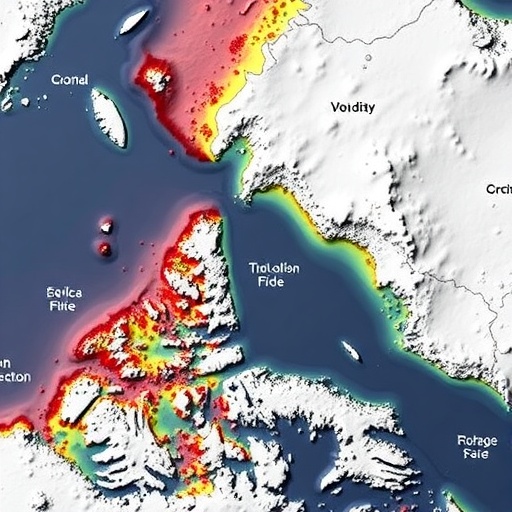
At the bottom of the world’s oceans, where the seafloor is pulled apart at one of the slowest rates on Earth, researchers have found evidence of a geological surprise: powerful pulses of molten rock can erupt even when a mid-ocean ridge appears to be largely starved of magma. The discovery comes from the Gakkel Ridge, a remote volcanic mountain chain beneath the Arctic Ocean, and challenges the idea that oceanic crust is created through a relatively steady supply of melt.
The study, published in Nature Communications, describes “melt burst events” occurring along a section of the Gakkel Ridge where the lithosphere is considered dominantly amagmatic. In geological terms, amagmatic does not mean that melting never occurs. Rather, it indicates that magma production and volcanic delivery are so limited that large areas of the ridge may fail to build a continuous layer of new crust in the way more vigorous spreading centers do.
Mid-ocean ridges form where tectonic plates move away from one another. As the plates separate, hot mantle rises beneath the ridge and undergoes decompression melting: pressure falls faster than temperature, allowing some of the mantle’s minerals to melt without requiring an additional heat source. The resulting magma normally rises through cracks, pools beneath the seafloor and erupts to create basaltic oceanic crust. At ultraslow-spreading ridges such as Gakkel, however, plate separation is so sluggish that the supply of melt can be highly uneven.
That unevenness is central to the new findings. Instead of producing magma continuously along the ridge, the mantle beneath Gakkel may remain comparatively cold and rigid for long intervals, with melt accumulating or migrating invisibly beneath the lithosphere. Then, under the right combination of tectonic stress, mantle flow and pressure conditions, a concentrated pulse of magma can rise rapidly. These brief episodes can generate volcanic material out of proportion to the average magma supply, leaving behind geological signatures of an eruption far larger than the surrounding ridge environment would suggest.
The Gakkel Ridge is an ideal natural laboratory for studying this process because it stretches across a remote and poorly explored part of the Arctic Ocean. It spreads at a rate of only a few millimeters per year, dramatically slower than the Mid-Atlantic Ridge. At such a pace, the seafloor is not necessarily covered by a uniform blanket of fresh basalt. Instead, tectonic faults may expose deep rocks from the mantle, while volcanic construction becomes concentrated into isolated segments. The result is a patchwork of crust, mantle and volcanic deposits formed by different mechanisms.
Zhou, Grevemeyer and Dyment’s analysis indicates that the apparent lack of persistent volcanism should not be mistaken for an absence of active magmatic processes. The ridge can switch from a state dominated by tectonic extension to one marked by intense, localized melt delivery. This distinction matters because the amount of magma present at any one moment may not reflect the total amount of melt produced over geological time. A quiet ridge today may preserve evidence of dramatic volcanic pulses that occurred thousands or millions of years ago.
The concept also offers a possible explanation for how oceanic crust develops at ultraslow ridges. In conventional models, crustal thickness is closely tied to the amount of mantle melting beneath the ridge. But if magma arrives in bursts, crustal architecture may depend not only on average melt production but also on the timing and location of individual events. A single burst could feed a volcanic center, fill fractures and create a localized body of crust, while neighboring sections remain tectonically exposed and nearly volcanic-free.
These events may have consequences beyond the formation of basalt. Magma transports heat, carbon dioxide, water and other volatile elements from Earth’s interior toward the seafloor. When a melt burst interacts with seawater or circulating hydrothermal fluids, it can drive chemical reactions that alter rocks and support ecosystems around deep-sea vents. Episodic volcanism could therefore influence the distribution of hydrothermal habitats and the way elements move between the mantle, oceanic crust and ocean.
The findings are likely to intensify interest in the hidden dynamics of ultraslow-spreading ridges. They suggest that Earth’s crust is not always built through a smooth, predictable process, but sometimes through geological ambushes: long periods of apparent inactivity interrupted by sudden injections of molten rock. For scientists, the Gakkel Ridge provides a reminder that the most important volcanic activity may not occur at the most obviously active ridges. Beneath an apparently barren Arctic seafloor, the planet may be assembling new crust in short, powerful bursts.
Cite Scienmag News
Violet Maxwell. (August 7, 2026). Melt Bursts Discovered in Mostly Magma-Free Lithosphere Along Arctic Ocean’s Gakkel Ridge. Scienmag. https://scienmag.com/melt-bursts-discovered-in-mostly-magma-free-lithosphere-along-arctic-oceans-gakkel-ridge/
Violet Maxwell. "Melt Bursts Discovered in Mostly Magma-Free Lithosphere Along Arctic Ocean’s Gakkel Ridge." Scienmag, 7 August 2026, https://scienmag.com/melt-bursts-discovered-in-mostly-magma-free-lithosphere-along-arctic-oceans-gakkel-ridge/. Accessed 4 September 2026.
Violet Maxwell. "Melt Bursts Discovered in Mostly Magma-Free Lithosphere Along Arctic Ocean’s Gakkel Ridge." Scienmag. August 7, 2026. https://scienmag.com/melt-bursts-discovered-in-mostly-magma-free-lithosphere-along-arctic-oceans-gakkel-ridge/


