


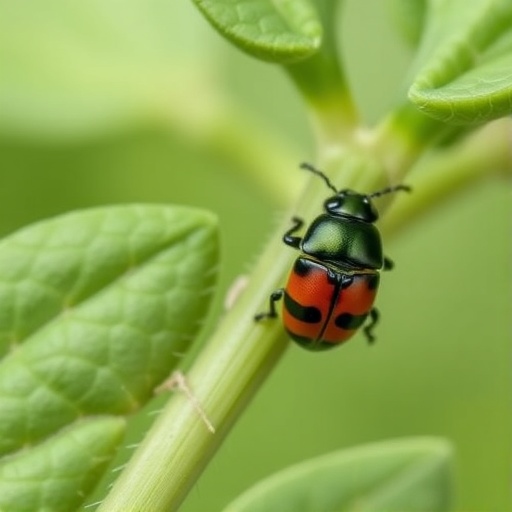
Researchers at Kyushu University have developed a plant-based nanoemulsion insecticide that significantly improves the toxicity of garlic- and spearmint-derived compounds against the adzuki bean beetle, a destructive pest responsible for major postharvest losses in stored legumes. The formulation combines nanotechnology with naturally occurring defensive chemicals produced by plants, offering a potential alternative to conventional synthetic pesticides. In laboratory experiments, the treatment was highly effective against the beetle while showing comparatively limited effects on a parasitic wasp that naturally suppresses the pest population.
The study focused on two compounds: diallyl disulfide, or DDS, an organosulfur molecule responsible for part of garlic’s characteristic odor, and (R)-carvone, a monoterpenoid found in spearmint and other aromatic plants. Both substances are known to possess biological activity against insects, but their practical use can be limited by factors such as volatility, poor dispersion in water and uneven contact with insect bodies. To address these problems, the researchers used ultrasonication to transform the compounds into oil-in-water nanoemulsions.
Nanoemulsions contain extremely small oil droplets suspended in water. In this study, the droplets measured approximately 50 to 60 nanometers in diameter, several thousand times smaller than a millimeter. Reducing the droplet size increases the surface area of the active compound that is available to interact with an insect’s body. It can also improve the stability and distribution of hydrophobic substances, which do not dissolve readily in water. These physical characteristics may allow more of the plant-derived compounds to reach vulnerable areas of the beetle, including the cuticle and respiratory openings.
The target insect was Callosobruchus chinensis, commonly known as the adzuki bean beetle. Females lay their eggs on stored beans, and the developing larvae burrow into the seeds, where they consume the interior and remain protected from many external treatments. Infestation can reduce the weight, nutritional quality and market value of stored legumes. Because the beetle develops inside the seed, effective control often depends on treatments that act rapidly on adults or prevent reproduction before larvae become inaccessible.
When the researchers tested the nanoemulsions against adult beetles, both compounds became more toxic after being processed into nanoscale droplets. The toxicity of DDS increased by 30.5 percent, while the toxicity of (R)-carvone rose by 8.2 percent compared with the corresponding non-nanoemulsified compounds. The team also found that combining DDS and (R)-carvone increased toxicity toward the pest, suggesting that the two plant chemicals may affect beetles through complementary biological pathways.
Although the precise mechanism remains under investigation, plant-derived compounds such as DDS and carvone can interfere with insect physiology in several ways. They may disrupt nervous-system signaling, damage cell membranes, interfere with respiration or alter behavior and feeding. Nanoemulsification does not necessarily create a new insecticidal molecule; instead, it changes how the active substance is delivered. More uniform dispersion and increased contact with the insect surface could help explain why the nanoscale formulations produced stronger effects.
An important part of the research was its assessment of unintended effects on Anisopteromalus calandrae, a parasitoid wasp that attacks adzuki bean beetle larvae. Beneficial organisms such as parasitoids are central to integrated pest management, but broad-spectrum insecticides can harm them and undermine biological control. The researchers reported that the nanoemulsions had relatively low toxicity toward the wasp. At a treatment level that killed half of the beetles, no more than 22 percent of the parasitoids died, indicating that the formulations may be compatible with the pest’s natural enemy under the tested conditions.
The experiments also examined whether the treatments affected adzuki bean seeds. According to the researchers, the nanoemulsions did not harm seed viability and instead promoted root growth. No residual DDS or carvone was detected on the seeds after treatment. These findings could be significant for stored-grain applications, where an insecticide must control pests without reducing germination capacity or leaving undesirable residues on food commodities. However, laboratory safety results do not automatically predict performance or environmental behavior in commercial storage facilities.
The researchers now plan to test the nanoemulsions under real-world conditions, including large-scale grain and legume storage environments. Such studies will need to examine how temperature, humidity, dust, storage duration and seed variety influence efficacy. They will also need to determine how long the compounds remain active, how the formulations interact with storage surfaces and whether repeated applications affect parasitoid populations or other non-target organisms. Further work will investigate how the nanoemulsions influence the beetle’s life cycle and whether the approach can be adapted to other stored-product pests.
By combining compounds already found in garlic and spearmint with a delivery system based on nanoscale droplets, the Kyushu University team has demonstrated a promising route toward more selective pest management. The results do not yet establish the formulation as a commercial pesticide, but they show how natural chemistry and nanotechnology can be combined to enhance efficacy while reducing harm to beneficial species. If the approach performs consistently outside the laboratory, it could contribute to safer strategies for protecting stored legumes and reducing dependence on conventional synthetic insecticides.
News Publication Date: 16-Jun-2026
Web References: https://doi.org/10.1016/j.ecoenv.2026.120374; https://www.kyushu-u.ac.jp/en/
References: Urvashi Sahu, Eman Ahmed Mohamed Helmy and Midori Tuda, “Enhanced toxicity of diallyl disulfide and carvone nanoemulsions against a stored bean pest and their nontarget effects on its parasitoid and seed viability,” Ecotoxicology and Environmental Safety, DOI: 10.1016/j.ecoenv.2026.120374.
Cite Scienmag News
Alan Morgan. (August 7, 2026). Garlic-Spearmint Nanoemulsion Controls Adzuki Bean Beetles With Minimal Nontarget Effects. Scienmag. https://scienmag.com/garlic-spearmint-nanoemulsion-controls-adzuki-bean-beetles-with-minimal-nontarget-effects/
Alan Morgan. "Garlic-Spearmint Nanoemulsion Controls Adzuki Bean Beetles With Minimal Nontarget Effects." Scienmag, 7 August 2026, https://scienmag.com/garlic-spearmint-nanoemulsion-controls-adzuki-bean-beetles-with-minimal-nontarget-effects/. Accessed 4 September 2026.
Alan Morgan. "Garlic-Spearmint Nanoemulsion Controls Adzuki Bean Beetles With Minimal Nontarget Effects." Scienmag. August 7, 2026. https://scienmag.com/garlic-spearmint-nanoemulsion-controls-adzuki-bean-beetles-with-minimal-nontarget-effects/


