


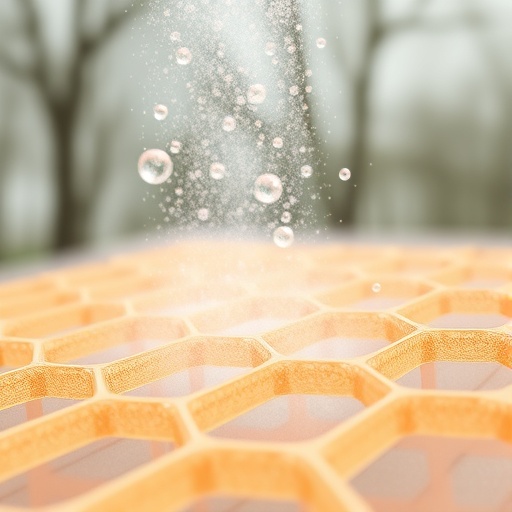
Fibrous membranes could soon become far more effective at collecting water from fog, separating oil from water, and moving moisture through advanced textiles, thanks to a new cross-scale design framework developed by researchers at Nanjing Tech University and collaborating institutions. The study, published in ENGINEERING Chemical Engineering, explains how liquid droplets behave across individual fibers, two-dimensional fiber networks, and three-dimensional layered membranes. By connecting these length scales, the researchers identified design rules for making liquids spread, detach, and travel in a controlled direction.
The work addresses a long-standing challenge in membrane engineering. A droplet does not behave the same way when it sits on a single fiber as it does when it encounters a network of intersecting fibers or a stack of chemically different layers. At the microscopic level, surface chemistry and curvature determine whether a droplet spreads or remains spherical. At larger scales, pore size, fiber spacing, and capillary bridges control whether liquid forms a continuous pathway or breaks into isolated droplets. Until now, these effects were often studied separately, making it difficult to translate microscopic observations into practical membrane designs.
Using in situ visualization together with multiphase-flow simulations, the team examined how droplets nucleate, grow, merge, and move on fibers made from two widely used polymers: hydrophilic polyacrylonitrile, or PAN, and hydrophobic polyvinylidene fluoride, or PVDF. The experiments revealed that fiber diameter plays a decisive role in the earliest stages of condensation. On hydrophilic PAN fibers, water droplets formed in an approximately axisymmetric arrangement along the fiber axis. Finer fibers, which have greater surface curvature, lowered the energy barrier for nucleation and produced a denser, more uniform population of droplets.
Coarser PAN fibers behaved differently. Their lower curvature reduced the likelihood of early droplet formation, allowing existing droplets to grow and merge into larger, more widely spaced structures. These larger droplets spread more completely across the fiber surface. The researchers also observed that droplet sphericity increased with volume because surface tension pulled the liquid toward a more compact shape. Detachment depended strongly on the surface chemistry: droplets generally slid away from hydrophilic fibers, while those on hydrophobic PVDF fibers tended to remain rounded until they detached by dripping.
The difference between PAN and PVDF was especially striking. On hydrophobic PVDF fibers, droplets remained highly spherical and appeared randomly distributed, largely independent of fiber diameter. This behavior reflects the low affinity between water and the polymer surface, which limits spreading and favors the accumulation of liquid into distinct beads. Fine fibers nevertheless promoted detachment at smaller critical droplet diameters, an important finding for systems that must continuously remove condensed water before droplets become heavy enough to block pores or reduce gas flow.
The researchers next moved from individual fibers to two-dimensional networks, where the spacing between neighboring fibers determined whether droplets could establish continuous transport routes. In hydrophilic PAN networks, narrow gaps supported the formation of stable liquid bridges and menisci. These bridges connected neighboring fibers and developed into continuous liquid films, allowing water to diffuse rapidly across the membrane. When the spacing became too wide, stable bridges could no longer form. The liquid then retracted into separated droplets, sharply limiting lateral spreading. Multiphysics simulations performed with COMSOL confirmed that pore size and interfiber spacing are central controls on capillary continuity.
Hydrophobic networks produced a contrasting transport pattern. Rather than spreading into films, droplets on PVDF structures grew mainly through coalescence. Two or more droplets merged when they came into contact, but the combined liquid still showed little tendency to wet the surrounding fibers. This distinction is crucial for membrane designers: hydrophilic networks can be engineered to promote continuous liquid transport, while hydrophobic networks can help resist premature wetting and preserve a dry surface for gas exchange or selective separation.
At the three-dimensional scale, the team demonstrated that stacking layers with different wettability can convert surface condensation into directional through-thickness transport. In a hydrophobic-hydrophilic bilayer, droplets initially remained nearly spherical on the PVDF surface. Once they contacted the underlying PAN layer, however, the wettability gradient drove water rapidly downward. Continued condensation generated repeated droplet transfers and new capillary bridges between the layers. As these bridges accumulated, interlayer resistance decreased and the membrane became increasingly efficient at moving liquid away from the exposed surface.
The researchers used these principles to construct Janus membranes consisting of hydrophobic PVDF top layers and hydrophilic PAN bottom layers. Janus materials have two chemically or physically distinct sides, allowing each surface to perform a separate function. In this case, the PVDF layer supported droplet formation while the PAN layer received and transported the water. Increasing the PAN fiber diameter enlarged the pores and improved gas permeability, while also reducing droplet penetration time from 14.8 seconds to just 0.4 seconds. The result is a rare combination of faster liquid removal and improved air transport.
The most effective architecture placed coarse PAN fibers near the interface with the PVDF layer and finer PAN fibers deeper inside the membrane. This arrangement encouraged rapid entry at the surface and efficient capillary transport below, producing high water-vapor transmission and strong fog-harvesting performance. Reversing the arrangement, from fine fibers to coarse fibers, created a capillary barrier that slowed penetration and reduced overall efficiency. The findings offer a practical blueprint for membranes used in fog collection, desalination, oil-water separation, moisture-management clothing, and other technologies where liquid must be absorbed quickly without sacrificing mass transfer. More broadly, the study shows that controlling fiber curvature, pore geometry, surface wettability, and layer order together can turn complex droplet behavior into a predictable engineering tool.
News Publication Date: 29-May-2026
Web References: https://doi.org/10.1007/s11705-026-2683-1
References: ENGINEERING Chemical Engineering, DOI: 10.1007/s11705-026-2683-1
Keywords
Fibrous membranes, microdroplets, liquid transport, fog harvesting, Janus membranes, PAN, PVDF, capillary flow, wettability gradient, mass transfer, oil-water separation, moisture management
Cite Scienmag News
Bethany Barker. (August 7, 2026). Multiscale Model Uncovers Droplet Transport in Fibrous Membranes for Fog Harvesting. Scienmag. https://scienmag.com/multiscale-model-uncovers-droplet-transport-in-fibrous-membranes-for-fog-harvesting/
Bethany Barker. "Multiscale Model Uncovers Droplet Transport in Fibrous Membranes for Fog Harvesting." Scienmag, 7 August 2026, https://scienmag.com/multiscale-model-uncovers-droplet-transport-in-fibrous-membranes-for-fog-harvesting/. Accessed 4 September 2026.
Bethany Barker. "Multiscale Model Uncovers Droplet Transport in Fibrous Membranes for Fog Harvesting." Scienmag. August 7, 2026. https://scienmag.com/multiscale-model-uncovers-droplet-transport-in-fibrous-membranes-for-fog-harvesting/


