


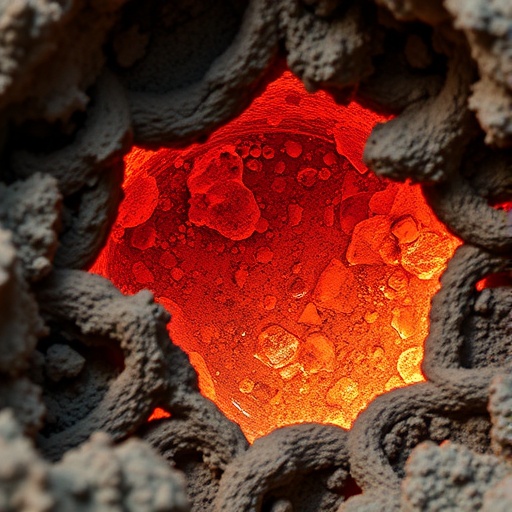
A new study is bringing genomic tools into one of Earth’s most inaccessible habitats: the deep biosphere, where microorganisms live far below the seafloor and within buried sediments and rocks. Published in Communications Earth & Environment, the research by A. Vuillemin, F. Ruiz-Blas, S. Yang and colleagues examines how metagenomics can reveal the biological and chemical processes associated with ferruginous mineralization in these hidden environments. The work focuses on a central question in deep Earth science: how do microbial communities influence the formation and transformation of iron-rich minerals over geological time?
The deep biosphere is an immense ecosystem extending beneath oceans and continents. Although it receives little sunlight and often contains extremely limited supplies of easily available organic carbon, it hosts microbial populations that can survive by exploiting chemical reactions rather than photosynthesis. These organisms may obtain energy from hydrogen, sulfur, carbon, nitrogen or iron compounds. Because their activity is tightly linked to the minerals surrounding them, studying deep subsurface life can reveal how biology and geology interact in places where conventional surface ecosystems have little influence.
Ferruginous mineralization refers to the accumulation or alteration of minerals rich in iron. Iron can occur in several oxidation states, most importantly ferrous iron, Fe(II), and ferric iron, Fe(III). Changes between these states are controlled by oxygen availability, acidity, temperature and the presence of chemical electron donors or acceptors. Microorganisms can accelerate these transformations by using iron as part of their metabolism. In turn, the resulting minerals can preserve chemical signatures of past biological activity, creating a geological record of life in the subsurface.
The study’s central tool, metagenomics, allows researchers to investigate entire microbial communities without growing individual organisms in the laboratory. Instead of isolating one species at a time, scientists extract genetic material from an environmental sample and sequence the mixture of DNA it contains. Computational analyses can then identify fragments belonging to different organisms and search for genes involved in respiration, carbon processing, iron cycling and stress resistance. This approach is particularly valuable in the deep biosphere, where many microorganisms are difficult or impossible to cultivate under laboratory conditions.
By connecting genetic information with mineral formation, the research addresses a major challenge in geomicrobiology. A mineral deposit may record that a chemical reaction occurred, but it does not automatically reveal whether microbes caused the reaction, benefited from it or merely survived nearby. Metagenomic data can provide clues by showing whether a community contains genes capable of carrying out relevant redox reactions. When these genetic signals are interpreted alongside mineralogical and geochemical evidence, researchers can build a more complete picture of how ferruginous deposits developed during diagenesis.
Diagenesis describes the physical, chemical and biological changes that affect sediments after they are deposited but before they become fully transformed into sedimentary rock. During this prolonged process, minerals dissolve, recrystallize and react with fluids moving through pores. Organic matter is gradually broken down, while microbial metabolisms reshape the availability of electron donors and acceptors. Iron minerals may therefore be both products and participants in diagenetic reactions. Their composition and structure can change as buried environments become progressively more isolated from the surface.
The significance of the research extends beyond identifying microbes in an unusual habitat. Iron minerals are important regulators of carbon and nutrient cycles because they can bind organic molecules, influence phosphorus availability and control the movement of trace metals. If microbial activity changes the stability of iron-bearing minerals, it can also affect how carbon is stored or released in buried sediments. Understanding these processes may improve models of how Earth’s chemical cycles operate over long timescales, particularly in environments where biological activity is slow but persistent.
The findings also have implications for the search for life beyond Earth. Iron-rich minerals are common on planetary bodies, and mineral deposits can survive long after the organisms or fluids that formed them have disappeared. On Mars, for example, iron oxides and other altered minerals have been detected by orbiters and rovers. Metagenomic research cannot be directly transferred to another planet, but it can help scientists recognize which mineralogical patterns may be associated with microbial redox activity. It also offers a framework for interpreting ancient terrestrial rocks as analogues for extraterrestrial environments.
At a broader level, the study demonstrates how modern biology is changing the way scientists read the geological record. DNA recovered from deep environments can reveal not only which organisms are present, but also which chemical strategies they may use to survive. When combined with mineral analysis, metagenomics turns iron-rich deposits into more than inert geological features: they become evidence of long-running interactions among microbes, fluids and rocks. By decoding these interactions, Vuillemin and colleagues’ work advances the effort to understand how life persists in Earth’s deep interior and how biology helps shape the planet beneath our feet.
Cite Scienmag News
Violet Maxwell. (August 6, 2026). Metagenomics Reveals How Iron-Rich Minerals Form in the Deep Biosphere. Scienmag. https://scienmag.com/metagenomics-reveals-how-iron-rich-minerals-form-in-the-deep-biosphere/
Violet Maxwell. "Metagenomics Reveals How Iron-Rich Minerals Form in the Deep Biosphere." Scienmag, 6 August 2026, https://scienmag.com/metagenomics-reveals-how-iron-rich-minerals-form-in-the-deep-biosphere/. Accessed 5 September 2026.
Violet Maxwell. "Metagenomics Reveals How Iron-Rich Minerals Form in the Deep Biosphere." Scienmag. August 6, 2026. https://scienmag.com/metagenomics-reveals-how-iron-rich-minerals-form-in-the-deep-biosphere/


