


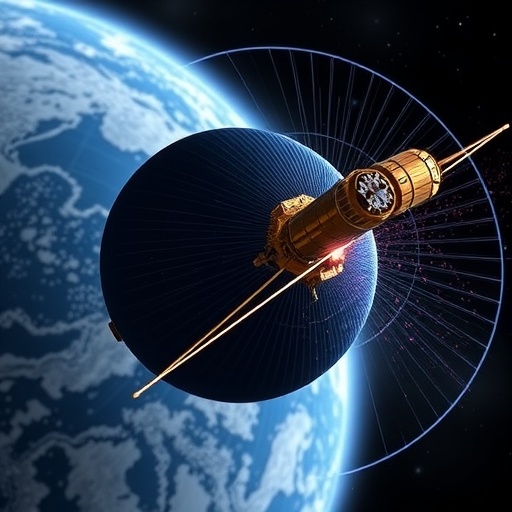
Earth’s radiation belts may be far less “random” than they appear. A new study suggests that energetic particles trapped by Earth’s magnetic field can move in a highly organised, predictable way while producing spacecraft measurements that look almost indistinguishable from random diffusion. The finding challenges one of the most established assumptions in radiation-belt science and raises the possibility that decades of observations have sometimes been interpreted through the wrong physical lens.
Published in Physical Review Research, the study, led by researchers at the University of Birmingham and the Czech Academy of Sciences, examines how spacecraft measurements can conceal the fine structure of particle motion. The international team argues that collisionless phase mixing—a process in which particles with slightly different velocities gradually separate into increasingly intricate patterns—can mimic the observational signature of diffusive transport, even when particles are not being randomly scattered.
Radiation belts are vast, doughnut-shaped regions surrounding planets with strong magnetic fields. Earth’s belts contain electrons and ions energetic enough to damage satellites, interfere with spacecraft electronics and threaten astronauts. Comparable particle environments have been identified around Jupiter, Saturn and Ganymede, and may also exist around ultracool brown dwarfs. Predicting how these particles accelerate and travel is therefore central to space-weather forecasting and the design of future missions.
The process described by the researchers begins with a localised injection of energetic particles. At first, the particles form a relatively coherent population. As they drift around the planet, however, they do not all move at exactly the same speed. Tiny differences in energy, pitch angle or position can cause some particles to move slightly ahead of others. Over time, the original population stretches into long, narrow filaments and eventually develops a complex, highly folded structure in phase space—the mathematical space describing both particle positions and velocities.
This evolution is deterministic rather than random. No wave-driven scattering or stochastic “jumps” are required to produce the increasingly dispersed appearance. Yet a spacecraft sampling the radiation belt does not observe the entire particle population at once. It records a limited measurement along its trajectory, with finite spatial, temporal and instrumental resolution. When the spacecraft crosses a region containing structures too fine to resolve, the detailed variations are effectively averaged out. The resulting signal becomes smooth, resembling the gradual spreading expected from diffusion.
Diffusion is a familiar concept in plasma physics. In conventional radiation-belt models, waves and other disturbances scatter particles, changing their energies and directions in a manner that can be described statistically. Over time, these random interactions spread a particle population through space or energy. The new study does not claim that diffusion is absent from radiation belts. Instead, it shows that the same broad observational pattern can arise from a fundamentally different mechanism, making it difficult to identify the underlying process from a single spacecraft record.
Lead author Adnane Osmane of the University of Helsinki says the distinction matters because models built on diffusion can produce confident predictions about particle lifetimes, acceleration and loss. If a smooth measurement is interpreted automatically as evidence of random scattering, researchers may estimate the strength of wave-particle interactions incorrectly. That could affect forecasts of when radiation levels will rise, how long hazardous particles will remain trapped and which satellites or missions are most vulnerable.
The study also exposes a broader problem in space physics: the difficulty of separating spatial structure from temporal change. A single spacecraft samples different locations at different moments, so it may be impossible to determine whether a measured variation reflects particles evolving with time or the spacecraft simply crossing a complicated pattern. Corresponding author Mirek Hanzelka of the Czech Academy of Sciences says this ambiguity is a major limitation of many past radiation-belt missions, because different physical processes can leave remarkably similar signatures in the data.
The researchers compare the effect to viewing a detailed Jackson Pollock painting from a great distance. The intricate lines and splashes do not become a Rothko-like field of colour, but the observer can no longer resolve the fine structure. In the same way, organised particle filaments do not transform into random motion; they are merely hidden by the measurement process. The team argues that future missions using constellations of spacecraft could help solve the problem by observing the same particle population simultaneously from multiple locations. Such multipoint measurements could reveal whether apparent diffusion is genuine scattering or the blurred signature of deterministic phase mixing. The result is a warning—and an opportunity—for space scientists: in the radiation belts, an image that looks smooth may conceal a system that is anything but random.
News Publication Date: 24 July 2026
Web References: https://journals.aps.org/prresearch/abstract/10.1103/5mmn-fm2p; https://teams.issibern.ch/beyonddiffusion/
References: Adnane Osmane et al., “Collisionless phase mixing mimics diffusive transport in radiation belt observations,” Physical Review Research, DOI: 10.1103/5mmn-fm2p
Keywords
Radiation belts, space weather, particle diffusion, collisionless phase mixing, plasma physics, spacecraft observations, Earth’s magnetosphere, satellite safety, energetic particles, space science
Cite Scienmag News
Grant Pearson. (August 5, 2026). Spacecraft observations may obscure how particles truly move through near-Earth space. Scienmag. https://scienmag.com/spacecraft-observations-may-obscure-how-particles-truly-move-through-near-earth-space/
Grant Pearson. "Spacecraft observations may obscure how particles truly move through near-Earth space." Scienmag, 5 August 2026, https://scienmag.com/spacecraft-observations-may-obscure-how-particles-truly-move-through-near-earth-space/. Accessed 5 September 2026.
Grant Pearson. "Spacecraft observations may obscure how particles truly move through near-Earth space." Scienmag. August 5, 2026. https://scienmag.com/spacecraft-observations-may-obscure-how-particles-truly-move-through-near-earth-space/


