


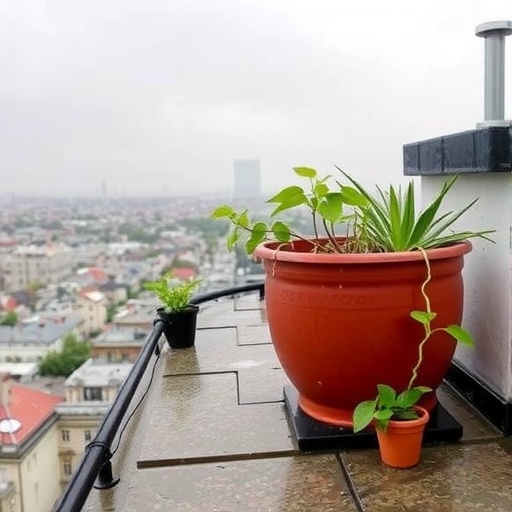
Cities could cool themselves with a resource that usually disappears down storm drains: rainwater. New research from The University of Manchester suggests that collecting rain from rooftops and spraying it back onto buildings during hot weather could reduce air-conditioning demand, limit waste heat and soften the intensity of urban heatwaves.
The idea targets a feedback loop that makes cities dangerously hot. As outdoor temperatures rise, buildings consume more electricity for cooling. Air-conditioning systems remove heat from indoor spaces but release that heat outdoors, adding to the warmth of streets and surrounding air. At the same time, dark roofs absorb solar radiation and transfer heat into buildings, increasing the burden on cooling systems. A rainwater-based roof-sprinkling system could interrupt both processes at once.
In a study published in Earth’s Future, researchers developed and tested a system that stores rainfall collected from rooftops and automatically uses it during periods of extreme heat. The team combined process-based numerical simulations with artificial intelligence to examine how the system might perform under different weather conditions and operating strategies. Tokyo was selected as the case study because of its dense urban form, high cooling demand and exposure to increasingly severe heat events.
The cooling mechanism is based largely on evaporation. When water is distributed across a hot roof, some of it absorbs heat from the roof surface and changes from liquid into vapor. This process consumes energy in the form of latent heat, lowering the roof’s temperature without requiring electricity in the way mechanical air-conditioning does. A cooler roof transfers less heat through the building envelope, reducing the amount of work required from indoor cooling systems. The result is not simply a cooler building, but potentially less heat released into the urban atmosphere.
The simulations indicated that the system could reduce air-conditioning energy use while also lowering urban temperatures. These effects reinforce each other: cooler roofs reduce heat entering buildings, and lower air-conditioning demand reduces the amount of waste heat expelled by cooling equipment. Across the simulated urban environment, the combined changes helped decrease the number of heatwave days and reduced the intensity of extreme heat events. The researchers also found that the benefits became stronger in hotter years, suggesting that the approach could become more valuable as climate change raises the frequency and severity of extreme temperatures.
One of the study’s most important findings was that the timing of roof sprinkling mattered more than simply increasing the size of a storage tank or the volume of water applied. Activating the system at the most effective moment allowed the available water to produce greater cooling. By contrast, very large tanks delivered only modest additional reductions in energy consumption and extreme heat. Applying more water also did not guarantee better results. If the roof could not evaporate the water quickly enough, some of the additional water remained on the surface, producing little extra cooling.
This distinction is technically important because evaporation depends on more than roof temperature. Air humidity, wind speed, solar radiation and the timing of rainfall all affect how quickly water can leave the roof as vapor. A roof may be extremely hot but relatively inefficient at evaporating water when the air is already humid. An automated system could therefore use weather forecasts, roof conditions and tank levels to decide when sprinkling would deliver the greatest cooling for each unit of stored water. The researchers’ use of artificial intelligence was intended to help identify these optimal operating strategies.
Rainwater harvesting also offers a second climate-adaptation benefit. By temporarily storing runoff, rooftop tanks can reduce the volume and speed of water entering drainage systems during heavy storms. This could lessen pressure on urban sewers and help reduce the risk of flooding. The same water captured during a wet period could later be used to address thermal stress during a heatwave, linking two hazards that are often managed separately: extreme rainfall and extreme heat.
The approach is not presented as a replacement for air-conditioning, green spaces or other urban cooling measures. Its effectiveness would depend on local rainfall patterns, roof materials, building design, storage capacity, maintenance requirements, water regulations and the availability of suitable automated equipment. Questions about water quality, roof durability and the risk of stagnant water would also need to be addressed before widespread deployment. Nevertheless, the research suggests that relatively simple infrastructure could turn roofs into active components of urban climate resilience.
As cities search for ways to protect public health while controlling soaring energy demand, rainwater-powered roof cooling offers an unusually direct strategy: capture water when the sky provides it, store it safely and release its cooling potential when heat becomes most dangerous. The Manchester team says the findings could help planners evaluate systems tailored to their own regions, balancing cost, water availability and performance. In a warming world, rooftops may no longer be passive surfaces above the city—they could become part of the machinery that keeps it cool.
News Publication Date: 5-Aug-2026
Web References: https://doi.org/10.1029/2026EF008876
References: Earth’s Future, DOI: 10.1029/2026EF008876
Cite Scienmag News
Russell Cooper. (August 5, 2026). Rooftop rainwater harvesting could cool cities and reduce heatwave days. Scienmag. https://scienmag.com/rooftop-rainwater-harvesting-could-cool-cities-and-reduce-heatwave-days/
Russell Cooper. "Rooftop rainwater harvesting could cool cities and reduce heatwave days." Scienmag, 5 August 2026, https://scienmag.com/rooftop-rainwater-harvesting-could-cool-cities-and-reduce-heatwave-days/. Accessed 4 September 2026.
Russell Cooper. "Rooftop rainwater harvesting could cool cities and reduce heatwave days." Scienmag. August 5, 2026. https://scienmag.com/rooftop-rainwater-harvesting-could-cool-cities-and-reduce-heatwave-days/


