


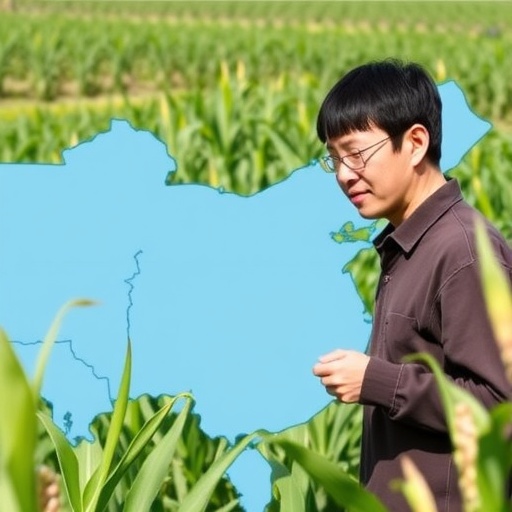
A finding that could reshape the global conversation about climate-smart agriculture is challenging one of the field’s most appealing assumptions: that increasing soil organic carbon will automatically raise crop yields. In a large study from Northeast China, researchers found that maize generally produced more grain as soil organic carbon increased in controlled field trials, yet the same benefit was not detectable on real-world farms. The contrast suggests that results achieved under carefully managed experimental conditions may not translate directly into everyday agricultural systems, where fertilizer decisions, equipment, knowledge and local constraints can determine whether healthier soils actually deliver more food.
The study, led by researchers including Shun Zhao, Stephen Schmidt and Zhen Quan, examined evidence from 1,246 field trials and 192 farms across Northeast China, one of the world’s major maize-producing regions. The researchers used several causal inference approaches, statistical methods designed to distinguish genuine effects from simple correlations. This distinction is crucial because soils with more organic carbon may also receive better management, more fertilizer or more water. Without accounting for these overlapping factors, it is difficult to determine whether carbon itself is increasing yields or merely appearing alongside other advantages.
In the field trials, the answer was consistently positive. As soil organic carbon rose, maize yields increased by approximately 8 to 13 percent, with the strongest benefits continuing until soil carbon reached a threshold of about 30 to 40 grams per kilogram of soil. Soil organic carbon is the carbon-rich component of soil organic matter, formed from decomposing crop residues, roots, manure and microbial activity. It can improve aggregation, water retention, nutrient storage and the habitat available to soil organisms. These properties can help crops withstand drought, access nutrients and develop stronger root systems, potentially creating both agricultural and climate benefits.
The results from farms looked dramatically different. On commercial fields, maize yields increased by no more than about 5 percent as soil organic carbon rose to roughly 10.0 grams per kilogram. Beyond that point, yields declined toward approximately their initial level rather than continuing upward. In statistical terms, the farm-level relationship was not a sustained positive response. The data therefore suggest that a soil can contain more organic carbon without producing more maize when other parts of the farming system prevent plants from benefiting from the soil’s improved physical or biological condition.
The researchers identified excessive nitrogen fertilizer use as the main factor weakening the expected yield response. Nitrogen is essential for maize growth, but applying more than the crop can absorb may create an imbalance in the soil–plant system. Heavy applications can reduce the relative importance of carbon-related improvements, increase nutrient losses and alter soil processes that regulate microbial activity and plant nutrition. Instead of allowing organic carbon to function as part of an efficient nutrient system, excessive nitrogen may encourage farmers to compensate for poor management or uncertainty with additional inputs, masking the contribution of soil carbon to yield.
The gap between trials and farms also reflects a fundamental difference in how agricultural research is conducted. Field experiments are often designed with carefully selected plots, uniform treatments, precise measurements and consistent management. Farmers, by contrast, operate under changing weather, variable soil conditions, financial pressures, limited labor and uneven access to machinery. Conservation practices such as returning crop residues, reducing tillage, applying manure or planting cover crops can increase soil carbon, but they may also require new equipment, additional planning or short-term investments before benefits become visible.
Limited farmer knowledge and inadequate infrastructure were also linked to the weak farm-level response. Building soil carbon is not a single intervention but a long-term management process. Farmers need to know which practices suit their soil, how to adjust fertilizer rates and how to manage residues without compromising planting operations or livestock needs. They also require access to equipment, agronomic advice, reliable soil testing and markets or support systems that reduce the risks of changing established practices. Without those conditions, a scientifically effective strategy may deliver little measurable benefit in the field.
The findings carry implications far beyond Northeast China. Soil carbon sequestration is widely promoted as a way to remove carbon dioxide from the atmosphere while improving food security. Yet the study warns that carbon targets alone are not enough. A rise in soil organic carbon should not be treated as a guaranteed yield investment unless it is accompanied by balanced fertilization, appropriate conservation practices and practical support for farmers. The research also highlights why agricultural policies based only on experimental results can overestimate benefits when they fail to account for real-world management.
For climate and food policy, the message is both cautionary and potentially encouraging. The positive trial results show that soil organic carbon can support higher maize yields under suitable conditions, while the farm results reveal that those conditions are not automatically present. Closing the gap will require integrating soil conservation with precision nutrient management, farmer training, improved rural infrastructure and locally adapted recommendations. The study ultimately reframes the promise of soil carbon: it is not a magic lever that raises yields by itself, but one component of a coordinated farming system whose benefits emerge only when biology, management and farmer support work together.
Cite Scienmag News
Alan Morgan. (August 5, 2026). Northeast China Farms Lack Soil Carbon’s Maize Benefits Seen in Trials. Scienmag. https://scienmag.com/northeast-china-farms-lack-soil-carbons-maize-benefits-seen-in-trials/
Alan Morgan. "Northeast China Farms Lack Soil Carbon’s Maize Benefits Seen in Trials." Scienmag, 5 August 2026, https://scienmag.com/northeast-china-farms-lack-soil-carbons-maize-benefits-seen-in-trials/. Accessed 3 September 2026.
Alan Morgan. "Northeast China Farms Lack Soil Carbon’s Maize Benefits Seen in Trials." Scienmag. August 5, 2026. https://scienmag.com/northeast-china-farms-lack-soil-carbons-maize-benefits-seen-in-trials/


