


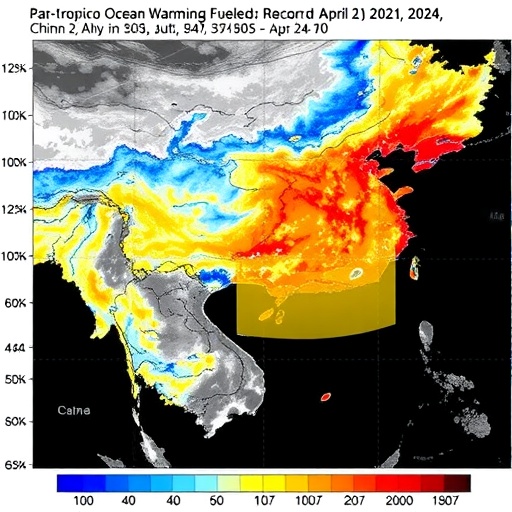
In April 2024, South China experienced rainfall so extreme that it shattered local records and raised a pressing question for climate scientists: was the deluge simply a regional weather anomaly, or was it connected to changes unfolding across the world’s tropical oceans? A new study by W. Xing, C. Wang and H. Liu argues that the answer lies far beyond China’s coastline. Their research indicates that unusually warm ocean waters throughout the tropics helped create the atmospheric conditions that drove the exceptional rainfall, revealing how climate signals spread across vast distances before arriving as a devastating storm over land.
The event struck during a month when southern China is already vulnerable to intense spring rainfall. Seasonal rainbands often develop as warm, moist air from the tropics meets cooler continental air, producing persistent clouds and heavy precipitation. In April 2024, however, the atmospheric system appears to have been supercharged. According to the study, pan-tropical ocean warming increased the amount of moisture available to the atmosphere and altered large-scale circulation patterns, allowing rainfall-producing systems to intensify and remain active over South China.
The phrase “pan-tropical warming” refers to temperature increases occurring across much of the tropical belt rather than in a single ocean basin. The tropics act as the planet’s atmospheric engine: sunlight heats the ocean surface, evaporation transfers water into the air, and rising moist air releases energy as it condenses into clouds. When tropical sea-surface temperatures rise, evaporation can increase and the atmosphere can hold more water vapor. This relationship is described by the Clausius–Clapeyron equation, which indicates that the capacity of air to contain water vapor rises by roughly 7 percent for every 1-degree Celsius increase in temperature, provided other conditions remain suitable for condensation.
That additional moisture does not automatically produce rain. It must be lifted, cooled and organized into clouds. The study’s central finding is that the warming tropical oceans did more than supply humidity: they helped reshape atmospheric circulation in a way that favored persistent ascent and moisture transport toward South China. Warm ocean regions can generate powerful convection, sending heat and water vapor high into the atmosphere. These convective heat sources influence pressure patterns and wind fields far away, creating what scientists describe as a teleconnection—a chain of atmospheric responses linking distant regions.
For South China, the consequences of this remote forcing were amplified by regional geography and seasonal circulation. Moist air flowing northward from the tropics encountered the boundary between warm, humid air and cooler air over the continent. Such boundaries can act as atmospheric assembly lines for rainfall, especially when winds repeatedly feed moisture into the same zone. If the frontal system or rainband moves slowly, precipitation can accumulate over one region for days, increasing the risk of flash floods, landslides, river swelling and urban inundation. The research connects the exceptional April rainfall to this combination of enhanced moisture supply and circulation patterns that favored prolonged rainfall.
The findings are significant because they challenge the idea that extreme rainfall should be analyzed only through local weather patterns. A storm over China may be influenced by ocean conditions thousands of kilometers away, even when those waters are not directly adjacent to the affected region. By examining the broader tropical climate system, the researchers identify a pathway through which simultaneous warming across multiple ocean basins can produce a coherent atmospheric response. This perspective may help explain why some rainfall extremes appear unusually widespread or persistent, rather than resembling isolated regional disturbances.
The study also carries an important warning for a warming world. As oceans continue to absorb heat from human-driven climate change, the atmosphere is likely to become increasingly capable of carrying large quantities of water vapor. That does not mean every location will become wetter, but it raises the potential intensity of rainfall when atmospheric circulation provides the necessary lift. The risk is especially serious in densely populated regions such as South China, where cities, transport networks, agriculture and river systems are exposed to sudden downpours. More moisture in the atmosphere can turn an already active rainy season into a record-breaking disaster when weather patterns stall.
Extreme rainfall attribution remains scientifically challenging because individual events are shaped by many interacting factors, including natural climate variability, tropical convection, jet-stream behavior, land temperatures and local topography. The study’s contribution is to place the April 2024 event within a global framework, showing how tropical ocean warming can influence regional precipitation through atmospheric connections. Its message is not that ocean warming alone determines every flood, but that a warmer ocean changes the starting conditions and can increase the odds that favorable weather patterns will produce extraordinary rainfall.
The April 2024 disaster therefore serves as both a regional alarm and a global climate signal. Rainfall records are often broken by combinations of circumstances that may never repeat in precisely the same way, yet the physical ingredients behind them—warmer oceans, greater atmospheric moisture and intensified climate connections—are becoming increasingly relevant. Understanding those ingredients could improve seasonal forecasting and early-warning systems, allowing authorities to prepare for rainfall risks before the clouds gather over the coast. The study suggests that watching the tropical oceans may be just as important as monitoring the skies above China when the next extreme rain event begins to take shape.
Cite Scienmag News
Violet Maxwell. (August 4, 2026). Pan-Tropical Ocean Warming Fueled Record April 2024 Rainfall in South China. Scienmag. https://scienmag.com/pan-tropical-ocean-warming-fueled-record-april-2024-rainfall-in-south-china/
Violet Maxwell. "Pan-Tropical Ocean Warming Fueled Record April 2024 Rainfall in South China." Scienmag, 4 August 2026, https://scienmag.com/pan-tropical-ocean-warming-fueled-record-april-2024-rainfall-in-south-china/. Accessed 3 September 2026.
Violet Maxwell. "Pan-Tropical Ocean Warming Fueled Record April 2024 Rainfall in South China." Scienmag. August 4, 2026. https://scienmag.com/pan-tropical-ocean-warming-fueled-record-april-2024-rainfall-in-south-china/


