


West Eifel’s Maar Volcanoes Erupted in Powerful Pulses, New Dating Study Finds
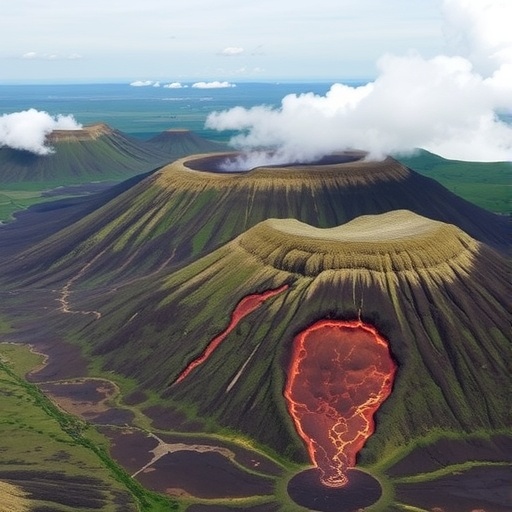
Beneath the tranquil lakes and rolling landscapes of western Germany lies a volcanic system that has repeatedly awakened in sudden, concentrated bursts. The West Eifel Volcanic Field contains more than one hundred maars—circular depressions and lakes created when rising magma explosively interacts with groundwater. A new study by researchers from Heidelberg University, Curtin University in Australia, and the University of Göttingen has reconstructed the timing of several of the region’s most recent eruptions, revealing that many volcanoes became active almost simultaneously across a broad area.
The findings indicate that West Eifel volcanism was not a steady, gradually declining process. Instead, eruptions occurred in short-lived pulses separated by thousands of years. The three most clearly identified eruptive episodes took place approximately 75,000, 48,000, and 25,000 years ago. The latest and most intense phase occurred during the coldest part of the last Ice Age, when the volcanic lakes known as the Dauner Maare formed, along with the Pulvermaar, one of the region’s best-known natural attractions.
Dating these eruptions has long been a major challenge. The volcanic rocks produced by maar eruptions generally lack zircon, a mineral widely used in geochronology because it can preserve chemical and radioactive information over geological timescales. To solve this problem, the researchers examined zircon crystals contained in crustal xenoliths—fragments of Earth’s crust ripped from depth and carried upward by magma during an eruption. These xenoliths provided the mineral record that the Eifel’s own magma could not supply.
The team used zircon uranium-thorium/helium dating, a technique capable of identifying when a mineral cooled after being transported to the surface. Zircon crystals naturally contain radioactive uranium and thorium. As these elements decay, they produce helium. At high temperatures, helium can escape from the crystal, but once the zircon cools sufficiently, the gas becomes trapped within its structure. By measuring the accumulated helium and determining how much uranium and thorium remain, scientists can calculate when the crystal cooled—and, in this case, estimate the timing of the eruption that brought it to the surface.
This approach allowed the researchers to establish a consistent age framework for several of the West Eifel’s best-known maar volcanoes. Rather than assigning isolated ages to individual lakes, the scientists were able to compare their formation histories and identify regional patterns. The results show that eruptions were clustered in time, with numerous volcanic centers becoming active during the same relatively brief intervals. Such synchronization suggests that the volcanic field responded to large-scale changes in the deep geological system rather than behaving as a collection of entirely independent vents.
The most recent eruptive pulse, around 25,000 years ago, transformed the landscape. Explosive interaction between magma and groundwater excavated broad craters and left behind lakes that now define the Dauner Maare. The same phase also produced the Pulvermaar, whose deep, nearly circular basin attracts visitors today. These eruptions occurred during the Last Glacial Maximum, a period of extreme global cooling and extensive ice-sheet growth, although the local timing predates the peak of maximum ice coverage in some regions.
One of the study’s most provocative conclusions concerns the relationship between volcanism and climate. The onset and strongest phases of the identified eruptions coincide with a major fall in sea level in the North Sea basin. This observation challenges earlier models that associated volcanic activity in the Eifel with warmer interglacial conditions, rising sea levels, and the unloading or loading of the crust in response to climate change. The new chronology does not necessarily prove that falling sea level triggered the eruptions, but it shows that the timing does not fit a simple warming-driven scenario.
The researchers emphasize that the geological forces behind these pulses may involve several interacting processes, including changes in crustal stress, pressure conditions in the mantle, and the movement of magma through fractured continental crust. When magma rises beneath a maar field, it may encounter groundwater-rich sediments and crustal rocks, producing exceptionally violent explosions even when the total volume of erupted magma is relatively small. The new age model provides an important temporal foundation for testing how these processes interact and why volcanic activity can intensify across an entire field within a short period.
The implications extend far beyond the West Eifel. Continental volcanic fields are often considered dormant for long periods, which can create a false impression that their hazard is negligible. Yet the study shows that such systems may remain quiet for tens of thousands of years before producing a concentrated series of eruptions. Many maar regions around the world are located near towns, infrastructure, agricultural land, or popular tourist destinations. A better understanding of eruptive pulsing could therefore improve long-term hazard assessments by helping scientists identify how volcanic fields behave before, during, and after renewed activity. The researchers’ results demonstrate that even landscapes that appear peaceful can preserve evidence of rapid and powerful geological change.
News Publication Date: 4 August 2026
Web References: https://doi.org/10.1007/s00410-026-02351-8
References: Contributions to Mineralogy and Petrology; DOI: 10.1007/s00410-026-02351-8
Cite Scienmag News
Violet Maxwell. (August 4, 2026). New research reveals eruption history of western Eifel maar volcanoes. Scienmag. https://scienmag.com/new-research-reveals-eruption-history-of-western-eifel-maar-volcanoes/
Violet Maxwell. "New research reveals eruption history of western Eifel maar volcanoes." Scienmag, 4 August 2026, https://scienmag.com/new-research-reveals-eruption-history-of-western-eifel-maar-volcanoes/. Accessed 3 September 2026.
Violet Maxwell. "New research reveals eruption history of western Eifel maar volcanoes." Scienmag. August 4, 2026. https://scienmag.com/new-research-reveals-eruption-history-of-western-eifel-maar-volcanoes/


