


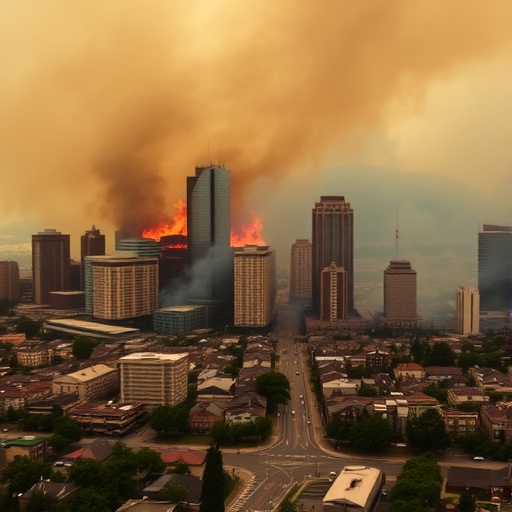
Wildfires are no longer a distant rural crisis. Across the United States, fire is increasingly intersecting with the places where people live, work and build infrastructure—and the ecological consequences do not end when the flames disappear. A new study by David Kucera and George D. Jenerette, published in npj Urban Sustainability, reports that the area burned by fires crossing into or near urban environments is increasing, while the landscapes left behind are recovering at sharply unequal rates.
The finding points to a hidden second phase of the wildfire emergency. Flames, smoke and evacuations are immediate and visible, but ecological recovery unfolds over years or even decades. Vegetation must re-establish, soils must regain structure, wildlife habitats must reconnect and water systems must stabilize. According to the study, these processes are not occurring evenly across U.S. urban-intersecting fire zones. Some locations may rebound relatively quickly, while others remain ecologically altered long after the event has passed.
The researchers’ focus on “urban-intersecting fires” captures a growing overlap between expanding development and fire-prone landscapes. Urban areas are not isolated from surrounding ecosystems; they are embedded within them. Housing, roads and commercial districts can extend into forests, shrublands and grasslands, creating complex boundaries where human infrastructure meets vegetation capable of carrying fire. At these edges, a single wildfire can become simultaneously a disaster for communities, a disturbance to ecosystems and a challenge for regional planning.
Burned area is a critical measure in understanding this transformation. It refers to the amount of land affected by fire, regardless of whether the burn is severe everywhere within that boundary. A larger burned area can mean more homes and infrastructure exposed, but it also signals a broader ecological footprint. Fire can remove plant cover, alter nutrient cycles, expose soil to erosion and change the amount of water that reaches streams. In urban-intersecting landscapes, those environmental effects may directly influence air quality, flood risk, heat exposure and the long-term livability of communities.
The study’s emphasis on unequal recovery is especially important because “recovery” is not a single, universal process. Ecologists may assess it through vegetation regrowth, the return of habitat structure, changes in surface temperature, soil stability or the reappearance of ecosystem functions. A landscape can look green again from a distance while still differing profoundly from its pre-fire condition. Fast-growing plants may return first, but mature forests, complex habitats and the ecological relationships they support can take much longer to re-form—or may not return in the same way at all.
Uneven recovery also reflects the physical and social diversity of the United States. Climate, elevation, soil type, vegetation, fire history and post-fire rainfall can all influence how an ecosystem responds. Areas that experience intense burning may face greater barriers to regrowth, while places with favorable moisture and resilient plant communities may recover more rapidly. Human decisions add another layer of variation: some sites receive extensive restoration, erosion control or invasive-species management, whereas others have limited resources for ecological repair.
That inequality matters because urban communities often depend on nearby ecosystems for protection and public benefits. Vegetation can reduce heat, slow runoff, stabilize slopes and support biodiversity. When recovery is delayed or redirected, those services may weaken. A burned watershed, for example, can remain vulnerable to erosion and sudden runoff even after emergency response operations have ended. In a warming climate, communities may therefore confront a repeating cycle in which fires become more extensive, recovery becomes less predictable and the time available to prepare for the next event grows shorter.
The research also challenges the assumption that rebuilding alone represents recovery. Roads, homes and utilities can be repaired on relatively visible timelines, but ecological systems operate according to different clocks. Replanting vegetation does not automatically recreate the structure of a mature ecosystem, and restoring a park or greenbelt does not guarantee that surrounding habitats will reconnect. Effective planning must therefore consider both the human footprint and the ecological processes that determine whether a burned landscape can regain resilience.
For scientists and policymakers, the study offers a strong argument for treating fire recovery as a long-term, spatially explicit problem. Instead of asking only how much land burned, planners may need to ask where it burned, which communities border it, what ecological functions were disrupted and how recovery is progressing across different locations. Mapping these patterns can help identify areas where restoration investment is most urgent, where future development may increase risk and where natural regeneration is likely to be sufficient.
The broader message is striking: the wildfire story is not simply about more flames, but about increasingly complex relationships between fire, cities and ecological time. As burned areas expand into urban-intersecting landscapes, the aftermath may become as consequential as the initial disaster. Kucera and Jenerette’s findings suggest that the United States is entering an era in which recovery cannot be assumed, measured by a single indicator or shared equally across the map. Preparing for the future will require communities to plan not only for ignition and evacuation, but also for the uneven ecological world that remains when the smoke clears.
Cite Scienmag News
Courtney Benton. (August 4, 2026). U.S. Urban-Intersecting Fires Grow, While Ecological Recovery Remains Uneven. Scienmag. https://scienmag.com/u-s-urban-intersecting-fires-grow-while-ecological-recovery-remains-uneven/
Courtney Benton. "U.S. Urban-Intersecting Fires Grow, While Ecological Recovery Remains Uneven." Scienmag, 4 August 2026, https://scienmag.com/u-s-urban-intersecting-fires-grow-while-ecological-recovery-remains-uneven/. Accessed 5 September 2026.
Courtney Benton. "U.S. Urban-Intersecting Fires Grow, While Ecological Recovery Remains Uneven." Scienmag. August 4, 2026. https://scienmag.com/u-s-urban-intersecting-fires-grow-while-ecological-recovery-remains-uneven/


