


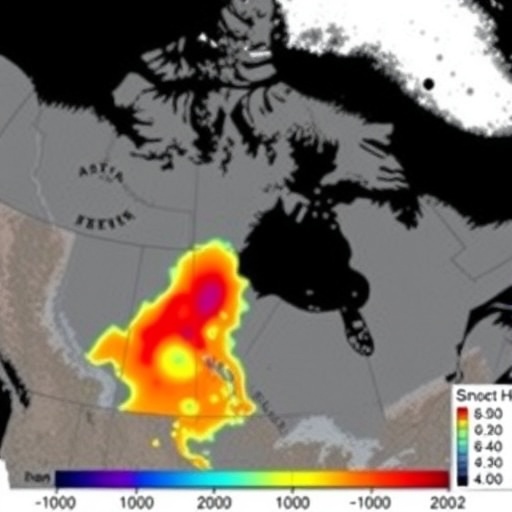
A hidden heat source deep beneath western Canada may be reshaping the geology of the continent, according to a new study published in Nature Communications. Researchers Q. Zhang, P. Audet, C. Ji and colleagues report seismic evidence suggesting that heat from the lower mantle is rising beneath the Cordilleran slab window, a remarkable opening in Earth’s subducted plate system. The finding offers a new explanation for how unusually warm material can reach the upper mantle in a region where the normal tectonic arrangement appears to leave a gap.
The Cordilleran slab window formed when the Juan de Fuca oceanic plate was caught between two spreading segments and began to break apart or retreat beneath western North America. Instead of a continuous slab descending into the mantle, the configuration created a window through which hotter mantle material could rise. Slab windows are important because they can alter volcanic activity, crustal deformation and the chemical evolution of the mantle beneath a continent.
For decades, geologists have debated where the heat beneath this part of Canada comes from. One possibility is that the warmth is generated locally in the shallow mantle, perhaps by decompression as mantle rises through the slab window. Another is that the region is connected to deeper circulation extending into the lower mantle, hundreds of kilometres below the surface. The new research points toward the second explanation, indicating that the thermal anomaly may be linked to a much deeper source than previously assumed.
The evidence comes from seismology, the science of using earthquakes to investigate Earth’s interior. Seismic waves change speed and direction as they pass through rocks with different temperatures, compositions and physical states. Hotter mantle is generally less dense and can transmit seismic energy differently from colder, more rigid material. By analysing these changes, scientists can construct images of structures that cannot be observed directly, effectively using earthquakes as a planetary-scale scanning system.
The study focuses on the seismic signature beneath the Cordilleran slab window in western Canada. Although seismic observations do not measure temperature with a thermometer, they can reveal zones where the mantle behaves in ways consistent with elevated heat or unusual material flow. The researchers interpret these patterns as evidence that thermal energy is being supplied from the lower mantle, rather than remaining confined to the shallow region immediately beneath the broken slab.
That interpretation matters because the lower mantle is Earth’s largest thermal reservoir and plays a central role in the planet’s long-term evolution. Heat left over from Earth’s formation, combined with energy released by radioactive elements and the cooling of the core, drives slow convection deep inside the planet. Over geological time, this movement transfers heat upward, influencing the production of magma, the motion of tectonic plates and the recycling of oceanic crust.
The Cordilleran slab window provides an unusually clear natural laboratory for studying this process. In most subduction zones, a cold oceanic slab acts as a barrier that separates the surface from deeper mantle circulation. Here, the break in the slab may allow scientists to detect how mantle material and heat move through an opening in the descending plate. The region therefore offers a rare opportunity to connect deep-mantle dynamics with geological processes visible at the surface.
The findings could also help explain why western Canada has experienced complex volcanic and tectonic activity over millions of years. When hot mantle rises, pressure decreases and parts of the rock can melt, generating magma that may migrate upward through fractures. Even when melting does not produce obvious volcanoes, it can modify the composition and strength of the crust. Heat entering from below may also affect the way faults behave and how the North American plate responds to forces transmitted through the mantle.
The researchers’ conclusion challenges a simple picture of slab windows as merely shallow gaps filled by nearby mantle. Instead, the seismic evidence suggests that these openings may act as conduits connecting the surface environment to the planet’s deeper thermal engine. If similar structures exist elsewhere, slab windows could represent underappreciated pathways for transporting heat and influencing continents far from conventional volcanic hotspots.
The result is a reminder that Earth’s surface is governed by processes extending far beyond the reach of drilling or direct sampling. A landscape in western Canada can bear the imprint of movements occurring deep within the mantle, while earthquakes provide the signals needed to trace that connection. By revealing a possible lower-mantle heat supply beneath the Cordilleran slab window, the study adds a new chapter to the story of how Earth transfers energy from its deep interior to the evolving crust above.
Cite Scienmag News
Violet Maxwell. (August 4, 2026). Seismic Evidence Reveals Lower-Mantle Heat Beneath Western Canada’s Cordilleran Slab Window. Scienmag. https://scienmag.com/seismic-evidence-reveals-lower-mantle-heat-beneath-western-canadas-cordilleran-slab-window/
Violet Maxwell. "Seismic Evidence Reveals Lower-Mantle Heat Beneath Western Canada’s Cordilleran Slab Window." Scienmag, 4 August 2026, https://scienmag.com/seismic-evidence-reveals-lower-mantle-heat-beneath-western-canadas-cordilleran-slab-window/. Accessed 3 September 2026.
Violet Maxwell. "Seismic Evidence Reveals Lower-Mantle Heat Beneath Western Canada’s Cordilleran Slab Window." Scienmag. August 4, 2026. https://scienmag.com/seismic-evidence-reveals-lower-mantle-heat-beneath-western-canadas-cordilleran-slab-window/


