


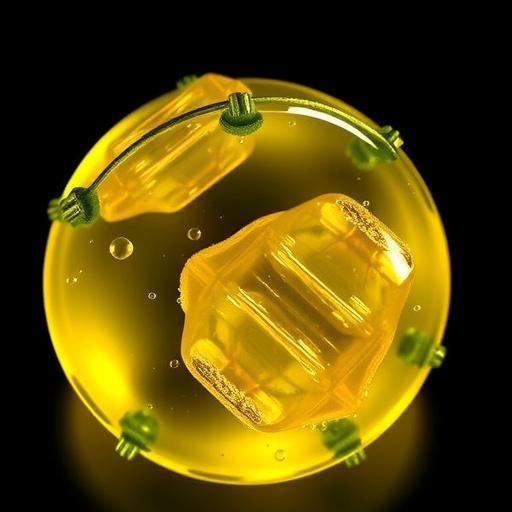
Researchers at Fuzhou University have developed a gelatin-stabilized liquid-metal hydrogel that combines stretchable electronics, artificial intelligence and solar-energy conversion in a single soft material. The technology addresses one of the central challenges in liquid-metal electronics: keeping tiny metal droplets evenly dispersed instead of allowing them to merge into larger pools. The resulting conductive hydrogel can stretch to more than seven times its original length, detect subtle human movements and translate electrical signals into recognizable handwriting. It can also convert light-induced heat into a small electrical output, suggesting a route toward wearable devices that sense, process information and partially power themselves.
Liquid metals are attractive for flexible electronics because they conduct electricity while remaining deformable. Yet when liquid-metal particles are incorporated into polymer networks, their surfaces can be unstable. Droplets may collide and coalesce, producing irregular conductive pathways and compromising the material’s mechanical and electrical performance. The Fuzhou University team, led by Yan Yu and Sheng-Hong Zhong, tackled this problem with gelatin, a natural biomolecule widely used in food, medicine and biomaterials. Instead of relying on conventional synthetic stabilizers, the researchers used gelatin to form a protective molecular layer around liquid-metal particles before embedding them in a hydrogel.
The stabilization mechanism is based on coordination bonding at the metal-particle surface. Liquid-metal droplets naturally develop a thin oxide layer when exposed to air. Functional groups in gelatin, particularly amino and carboxyl groups, interact strongly with this oxide coating. The resulting molecular associations create a gelatin-rich shell that helps keep individual liquid-metal particles separated and uniformly distributed. This arrangement prevents uncontrolled coalescence while preserving contact between neighboring particles, allowing the droplets to form a continuous and deformable conductive network throughout the hydrogel.
The gelatin performs another important chemical function during fabrication. According to the researchers, it helps initiate the polymerization of acrylic acid without the traditional chemical initiators normally required to start the reaction. In this process, acrylic acid molecules link together to form the polymer framework, while gelatin-coated liquid-metal particles become integrated into the developing network. Eliminating harsh initiators simplifies preparation and may improve the material’s environmental and biological compatibility. The researchers describe the method as rapid, scalable and more sustainable than approaches that require multiple synthetic additives or complicated processing steps.
The resulting material, known as a Gelatin-Mediated Hydrogel, or GMH, combines the water-rich softness of a hydrogel with the conductivity and deformability of liquid metal. It can be stretched beyond 700 percent of its original length and recover its shape without a major loss of function. Such resilience is essential for electronic skin, where a sensor must follow bending joints, moving muscles and repeatedly flexing fingers. Because the liquid-metal particles remain distributed throughout the polymer matrix, mechanical deformation changes the conductive pathways in a measurable way. This produces electrical signals that can be correlated with strain, pressure and motion.
In one demonstration, the researchers attached the hydrogel to a finger and used it to record electrical changes produced while writing the 26 letters of the English alphabet. Each movement generated a distinctive signal pattern as the hydrogel stretched and relaxed. The data were then analyzed using a convolutional neural network, a type of deep-learning model commonly used for image and pattern recognition. The system identified handwritten letters in real time with an accuracy of 93.3 percent. The result turns a soft sensor into more than a passive detector: it becomes an interface capable of converting body movement into machine-readable information.
This combination of flexible sensing and artificial intelligence could have wide implications for wearable technology. Conventional keyboards and touchscreens require rigid surfaces or deliberate finger contact, while a hydrogel sensor can gather information directly from natural movement. Similar systems could support gesture recognition, rehabilitation monitoring, sign-language interfaces or controls for wearable and robotic devices. The researchers’ demonstration remains a laboratory proof of concept, but its use of a simple biomolecule and a deformable conductive network highlights how materials science and machine learning can be integrated into lightweight human-machine interfaces.
The GMH also demonstrated a method for converting solar or near-infrared light into electricity. Liquid metal acts as an efficient photothermal component: it absorbs incoming light and rapidly converts part of that energy into heat. When the hydrogel was exposed to near-infrared illumination, its temperature increased. Coupling the material to a thermoelectric module allowed the temperature difference to be converted into an electrical voltage of approximately 16 millivolts. That output is modest, but the principle could support low-power sensors or help extend the operating time of wearable systems by reducing dependence on conventional batteries.
The researchers say the work establishes a versatile platform for multifunctional hydrogel electronics, but practical deployment will require further development. Future studies will need to examine long-term stability, performance under repeated environmental exposure, large-scale manufacturing and integration with complete power-management circuits. Even so, the material offers an unusually broad combination of properties: liquid-metal conductivity, hydrogel softness, gelatin-mediated stabilization, AI-compatible sensing and photothermal energy conversion. By using a common natural biomolecule to control an otherwise difficult-to-handle electronic material, the Fuzhou University team has brought flexible “electronic skin” a step closer to becoming adaptive, intelligent and partially self-powered.
News Publication Date: 23-Jun-2026
Web References: https://doi.org/10.26599/NR.2026.94908692; Nano Research
References: Nano Research, DOI: 10.26599/NR.2026.94908692
Keywords
Liquid metal; gelatin; conductive hydrogel; electronic skin; wearable sensors; artificial intelligence; handwriting recognition; photothermal conversion; thermoelectric energy harvesting; flexible electronics
Cite Scienmag News
Bethany Barker. (August 4, 2026). Gelatin-Stabilized Liquid Metal Enables Conductive Hydrogels for Sensing, Energy Harvesting. Scienmag. https://scienmag.com/gelatin-stabilized-liquid-metal-enables-conductive-hydrogels-for-sensing-energy-harvesting/
Bethany Barker. "Gelatin-Stabilized Liquid Metal Enables Conductive Hydrogels for Sensing, Energy Harvesting." Scienmag, 4 August 2026, https://scienmag.com/gelatin-stabilized-liquid-metal-enables-conductive-hydrogels-for-sensing-energy-harvesting/. Accessed 3 September 2026.
Bethany Barker. "Gelatin-Stabilized Liquid Metal Enables Conductive Hydrogels for Sensing, Energy Harvesting." Scienmag. August 4, 2026. https://scienmag.com/gelatin-stabilized-liquid-metal-enables-conductive-hydrogels-for-sensing-energy-harvesting/


