


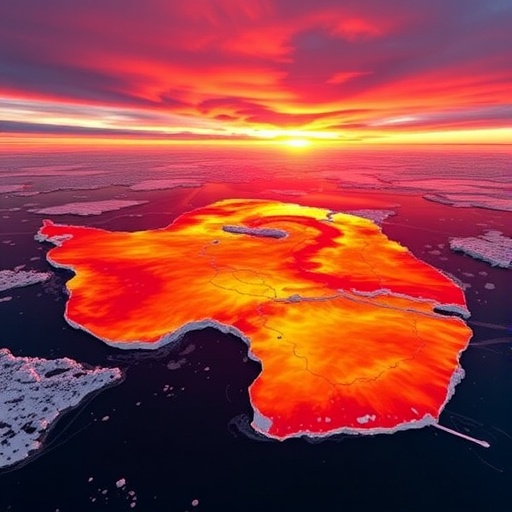
A new study has identified thermodynamics as the central force behind a recent increase in surface melting across the Antarctic Peninsula, a finding that could reshape how scientists interpret one of the most rapidly changing regions of the Southern Hemisphere. Published in Nature Communications, the research by Q. Zhang, B. Huai, S. Wang and colleagues examines why the peninsula’s snow and ice surface has been melting more intensely in recent years. The answer, the authors report, lies not simply in warmer air, but in the way atmospheric heat, moisture, radiation and the physical properties of snow interact at the surface.
The Antarctic Peninsula stretches northward from the continent toward South America and is exposed to some of the most complex weather systems on Earth. Its steep mountains, narrow ice shelves and proximity to the Southern Ocean create sharp contrasts in temperature and precipitation over very short distances. Although the region is cold for much of the year, brief periods of above-freezing conditions can trigger extensive surface melt. Water produced at the top of glaciers and ice shelves can refreeze within the snowpack, drain toward the ocean or contribute to structural weakening when it accumulates in crevasses and depressions.
The new analysis focuses on the physical energy balance at the ice surface. Melting begins when the surface receives enough energy to reach the melting point and supply the latent heat required to convert solid ice into liquid water. That energy can arrive as shortwave solar radiation, longwave radiation emitted by the atmosphere and clouds, or turbulent heat transferred from the air. At the same time, the surface loses energy through reflected sunlight, outgoing infrared radiation and evaporation or sublimation. The balance among these competing processes determines whether snow remains frozen, cools further or begins to melt.
Thermodynamics provides the framework for understanding how small atmospheric changes can have large consequences. A warmer atmosphere can hold more water vapour, increasing the potential for humid air and low clouds over the peninsula. Water vapour and clouds absorb and emit infrared radiation, potentially increasing the downward longwave energy reaching the surface. When that energy is strong enough, it can offset the cooling effects of reflected sunlight and push the snow surface toward its melting point. The relationship between temperature and atmospheric moisture is also highly nonlinear, meaning that warming can amplify the amount of water vapour available to influence the surface energy budget.
Snow itself adds another layer of complexity. Fresh, bright snow reflects much of the incoming solar radiation, keeping the surface relatively cool. As snow grains enlarge, become wet or are covered by darker debris, the surface albedo declines and more sunlight is absorbed. Meltwater can accelerate this transition by changing the structure of the snowpack and reducing its reflectivity. Once melting begins, the surface may therefore absorb more energy, creating conditions that favour additional melt. This is a classic positive feedback, although its strength depends on cloud cover, snow accumulation, wind and the timing of the melt season.
The study’s emphasis on thermodynamics is significant because surface melt is often associated with atmospheric circulation and dramatic weather events. Warm air can be transported toward the peninsula by large-scale pressure patterns, while winds crossing the mountains may descend on the western or eastern slopes and undergo adiabatic warming. These so-called föhn winds have long been linked to melt episodes in the region. However, circulation alone does not determine how much ice melts. The temperature, humidity and radiative properties of the incoming air must also be compatible with the energy requirements of melting. The researchers’ interpretation places those thermodynamic conditions at the centre of the recent trend.
This distinction matters for climate modelling. Two weather systems can produce similar surface temperatures but very different melting outcomes if they carry different amounts of moisture or generate different cloud conditions. Likewise, a period of strong sunlight may not cause substantial melt if the snow surface remains dry and highly reflective. By identifying the thermodynamic controls, the research offers a way to separate the influence of atmospheric temperature from the effects of humidity, radiation and surface conditions. That could help improve forecasts of melt events, particularly during short periods when rapid changes occur over a broad area.
The consequences extend beyond the visible appearance of the ice. Surface meltwater can infiltrate snow and firn, the compacted layer between fresh snow and glacial ice. When it refreezes, it releases heat and can form dense ice layers that reduce the snowpack’s ability to absorb future meltwater. If water persists and flows through cracks, it can also increase the risk of hydrofracturing, in which the weight of liquid water forces fractures deeper into an ice shelf. Ice shelves act as floating extensions of glaciers, and their thinning or collapse can remove resistance that slows the flow of land-based ice toward the ocean.
The Antarctic Peninsula has already experienced major changes, including the retreat of glaciers, the breakup of ice shelves and shifts in snowfall and temperature patterns. The new findings do not imply that every warm spell will produce the same amount of melt, nor that thermodynamics operates independently of atmospheric circulation. Instead, they show that the surface response depends on whether the atmosphere supplies the precise combination of heat and moisture needed to overcome the ice’s energy barriers. As global temperatures rise, those combinations may become more frequent, making thermodynamic monitoring increasingly important for detecting early warning signs of instability.
For scientists, the study provides a more precise lens through which to view a rapidly evolving polar landscape. Measurements of air temperature remain essential, but they are not enough on their own to explain surface melting. Future assessments will need to track humidity, cloud properties, radiation, snow reflectivity, firn structure and the movement of meltwater together. The Antarctic Peninsula is a natural laboratory for this approach because its rugged terrain magnifies interactions between the atmosphere and the ice. Understanding those interactions could improve projections of future ice loss and clarify how a warming atmosphere is transforming one of Antarctica’s most vulnerable regions.
Cite Scienmag News
Kelsey Dorsey. (August 4, 2026). Thermodynamics Drive Recent Increase in Surface Melting Across Antarctic Peninsula. Scienmag. https://scienmag.com/thermodynamics-drive-recent-increase-in-surface-melting-across-antarctic-peninsula/
Kelsey Dorsey. "Thermodynamics Drive Recent Increase in Surface Melting Across Antarctic Peninsula." Scienmag, 4 August 2026, https://scienmag.com/thermodynamics-drive-recent-increase-in-surface-melting-across-antarctic-peninsula/. Accessed 3 September 2026.
Kelsey Dorsey. "Thermodynamics Drive Recent Increase in Surface Melting Across Antarctic Peninsula." Scienmag. August 4, 2026. https://scienmag.com/thermodynamics-drive-recent-increase-in-surface-melting-across-antarctic-peninsula/


