


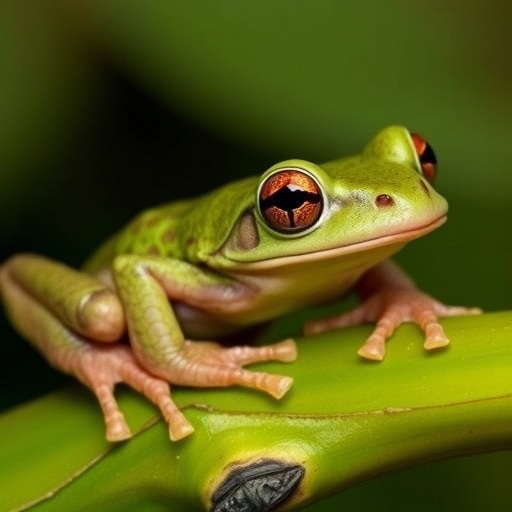
An international team of scientists has described seven new species of diamond frogs from Madagascar, revealing that the island’s secretive genus Rhombophryne contains far more evolutionary diversity than previously recognised. The discovery brings the total number of known diamond frog species to 27 and highlights how much biodiversity may remain hidden in Madagascar’s forests, leaf litter and museum collections.
The findings, published in Vertebrate Zoology, result from a 12-year research effort combining field surveys, comparative anatomy, acoustic data, genetic analysis and the sequencing of DNA from historical specimens. The researchers say the work resolves a long-standing taxonomic problem: several frogs collected decades ago could not be confidently matched with modern species because their physical appearance was similar and their original genetic relationships were unknown.
“Diamond frogs have been hiding their diversity beneath our feet,” said Mark D. Scherz, curator of herpetology at the Natural History Museum Denmark and lead author of the study. Many members of the genus spend most of their lives beneath leaf litter or in the soil, where they are difficult to locate. Even when they emerge, closely related species may appear nearly identical, making traditional identification based on colour, body shape or size unreliable.
The frogs themselves occupy a striking range of forms. Some species have compact, rounded bodies that resemble African rain frogs, while others are long-legged and associated with moss-covered habitats. Several are robust terrestrial animals adapted to life on the forest floor. Their generally brown or muted colouring provides camouflage, but some species display vivid orange, white or black markings on the thighs and lower back. These hidden patterns may function as defensive signals, startling predators when the frogs suddenly reveal them.
Identifying the new species required more than collecting additional frogs in the field. The researchers examined skeletal and external characteristics, compared vocalisations and analysed genetic markers that reveal evolutionary relationships. They also used museomics, a rapidly developing approach that extracts and sequences DNA from preserved museum specimens. Although DNA in old specimens is often fragmented and chemically degraded, modern sequencing techniques can recover enough genetic information to compare historical animals with recently collected individuals.
This approach proved especially important for resolving the identities of older species names. In taxonomy, a species name is linked to a type specimen, the preserved individual that serves as the formal reference for that name. If the type specimen cannot be matched to a living population or genetic lineage, the name’s correct use may remain uncertain. By sequencing historical material, including original type specimens, the researchers were able to connect names from earlier scientific descriptions to the evolutionary lineages identified in modern samples.
“By sequencing historical specimens, including the original type specimens, we were able to answer questions that have persisted for generations,” said Alice Petzold of the University of Potsdam, who led the museomics component of the project. The integration of museum DNA with field-collected material allowed the team to distinguish species that might otherwise have been combined and to recognise populations that had previously been overlooked.
The research also illustrates why taxonomic work is central to conservation biology. Madagascar’s forests are being fragmented by deforestation and other human pressures, while many diamond frogs remain poorly known. For numerous species, researchers still lack basic information about breeding behaviour, population size, habitat requirements and geographic range. Without accurate species boundaries and distribution maps, conservation assessments can underestimate threats or direct protection toward the wrong populations.
Andolalao Rakotoarison of the Institut d’Enseignement Supérieur de Soavinandriana Itasy in Madagascar said that the new information is already contributing to conservation planning. During a protected-area workshop held in March 2026 as part of Madagascar’s Biodiversity 30×30 Program, several newly described species, including Rhombophryne quentini, were incorporated into proposals to strengthen or expand protected areas. Such decisions depend on knowing precisely where restricted-range species occur, particularly when a frog may be confined to a single mountain, forest fragment or high-elevation habitat.
The scientists caution that the seven newly described species are unlikely to represent the final word on Rhombophryne diversity. Additional unnamed species almost certainly remain in remote habitats and biological collections, waiting to be recognised through future fieldwork and genetic research. The study demonstrates that Madagascar’s biodiversity is not simply disappearing from well-known landscapes; in many cases, it has never been fully documented. Each newly identified frog represents a distinct evolutionary lineage shaped over millions of years, and the researchers argue that revealing those lineages is an essential first step toward protecting them.
News Publication Date: 22-Jul-2026
Web References: https://doi.org/10.3897/vz.76.e172567
References: Vertebrate Zoology, DOI: 10.3897/vz.76.e172567
Cite Scienmag News
Margaret Porter. (August 3, 2026). Scientists Identify Seven Previously Unknown Frog Species in Madagascar. Scienmag. https://scienmag.com/scientists-identify-seven-previously-unknown-frog-species-in-madagascar/
Margaret Porter. "Scientists Identify Seven Previously Unknown Frog Species in Madagascar." Scienmag, 3 August 2026, https://scienmag.com/scientists-identify-seven-previously-unknown-frog-species-in-madagascar/. Accessed 3 September 2026.
Margaret Porter. "Scientists Identify Seven Previously Unknown Frog Species in Madagascar." Scienmag. August 3, 2026. https://scienmag.com/scientists-identify-seven-previously-unknown-frog-species-in-madagascar/


