


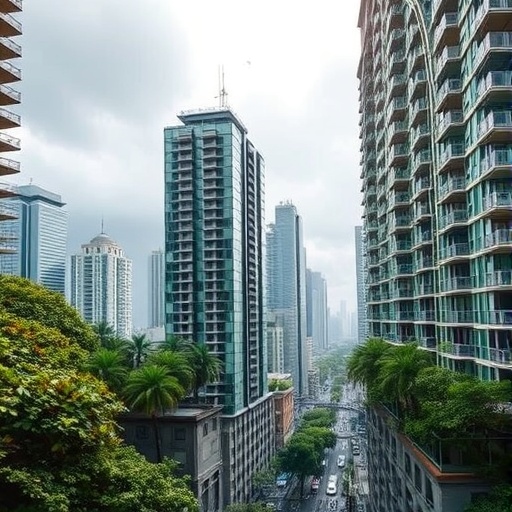
A new study is challenging one of the most comforting assumptions in urban climate design: that adding vegetation to dense cities always makes hot weather safer. Research published in npj Urban Sustainability reports that compact, high-rise urban forms can amplify humid heat risks associated with vegetation transpiration—a process usually considered an essential cooling service. The finding does not suggest that trees and plants should be removed from cities. Instead, it reveals that the success of green infrastructure depends heavily on building geometry, airflow, humidity, and the way heat and moisture move through the urban atmosphere.
Vegetation transpiration occurs when plants release water vapor through microscopic openings in their leaves. This process consumes energy and can lower leaf and surrounding air temperatures, much like evaporation from human skin. In a well-ventilated environment, the added moisture may be dispersed efficiently, allowing evaporative cooling to provide a net thermal benefit. But in tightly packed high-rise districts, the same moisture can become trapped between buildings. The result is a more humid microclimate in which the body’s ability to cool itself through sweating is weakened.
That distinction matters because humid heat is more dangerous than air temperature alone suggests. The human body relies on evaporation to transfer heat away from the skin. When atmospheric moisture is already high, sweat evaporates more slowly, forcing the body to work harder to maintain a stable internal temperature. Heat-stress indicators such as wet-bulb temperature and the Wet-Bulb Globe Temperature account for this interaction between heat and humidity. A neighborhood with slightly lower temperatures but substantially higher humidity can therefore feel more oppressive—and pose greater health risks—than a drier location with hotter air.
The study focuses on the urban “canyon” effect created by tall buildings arranged close together. These structures can obstruct wind, reduce the exchange of air with the atmosphere above, and alter the amount of sunlight reaching streets and façades. When vegetation in such spaces transpires, the released water vapor may accumulate rather than disperse. The compact geometry can also create complex circulation patterns, with warm and moist air repeatedly moving through pedestrian-level spaces. In this setting, greenery may cool surfaces while simultaneously increasing the moisture burden experienced by people outdoors.
This is a crucial refinement of the popular idea that urban greening is universally beneficial. Plants perform several valuable functions: they provide shade, intercept solar radiation, reduce surface temperatures, store carbon, and improve the visual and psychological quality of public space. Yet their cooling performance is not fixed. It changes with species, soil moisture, canopy density, irrigation, wind conditions, building height, street width, and background humidity. The new research emphasizes that these factors must be evaluated together rather than treating vegetation as an isolated solution to urban heat.
The implications are particularly significant for rapidly growing cities where vertical development is being used to accommodate rising populations. High-rise construction can reduce land consumption, but dense towers may produce localized atmospheric conditions that differ dramatically from those in surrounding neighborhoods. A cooling strategy designed for an open suburban street may behave differently in a narrow urban canyon surrounded by tall façades. Planners could therefore face a difficult balancing act: maximizing shade and ecological benefits without creating stagnant pockets where moisture and heat combine into dangerous conditions.
The findings also raise questions about how cities measure the success of climate adaptation projects. A street may record a lower surface temperature after trees are planted, yet still expose pedestrians to greater physiological stress if humidity increases and air movement declines. This means future assessments should include multiple variables, including air temperature, relative humidity, wind speed, radiant heat, and human thermal response. Satellite observations and conventional weather stations may not fully capture conditions at street level, where building walls, tree canopies, pavement, and human activity interact within a few meters.
The research is likely to intensify debate over “smart” urban greening rather than green infrastructure in general. Possible responses include selecting vegetation according to local humidity and wind conditions, designing wider or better-connected ventilation corridors, combining trees with reflective or permeable surfaces, and ensuring that shaded areas do not become poorly ventilated enclosures. Building orientation and spacing may be as important as the number of trees planted. Irrigation practices could also matter, since additional water supplied to vegetation may increase transpiration during precisely the periods when atmospheric moisture is already high.
For residents, the message is both cautionary and practical. A leafy street can still be healthier than an exposed one, particularly when shade reduces direct solar radiation. But during extreme heat, people should not assume that every green space offers the same level of protection. Dense, humid, windless areas may require additional measures such as cooling centers, drinking-water access, timed outdoor activities, and heat alerts that account for humidity. The study’s central contribution is to show that urban climate risk is not determined by temperature alone—or by the presence of greenery alone—but by the interaction between city form, plant physiology, and human vulnerability.
As climate change increases the frequency and intensity of heat extremes, these interactions could become more consequential. The research presents cities with a deceptively simple lesson: cooling the urban environment is not just a matter of adding more plants. It requires understanding where the water released by vegetation goes, how buildings control its movement, and how the resulting air feels to a human body. In the race to make cities greener, the next generation of design may need to be equally focused on keeping them breathable.
Cite Scienmag News
Courtney Benton. (August 2, 2026). Compact urban high-rises intensify humid heat from vegetation transpiration. Scienmag. https://scienmag.com/compact-urban-high-rises-intensify-humid-heat-from-vegetation-transpiration/
Courtney Benton. "Compact urban high-rises intensify humid heat from vegetation transpiration." Scienmag, 2 August 2026, https://scienmag.com/compact-urban-high-rises-intensify-humid-heat-from-vegetation-transpiration/. Accessed 3 September 2026.
Courtney Benton. "Compact urban high-rises intensify humid heat from vegetation transpiration." Scienmag. August 2, 2026. https://scienmag.com/compact-urban-high-rises-intensify-humid-heat-from-vegetation-transpiration/


