


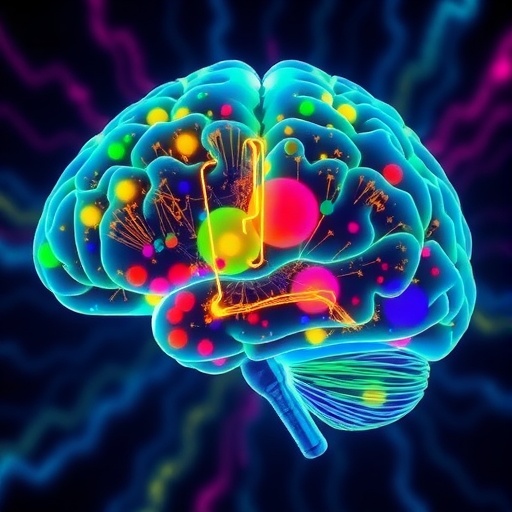
The brain may be constantly calculating a hidden ratio that helps determine whether neural circuits remain stable, flexible, and capable of processing information. A new study by D.J. Hauke, J. Rodriguez-Sanchez, H. Oloye and colleagues presents a canonical microcircuit for estimating the balance between excitation and inhibition, commonly known as the E/I balance. Published in Translational Psychiatry, the work focuses on one of neuroscience’s most important—and most difficult to measure—questions: how does the brain keep its electrical activity from becoming either dangerously intense or too weak to support meaningful computation?
Every thought, sensation, and movement depends on communication between neurons. Excitatory neurons increase the likelihood that downstream cells will fire, while inhibitory neurons suppress or regulate that activity. These opposing forces are not simply competing systems. They form a dynamic control mechanism that allows neural networks to amplify important signals, filter noise, coordinate timing, and adapt to changing conditions. The E/I balance refers to the relationship between these influences, and disturbances in that relationship have been associated with conditions including autism, schizophrenia, epilepsy, depression, and other psychiatric or neurological disorders.
The challenge is that excitation and inhibition are distributed across several levels of brain organization. Electrical activity can be measured from individual cells, local populations, or large-scale brain networks, but each approach captures a different part of the system. A strong signal in a brain scan, for example, does not automatically reveal whether it was generated by increased excitation, reduced inhibition, or a complicated combination of both. By proposing a canonical microcircuit, the researchers address this problem at the level where neuronal interactions are directly organized: the local network.
A canonical microcircuit is a simplified but biologically informed model of how neurons interact within a region of the brain. Although real circuits vary across brain areas, many share recurring architectural principles. Excitatory pyramidal cells communicate with other excitatory neurons and recruit inhibitory interneurons, which in turn feed back onto the network. These interactions can be arranged into recurrent loops, allowing the circuit to regulate its own activity. The model described in the new study uses this kind of organization as a foundation for estimating how excitation and inhibition shape the circuit’s output.
The importance of the approach lies in its focus on inference rather than direct measurement alone. In many experiments, researchers can observe a circuit’s response to a stimulus without being able to measure every excitatory and inhibitory event separately. A computational microcircuit can connect observable activity patterns to the underlying balance of cellular influences. In principle, this makes it possible to estimate whether a change in network behavior reflects excessive excitation, insufficient inhibition, stronger inhibitory control, or altered interactions between the two.
Technically, such a model treats neural activity as the product of interconnected populations rather than isolated cells. Excitatory and inhibitory units can be represented by firing rates, membrane-potential dynamics, synaptic interactions, or other mathematical descriptions of neuronal behavior. Parameters governing connection strength, transmission speed, and feedback determine how the simulated circuit responds. By comparing model predictions with measured neural signals, researchers can test which combinations of excitation and inhibition best explain the observed dynamics.
This framework could also help clarify why the same brain signal may have different biological meanings in different circumstances. A rise in overall activity might indicate stronger excitatory drive, but it could also arise when inhibition is precisely timed and allows brief bursts of coordinated firing. Conversely, apparently normal average activity could conceal a disruption in the timing or spatial distribution of inhibition. An E/I estimation method grounded in circuit architecture may therefore provide more informative measures than a single global activity level.
The translational implications are substantial. If researchers can estimate E/I balance more reliably, they may be able to compare circuit alterations across psychiatric disorders, identify biologically distinct subgroups of patients, and track how treatments affect neural computation. The framework could eventually support the interpretation of electrophysiological recordings, imaging data, or computational biomarkers. It may also offer a way to connect microscopic mechanisms—such as synaptic dysfunction or altered interneuron activity—with symptoms that emerge at the level of cognition and behavior.
The study does not suggest that the brain operates according to one universal ratio of excitation to inhibition. Healthy neural function requires the balance to shift across brain regions, developmental stages, behavioral states, and environmental demands. A circuit processing a sudden sensory signal may temporarily favor excitation, while another network may increase inhibition to prevent interference. The value of a canonical model is not that it eliminates this complexity, but that it provides a common language for describing and testing it.
By placing E/I estimation inside a recognizable microcircuit, Hauke and colleagues contribute to an effort to make one of neuroscience’s most influential concepts more measurable and mechanistically precise. The work highlights a central principle of brain function: stability does not mean stillness. Neural circuits remain useful because excitation and inhibition continuously adjust one another, allowing the brain to respond rapidly without losing control. A computational framework capable of estimating that interaction could become an important tool for linking cellular physiology, network activity, and psychiatric disease.
Cite Scienmag News
Cassandra Pierce. (August 2, 2026). Brain Researchers Identify Canonical Circuit for Estimating Excitation-Inhibition Balance. Scienmag. https://scienmag.com/brain-researchers-identify-canonical-circuit-for-estimating-excitation-inhibition-balance/
Cassandra Pierce. "Brain Researchers Identify Canonical Circuit for Estimating Excitation-Inhibition Balance." Scienmag, 2 August 2026, https://scienmag.com/brain-researchers-identify-canonical-circuit-for-estimating-excitation-inhibition-balance/. Accessed 3 September 2026.
Cassandra Pierce. "Brain Researchers Identify Canonical Circuit for Estimating Excitation-Inhibition Balance." Scienmag. August 2, 2026. https://scienmag.com/brain-researchers-identify-canonical-circuit-for-estimating-excitation-inhibition-balance/


