


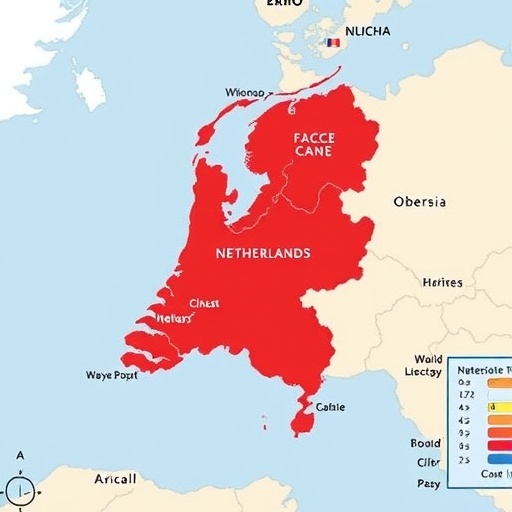
Bologna, Italy — The Netherlands has officially joined the Cherenkov Telescope Array Observatory European Research Infrastructure Consortium (CTAO ERIC) as an Observer, opening a new chapter in the country’s long-running contribution to one of the most ambitious astronomy projects ever conceived. The decision was unanimously approved by the CTAO ERIC Council on 20 July, formalising the Netherlands’ participation at a moment when construction of the observatory’s two giant telescope arrays is accelerating. The move brings the CTAO’s international coalition to 11 countries and one intergovernmental organisation, while strengthening the scientific and engineering links connecting Europe to the future of high-energy astrophysics.
Observer status will initially last three years under the CTAO ERIC statutes. During this period, the Dutch delegation will be entitled to attend meetings of both the Council and the Administrative and Finance Committee. Although Observers do not hold the same decision-making authority as funding Members, their presence allows them to follow strategic discussions, contribute to the observatory’s development and remain closely involved in decisions made during its critical construction phase. For the Netherlands, the arrangement also provides a formal platform from which to evaluate a possible transition toward full membership.
“The Netherlands is pleased to join the CTAO ERIC as an Observer,” said Saskia Matheussen of the Dutch Research Council, known as NWO, who will represent the country on the CTAO ERIC Council. She described the decision as a milestone for a scientific community that has contributed to the CTAO project since its inception in 2007. According to Matheussen, Observer status recognises that sustained involvement and creates a foundation for deeper cooperation with international partners as researchers prepare to exploit the observatory’s unprecedented sensitivity to gamma rays.
The Dutch contribution is not limited to institutional participation. Through NWO, the Netherlands previously served as an Associate Member in the Council of the former CTAO legal entity and provided multi-year financial support during the project’s pre-construction phase. With earlier and continuing in-kind contributions combined, Dutch support now amounts to approximately €3 million. In-kind contributions are especially valuable for a large scientific infrastructure because they provide specialised hardware, software and technical expertise directly, rather than only financial resources.
Backed by grants from NWO and the Netherlands Research School for Astronomy, NOVA, Dutch researchers are supplying hardware for the CTAO’s Medium-Sized Telescopes and co-producing more than 37 cameras for its Small-Sized Telescopes. These instruments are central to the observatory’s ability to detect very-high-energy gamma rays. Dutch teams are responsible for assembling focal-plane arrays, coordinating software development and participating in testing, calibration and commissioning. The focal plane is the camera’s light-sensitive core, where faint flashes generated by gamma-ray interactions in Earth’s atmosphere are converted into electronic signals that can be reconstructed into astronomical events.
The CTAO will detect gamma rays indirectly rather than collecting them like ordinary visible light. When a high-energy gamma ray enters Earth’s atmosphere, it can trigger a cascade of secondary particles travelling faster than the speed of light in air. These particles produce a brief blue flash called Cherenkov light. The observatory’s cameras and mirrors will capture that flash, allowing scientists to calculate the direction and energy of the original gamma ray. By combining signals from multiple telescopes, researchers can distinguish genuine cosmic events from background particle showers and create detailed maps of violent objects across the universe.
Dutch scientists have helped build the intellectual infrastructure behind this effort as well. Jacco Vink and Sera Markoff of the University of Amsterdam have led initiatives to expand interest in the CTAO within the Netherlands, later joined by Manuela Vecchi and Andrey Baryshev of the University of Groningen. Markoff previously coordinated the CTAO Consortium’s Multiwavelength/Multimessenger Working Group, while Vecchi served as coordinator of its Dark Matter Working Group and is now the consortium’s Physics Coordinator. Their work links the observatory’s engineering programme to research questions involving black holes, neutron stars, cosmic particles and the nature of dark matter.
Once fully operational, the CTAO will cover an energy range from approximately 20 gigaelectronvolts to 300 teraelectronvolts, extending far beyond the capabilities of conventional optical telescopes. More than 60 telescopes are planned across two sites: CTAO-North at the Roque de los Muchachos Observatory on La Palma, Spain, and CTAO-South at the European Southern Observatory’s Paranal Observatory in Chile’s Atacama Desert. The northern and southern locations will provide broad access to the sky, enabling the observatory to investigate sources ranging from nearby remnants of stellar explosions to distant active galaxies powered by supermassive black holes.
The scientific payoff could be substantial. Gamma rays trace some of the most extreme environments known, including regions where magnetic fields accelerate particles to near-light speed and compact objects release enormous amounts of energy. CTAO observations are expected to help determine how cosmic rays are produced, examine the physics surrounding black holes and neutron stars, search for signatures of dark matter and test whether the laws of relativity remain valid under the most intense conditions. Its rapid response and high sensitivity will also support multimessenger astronomy, in which gamma-ray observations are combined with gravitational waves, neutrinos and other forms of astronomical evidence.
Francisco Colomer, Chair of the CTAO ERIC Council, said the unanimous approval reflected the respect held for the Netherlands’ technical and scientific contribution. Stuart McMuldroch, Director General of the CTAO ERIC, added that formally bringing Dutch representatives into the governance structure would help ensure their expertise continues to shape the observatory. The Netherlands now joins Austria, Croatia, the Czech Republic, ESO, France, Germany, Italy, Poland, Slovenia, Spain and Switzerland as part of the CTAO’s funding membership, while Australia, Brazil, Japan, South Africa and the United States are engaged as potential Strategic Partners or Third Parties. Together, these participants are building an open, proposal-driven facility designed to generate vast quantities of data and make high-level scientific products publicly accessible, potentially transforming the study of the most energetic phenomena in the cosmos.
News Publication Date: 20 July
Web References: https://www.ctao.org/organisation/governance/; https://www.ctao.org/emission-to-discovery/telescopes/mst/; https://www.ctao.org/emission-to-discovery/telescopes/sst/; https://www.ctao.org/; https://www.ctao.org/emission-to-discovery/science/study-themes/
Keywords
CTAO, Cherenkov Telescope Array Observatory, gamma-ray astronomy, Netherlands, NWO, NOVA, astrophysics, cosmic rays, dark matter, black holes, neutron stars, multimessenger astronomy, high-energy physics, observatories
Cite Scienmag News
Grant Pearson. (August 1, 2026). Netherlands Joins CTAO ERIC as Observer. Scienmag. https://scienmag.com/netherlands-joins-ctao-eric-as-observer/
Grant Pearson. "Netherlands Joins CTAO ERIC as Observer." Scienmag, 1 August 2026, https://scienmag.com/netherlands-joins-ctao-eric-as-observer/. Accessed 3 September 2026.
Grant Pearson. "Netherlands Joins CTAO ERIC as Observer." Scienmag. August 1, 2026. https://scienmag.com/netherlands-joins-ctao-eric-as-observer/


