


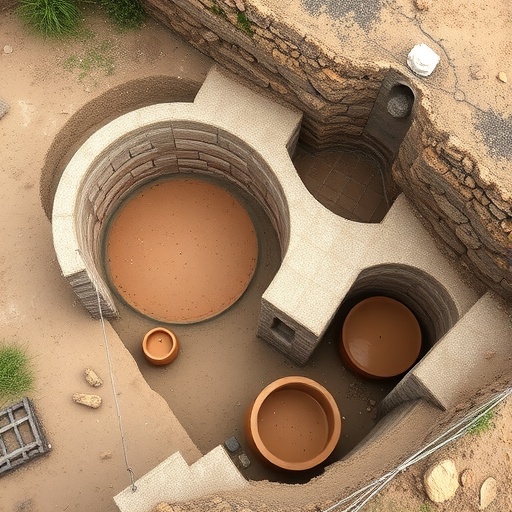
Archaeologists have uncovered two Roman-period pottery kilns at the Asten archaeological site near Burg, in the municipality of Hannersdorf, Austria, revealing what may be one of the largest known local production centres for utilitarian pottery in the region. The discovery follows several years of archaeological investigation prompted by construction work, and researchers believe that as many as 100 additional kilns remain buried beneath nearby fields. The production complex appears to have operated from the middle of the first century to the middle of the second century CE, when the Roman Empire was expanding its economic networks across Central Europe.
The site first attracted attention in 2021, when construction work on the B56 Geschriebenstein Straße exposed Roman pottery fragments and structural remains. Archaeologists subsequently carried out geomagnetic surveys, a non-invasive technique that detects contrasts in the magnetic properties of buried features. Fired clay, ash, stone and other materials associated with kilns often create strong magnetic anomalies, allowing researchers to map underground archaeological structures without disturbing them. At Asten, these surveys revealed a dense concentration of kilns, building foundations, pits and flattened burial mounds beneath agricultural land.
A recent educational excavation directed by Basema Hamarneh of the University of Vienna has now confirmed that at least some of the detected anomalies are ancient pottery kilns. Within the first two weeks of excavation, the team documented two kilns, each associated with working pits, as well as additional pits interpreted as clay-extraction areas and waste deposits. The remains were located only about 40 centimetres below the modern ground surface. Their shallow depth makes the site especially vulnerable to agricultural activity and construction, but it has also allowed archaeologists to examine production features that are unusually well preserved.
The kilns and surrounding pits contained substantial quantities of pottery, including bowls, dishes, cups and storage vessels. Their arrangement suggests a coordinated manufacturing operation rather than isolated household production. Roman pottery kilns typically consisted of a firing chamber separated from a combustion area by a perforated floor or supporting structure. Hot gases circulated through the pottery chamber, allowing vessels to be fired at controlled temperatures. The presence of multiple kilns, working spaces and waste pits indicates that the Asten community had access to organised labour, fuel, clay and distribution networks necessary to sustain repeated or large-scale firing.
Among the most important discoveries are vessels preserved almost entirely, alongside numerous defective pieces that failed during manufacture. Such wasters can be more informative than perfect objects because they record the technical problems encountered by ancient potters. Cracks, warping, incomplete firing and accidental fusion can reveal how vessels were stacked, how heat moved through a kiln and whether firing temperatures were stable. The combination of complete vessels and production waste gives researchers an opportunity to reconstruct the entire manufacturing process, from clay preparation and shaping to drying, firing and disposal.
The material also points to connections extending beyond the immediate area. Archaeologists recovered imported Terra Sigillata, the finely made, often red-slipped tableware that circulated widely across the Roman world. These imports demonstrate that the inhabitants of the site participated in broader commercial networks while producing more practical ceramics locally. The absence of a known consumer settlement directly beside the kilns is particularly significant. The nearest major Roman centre was Savaria, in present-day Szombathely, Hungary, approximately 16 kilometres away as the crow flies. A production facility of this scale may therefore have supplied communities across a wider territory rather than serving only a nearby village.
The discovery is also changing perceptions of Roman economic activity in what is now Burgenland. The region has sometimes been described as peripheral to the Roman Empire, yet the pottery complex suggests that it was integrated into systems of manufacturing, exchange and consumption. Locally produced utilitarian vessels could have supported households, farms, military or administrative sites and urban markets. Their distribution may eventually be traced through chemical and mineralogical analyses of the clay, which can compare the composition of pottery with geological sources and help identify where vessels were made and where they were used.
Evidence from much earlier periods indicates that the location offered favourable conditions for human activity long before the Roman occupation. Surface finds include Neolithic pottery fragments and traces of post-built longhouses dating to the sixth millennium BCE. Although these remains are not directly connected to the Roman workshops, they show that the area had attracted settlement thousands of years earlier. Access to suitable clay, water, fuel, transport routes and relatively stable ground may have made the landscape repeatedly valuable for both habitation and production.
Geomagnetic data have also identified features about 1.5 kilometres away that appear to be outliers of the Hallstatt and Roman-period Schandorf burial mound field. Together with the Neolithic and Roman evidence, these discoveries suggest that the wider landscape was a long-term hub of human activity. Excavations at Asten will continue until 7 August, and researchers expect further finds as they investigate the buried production zone. Each kiln, waster and imported vessel could help reveal how Roman communities in the region organised labour, managed technology and participated in trade, offering a more detailed picture of an economically active Central European landscape.
Cite Scienmag News
Courtney Benton. (August 1, 2026). Unprecedented Excavation Uncovers Roman-Era Pottery Kilns in Burgenland. Scienmag. https://scienmag.com/unprecedented-excavation-uncovers-roman-era-pottery-kilns-in-burgenland/
Courtney Benton. "Unprecedented Excavation Uncovers Roman-Era Pottery Kilns in Burgenland." Scienmag, 1 August 2026, https://scienmag.com/unprecedented-excavation-uncovers-roman-era-pottery-kilns-in-burgenland/. Accessed 4 September 2026.
Courtney Benton. "Unprecedented Excavation Uncovers Roman-Era Pottery Kilns in Burgenland." Scienmag. August 1, 2026. https://scienmag.com/unprecedented-excavation-uncovers-roman-era-pottery-kilns-in-burgenland/


