



view more
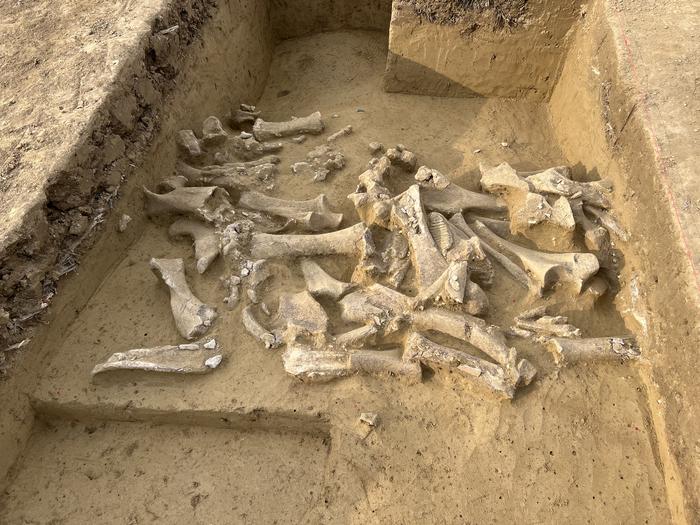
Credit: Marc Händel/Austrian Academy of Sciences
Analysing ancient DNA of over 500 mammoth bones, an international team of researchers found that Ice Age humans selectively targeted female woolly mammoths. The results of the study, published in Current Biology, show that in contrast to the sex ratio among naturally occurring woolly mammoth remains, large bone accumulations associated with ancient human activity are dominated by females.
“Whether these massive mammoth bone accumulations were formed naturally or by human hunting has been debated for decades”, says David Díez del Molino, Researcher at the Centre for Palaeogenetics and co-senior author of the study. “By comparing the genetic sex ratios of hundreds of mammoths from natural settings with those found in these archaeological contexts, we can now infer that human activity was the primary driver behind these bone accumulations.”
Divergent sex ratios in different contexts
The team analysed genome data from 521 woolly mammoths across Eurasia and North America, including 448 individuals sequenced for the first time. Genetic sex inference revealed a striking contrast depending on where the remains were found. Mammoth remains recovered from dispersed, natural settings were mostly male (34 per cent female: 66 per cent male), consistent with the idea that solitary males were more likely to die in natural traps (for example sinkholes or landslides), thereby increasing the chance of long-term bone preservation. In contrast, mammoths from accumulation sites were predominantly female (70 per cent female: 30 per cent male). These results raised questions about how Ice Age hunter-gatherers interacted with mammoths.
“We know that Upper Palaeolithic hunter-gatherers sometimes hunted mammoths directly, as evidenced by projectile points embedded in mammoth bones, and they may also have scavenged material from carcasses”, says Jarosław Wilczyński, archaeologist at the Institute of Systematics and Evolution of Animals of the Polish Academy of Sciences.
“While it is tempting to assume that hunters would have targeted females because they were smaller than adult males, the reality may have been more complex. If mammoths behaved like modern elephants, females living in matriarchal herds may have had group defences that would have made encounters with herds equally or even more risky. Another possibility is that female-led herds moved across the landscape in more predictable ways than solitary males, meaning Upper Palaeolithic hunter-gatherers may simply have encountered them more frequently, whether for hunting or scavenging”, says Hannah M. Moots, Postdoctoral Researcher at the Centre for Palaeogenetics and lead author of the study.
Reconstructing Ice Age human-mammoth interactions
Mammoths were a vital resource for Ice Age human populations, providing meat, fat, hide and bones for building structures, and ivory for tools, art, and ornaments. The mammoth bone accumulations included in the study span eleven key Ice Age archaeological sites across Eurasia, dating to roughly 30,000–20,000 years ago. By combining 100 individuals from these human-associated site accumulations with 421 mammoths from natural depositional settings, the team analysed a large dataset of woolly mammoths across Eurasia and North America. This unprecedented scale provides a rare look at how ancient humans and woolly mammoths interacted across the Late Pleistocene.
“This research demonstrates the power of ancient DNA studies to answer long-standing archaeological questions”, says Love Dalén, Professor in Evolutionary Genomics at Stockholm University, co-senior author of the study. “By scaling up sample sizes, ancient DNA can go beyond evolutionary history to teach us about animal behaviour and human culture tens of thousands of years ago.”
A rare genetic discovery in an extinct species
The researchers identified one mammoth from Wrangel Island that was neither XX (biologically female) nor XY (biologically male). Instead, this individual had a different sex chromosome combination known as X0/XX mosaicism, where the individual has a single copy of the X chromosome in some cells, and two in others. In humans, this is known as Turner syndrome. This is the first time that this has been documented in an extinct species.
Article
“Palaeogenomic sex inference of mammoth remains sheds light on the anthropogenic nature of bone accumulations” Moots et al., Current Biology. DOI: 10.1016/j.cub.2026.07.023.
Media folder
https://drive.google.com/drive/folders/1xgnCOUDFYX204h3kmpY2IB1n9eJ3har7?usp=sharing
Journal
Current Biology
Subject of Research
Animal tissue samples
Article Title
Palaeogenomic sex inference of mammoth remains sheds light on the anthropogenic nature of bone accumulations
Article Publication Date
30-Jul-2026
COI Statement
The authors declare no competing interests.
Karin Tjulin
Stockholm University
Office: 08-16 46 63
Cell: 070-754 15 54
Journal
Current Biology
Subject of Research
Animal tissue samples
Article Title
Palaeogenomic sex inference of mammoth remains sheds light on the anthropogenic nature of bone accumulations
Article Publication Date
30-Jul-2026
COI Statement
The authors declare no competing interests.
Cite Scienmag News
Gabrielle Wells. (July 30, 2026). Ancient DNA reveals Ice Age humans preferred female mammoths. Scienmag. https://scienmag.com/ancient-dna-reveals-ice-age-humans-preferred-female-mammoths/
Gabrielle Wells. "Ancient DNA reveals Ice Age humans preferred female mammoths." Scienmag, 30 July 2026, https://scienmag.com/ancient-dna-reveals-ice-age-humans-preferred-female-mammoths/. Accessed 3 September 2026.
Gabrielle Wells. "Ancient DNA reveals Ice Age humans preferred female mammoths." Scienmag. July 30, 2026. https://scienmag.com/ancient-dna-reveals-ice-age-humans-preferred-female-mammoths/

