



view more
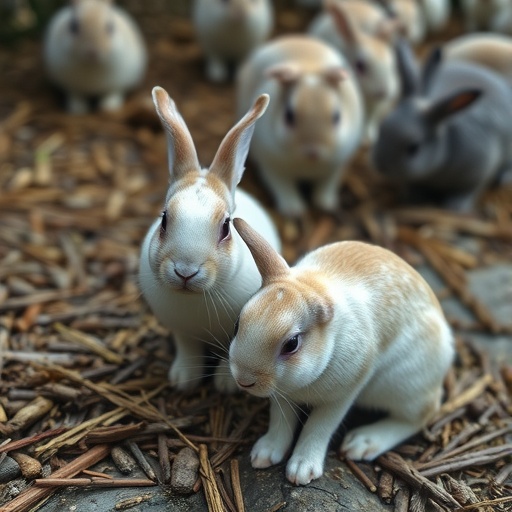
Credit: Eri Kondo
Feeding wild animals is a popular activity at tourist destinations. While these interactions often appear harmless, scientists are recognizing how these supplemental feeding of wild animals can alter the ecosystem in unexpected ways. These activities not only affect the animals that are being fed but also other species that share the same environment. A similar effect is unfolding at the Okunoshima Island in Hiroshima Prefecture, Japan. Okunoshima attracts large numbers of visitors each year who come to interact with its free-ranging rabbits. However, researchers now suggest that the intensive feeding by tourists may be contributing to broader ecological changes on the island.
The study grew out of a collaboration with the creators of the children’s picture book Usagi no Shima (Rabbit Island; Eri Kondo & Hiroshi Tateno, Sekaibunka, 2025). At their request, researchers from Fukushima University set out to investigate the origins of the island’s rabbit population and document the status of local wildlife. The study was authored by Professor Shingo Kaneko from the Faculty of Symbiotic Systems Science and Engineering, Fukushima University, Japan, and co-authored by Associate Professor Asami Ogura from the Faculty of Humanities and Social Sciences, National Institute of Technology (KOSEN), Kure College, Japan, in collaboration with researchers from Kobe College, and was published in the Journal of Ecotourism on 29 July 2026.
“When we first heard that a wild boar had preyed on a live rabbit, we were surprised,” explains Dr. Kaneko. “Wild boars are known to scavenge animal carcasses, but they are not generally regarded as animals that actively hunt live prey.”
“At the same time, during our fieldwork, we were struck by how closely wild boars, rabbits, and humans were interacting on the island. Within this isolated environment, events unlike those we usually observe elsewhere appeared to be occurring throughout the island.”
Unlike native Japanese hares, the rabbits on Okunoshima are European domestic rabbits that were introduced to the island and have since become established there. Their population is considered to be largely supported by the food provided by tourists, allowing rabbit numbers to exceed what the island’s natural environment could otherwise support. This is evident from the previous observations, which show that the rabbit abundance dramatically increased before the COVID-19 pandemic, but it declined when tourism temporarily decreased. This underscores the dependence of the island’s rabbit population on human provisioning.
Notably, the ecological effects of this artificial support are also visible throughout the island. Heavy grazing by rabbits has altered the vegetation structure of the island, producing a distinct “rabbit line,” where much of the low-growing vegetation and lower tree branches have been eaten away by rabbits. These environmental changes indicate that the island has already been experiencing ecological pressures associated with the unnaturally high rabbit population.
However, the researchers propose that these conditions are also promoting unusual interactions among different animal species. They observed wild boars consuming leftover rabbit food, scavenging rabbit carcasses, and demonstrating occasional predation attempts on live rabbits. While the study does not conclude predation as the central issue, it highlights the symptoms of ecological changes driven by long-term supplemental feeding.
According to the authors, several mechanisms might be occurring simultaneously. “Food left by tourists may be attracting wild boars into the areas heavily populated by rabbits. High rabbit densities may increase the availability of rabbit carcasses and may also lead to frequent encounters between the two species,” notes Dr. Kaneko. These factors together could be encouraging the behaviors that are rarely observed under natural conditions.
Moreover, the effects may extend beyond wild boars. Other opportunistic species, including crows and black kites, have also been observed to exploit leftover food and animal remains on the island, suggesting that tourist feeding may be influencing ecological networks more broadly.
The authors emphasize that their study does not suggest that wildlife tourism is harmful. Rather, it indicates that the feeding practices during the tourism should be carefully managed and monitored to avoid unintended consequences for the ecosystem. The researchers recommend establishing a long-term management framework for Okunoshima. Suggested measures include regulating feeding practices and food sales, monitoring rabbit populations and vegetation recovery, and analyzing the impacts on other wildlife species. Additionally, promoting cooperation among local communities, tourism operators, researchers, and government agencies could help establish effective strategies for wildlife tourism and animal welfare.
About Fukushima University
Popularly referred to as “Fukudai,” Fukushima University is a national university with a main campus in Kanayagawa, Fukushima Prefecture. It was established in 1949 and consists of five faculties—Human Development and Culture, Administration and Social Sciences, Economics and Business Administration, Symbiotic Systems Science, and Food and Agricultural Sciences—and four graduate schools —Regional Design, Professional Teacher Education, Symbiotic Systems Science and Technology, and Food and Agricultural Science. Approximately 4,500 students study on the campus, while actively engaging in extracurricular activities such as clubs, circles, and volunteer activities.
Fukushima University attaches great importance to education and aims to produce graduates who can take up the challenge of addressing problems in modern society. The university’s educational philosophy is “education based on problem solving.” Learning at Fukushima University is not limited to the acquisition of systematic knowledge from books. The students undergo holistic development by going out into the community, where they talk with residents and gain experiences that allow them to develop their own approach to identifying problems in the real world.
Website:
About Professor Shingo Kaneko from Fukushima University
Shingo Kaneko is a Professor at the Faculty of Symbiotic Systems Science at Fukushima University, Japan. He earned his doctoral degree from Hiroshima University in 2008. His research interests include molecular ecology, conservation ecology, biodiversity and systematics, and conservation genetics, with a particular focus on understanding the ecology and evolutionary history of wild organisms through DNA analysis. He has authored more than 120 scientific publications and has contributed extensively to research on wildlife conservation and biodiversity management. Through his research, he aims to promote the conservation and sustainable management of wild animals and plants.
About Associate Professor Asami Ogura from the National Institute of Technology (KOSEN), Kure College
Asami Ogura is an Associate Professor in the Faculty of Humanities and Social Sciences at the National Institute of Technology (KOSEN), Kure College, Japan. She holds a Doctor of Philosophy from Hiroshima University. Her research interests include ecology and environmental science, environmental conservation, international peacebuilding, and supporting children with foreign roots. She has authored more than 36 scientific publications on topics including environmental sustainability, sustainable tourism, and biodiversity conservation. Through her research, she seeks to develop sustainable approaches that balance human activities with the conservation of ecosystems and wildlife.
Journal
Journal of Ecotourism
Method of Research
Observational study
Subject of Research
Animals
Article Title
Wild boar predation on feral rabbits in a tourist-fed island population: ecological and management implications from Okunoshima Island, Japan
Article Publication Date
29-Jul-2026
COI Statement
No potential conflict of interest was reported by the authors.
Public Relation Section
Fukushima University
kouho@adb.fukushima-u.ac.jp
Journal
Journal of Ecotourism
Method of Research
Observational study
Subject of Research
Animals
Article Title
Wild boar predation on feral rabbits in a tourist-fed island population: ecological and management implications from Okunoshima Island, Japan
Article Publication Date
29-Jul-2026
COI Statement
No potential conflict of interest was reported by the authors.
Tags
Cite Scienmag News
Drew Townsend. (July 30, 2026). Beyond bunny tourism: the hidden consequences of unregulated feeding of rabbits on Okunoshima Island. Scienmag. https://scienmag.com/beyond-bunny-tourism-the-hidden-consequences-of-unregulated-feeding-of-rabbits-on-okunoshima-island/
Drew Townsend. "Beyond bunny tourism: the hidden consequences of unregulated feeding of rabbits on Okunoshima Island." Scienmag, 30 July 2026, https://scienmag.com/beyond-bunny-tourism-the-hidden-consequences-of-unregulated-feeding-of-rabbits-on-okunoshima-island/. Accessed 4 September 2026.
Drew Townsend. "Beyond bunny tourism: the hidden consequences of unregulated feeding of rabbits on Okunoshima Island." Scienmag. July 30, 2026. https://scienmag.com/beyond-bunny-tourism-the-hidden-consequences-of-unregulated-feeding-of-rabbits-on-okunoshima-island/

