


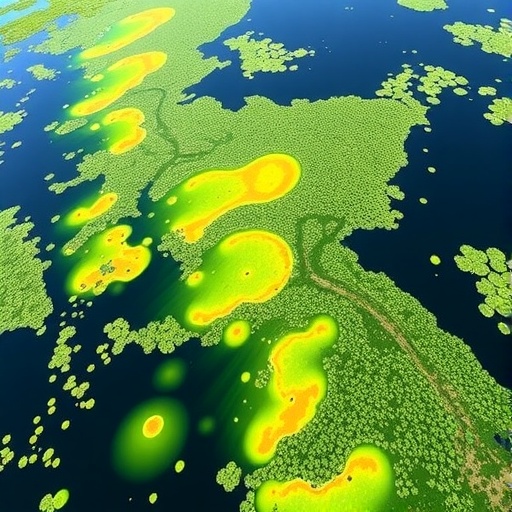

BloomNet enables interpretable early warning of harmful algal blooms.
view more
Credit: Environmental Science and Ecotechnology
A research team has developed BloomNet, an interpretable deep-learning framework that forecasts harmful algal blooms at hourly resolution up to 72 hours ahead while also showing how risk changes over time. Rather than issuing a single yes-or-no alert, the model produces probabilistic forecasts that distinguish routine, elevated, and high-risk conditions. It also identifies which environmental signals matter most at different lead times, revealing a shift from short-term temperature control to medium-term nutrient influence. By combining accuracy, uncertainty estimates, and built-in explanations, the approach could give water managers more time to prepare, target monitoring, and match interventions to the level of risk.
Harmful algal blooms are becoming more frequent and widespread as warming, eutrophication, agricultural runoff, aquaculture, and wastewater alter freshwater ecosystems. Once a bloom is visible, treatment can be costly, ineffective, or environmentally disruptive, making early warning essential. Yet many forecasting systems work at daily or weekly resolution, rely on fixed thresholds, or return only one predicted value without showing uncertainty. Deep-learning models may improve accuracy, but their decision processes often remain difficult to interpret, especially when drivers change rapidly before bloom onset. These gaps point to a need for in-depth research to develop high-frequency forecasting systems that quantify risk and explain when and why harmful algal blooms may emerge.
The study was conducted by researchers from Beijing Institute of Technology, China University of Mining and Technology, and the Research Center for Eco-Environmental Sciences of the Chinese Academy of Sciences. Published (DOI: 10.1016/j.ese.2026.100733) online on July 21, 2026, in Environmental Science and Ecotechnology, the work introduces BloomNet as a multi-horizon forecasting system for harmful algal blooms. The model combines historical water-quality observations with environmental information available over the forecast window, producing hourly algal-density predictions for the next 24, 48, and 72 hours together with interpretable indicators of uncertainty and ecological drivers.
The researchers trained and tested BloomNet using monitoring records from Datong Lake, a eutrophic freshwater lake in Hunan Province, China. The dataset covered January 2019 to October 2022 and included algal density and 10 water-quality variables, such as water temperature, chlorophyll a concentration, dissolved oxygen, total phosphorus, total nitrogen, turbidity, and pH. BloomNet uses a variable-selection network to rank changing environmental influences, a long short-term memory (LSTM) encoder-decoder to learn temporal patterns, masked attention to identify critical historical periods, and quantile forecasting to generate the 10th, 50th, and 90th percentile outcomes. Compared with LSTM, Transformer, and temporal convolutional network (TCN) baselines, BloomNet achieved the lowest 24-hour mean absolute percentage error (MAPE) of 25.7% and maintained the lowest error at 72 hours, with a MAPE of 34.6%. Its coefficient of determination (R²) reached 0.78 at short lead times. The upper 90th-percentile forecasts also improved bloom recall, helping reduce missed events despite producing more false alarms. The model also revealed horizon-specific drivers: water temperature dominated 24-hour forecasts, total phosphorus became most influential at 48 hours, and dissolved oxygen carried greater weight at 72 hours. Distinct attention patterns appeared up to 48 hours before bloom onset, offering an interpretable signal of ecological transition.
The authors said the central advance is not simply predicting algal density, but turning the forecast into a practical picture of changing risk. They said managers need to know whether a bloom is merely possible, increasingly likely, or strongly supported by several signals, because each situation calls for a different response. By showing both the expected trajectory and the range of plausible outcomes, BloomNet can make uncertainty visible rather than hiding it behind one number. Its built-in attribution tools also help connect model outputs with recognizable environmental processes, making the warning easier for non-specialists to assess and act on.
BloomNet could support a four-level warning system based on its lower, median, and upper quantile forecasts. A low-level alert could trigger denser sampling and equipment checks, while stronger signals could justify staff mobilization, public advisories, temporary water-intake restrictions, or other locally approved measures. The 24-hour forecast is suited to urgent response, the 24-hour window allows resource deployment, and the 72-hour outlook can guide lower-cost preparation. The authors caution that the present findings come from one monitoring station in one lake, so the model must be retrained and validated elsewhere. Future work should add meteorological forecasts, multi-station observations, satellite remote sensing, and spatial models to improve transferability and capture sudden bloom transitions.
###
References
Original Source URL
Funding information
The National Science Fund for Distinguished Young Scholars of China (52425005) and General Program of National Natural Science Foundation of China (52370189).
About Environmental Science and Ecotechnology
Environmental Science and Ecotechnology (ISSN 2666-4984) is an international, peer-reviewed, and open-access journal published by Elsevier. The journal publishes significant views and research across the full spectrum of ecology and environmental sciences, such as climate change, sustainability, biodiversity conservation, environment & health, green catalysis/processing for pollution control, and AI-driven environmental engineering. The latest impact factor of ESE is 14.3, according to the Journal Citation ReportsTM 2024.
Journal
Environmental Science and Ecotechnology
Subject of Research
Not applicable
Article Title
Deep learning decodes multi-horizon dynamics and probabilistic risks of harmful algal blooms
Article Publication Date
21-Jul-2026
COI Statement
The authors declare that they have no competing interests.
Editorial office of Environmental Science and Ecotechnology
Environmental Science and Ecotechnology
ese@chinacses.org
Journal
Environmental Science and Ecotechnology
Subject of Research
Not applicable
Article Title
Deep learning decodes multi-horizon dynamics and probabilistic risks of harmful algal blooms
Article Publication Date
21-Jul-2026
COI Statement
The authors declare that they have no competing interests.
Tags
Cite Scienmag News
Denise Maddox. (July 30, 2026). BloomNet turns lake data into early algal bloom warnings. Scienmag. https://scienmag.com/bloomnet-turns-lake-data-into-early-algal-bloom-warnings/
Denise Maddox. "BloomNet turns lake data into early algal bloom warnings." Scienmag, 30 July 2026, https://scienmag.com/bloomnet-turns-lake-data-into-early-algal-bloom-warnings/. Accessed 3 September 2026.
Denise Maddox. "BloomNet turns lake data into early algal bloom warnings." Scienmag. July 30, 2026. https://scienmag.com/bloomnet-turns-lake-data-into-early-algal-bloom-warnings/

