



view more
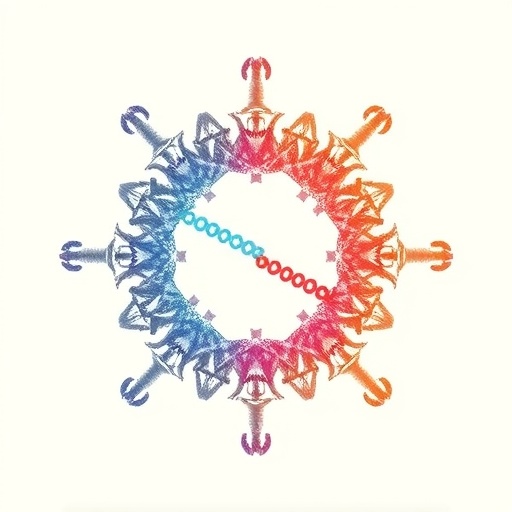
Credit: © Jörg Harms, Zhiyang Zeng (MPSD)
Chirality is an important property of matter. It is defined as a property of objects that cannot be superimposed to their mirror images through any combination of rotations or translations, much like the distinct left and right hands. In chiral crystals, the spatial arrangement of atoms gives rise to a specific handedness, with the crystal structure twisting along one propagation direction in a way similar to a screw. As a consequence, propagation in one direction, for example of an electrical current, may experience different resistance than that propagating in the opposite direction. This effect also influences certain chemical reactions and biological processes, which select for one specific handedness. In this sense, the ability to control chirality on demand, turning a right-handed structure into a left-handed one, is very desirable.
Yet “unlike electrical polarization or magnetization, chirality has lacked a general physical handle for external control,” notes Zhiyang Zeng, first author of this study. The MPSD researchers have now shown that mechanical strain provides precisely such a handle. Rather than synthesizing a chiral material, they begin with a crystal that is not chiral in its unstrained state. Applying strain rearranges the positions of the atoms in the crystal just enough to create a left- or right-handed structure.
To demonstrate this effect, the team monitored the appearance of the crystal’s optical activity – a characteristic signature of chirality – while applying controlled mechanical strain. Remarkably, the handedness of the induced chiral state is determined by the strain conditions. Tensile and compressive strain generate opposite handedness, while applying strain along different crystal directions provides another way to select the resulting chiral state. “Because the deformation is reversible, the induced chirality can be generated, removed, and selected repeatedly,” explains Michael Först, co-author of this publication.
Beyond demonstrating the effect experimentally, the team established a theoretical framework that reveals when crystal symmetry allows this piezochiral effect to occur. They used it to compile an open-access database of candidate materials ( making it possible for researchers worldwide to search for and explore piezochiral crystals.
This work establishes a new strategy for engineering chirality. Instead of being permanently fixed by crystal growth or chemical synthesis, chirality can now be generated, controlled, and switched on demand in an originally achiral material. This is opening new opportunities to control mechanically reconfigurable materials.
“We termed this phenomenon the piezochiral effect,” says Andrea Cavalleri, who led the research in Hamburg (in collaboration with Paolo Radaelli from the University of Oxford). “It enables one to induce chirality in substrates for a large variety of thin films or in bulk materials, and may enable strategies to, for example, create new types of chiral properties such as superconductivity”.
This work received financial support from the Deutsche Forschungsgemeinschaft via the Cluster of Excellence ‘CUI: Advanced Imaging of Matter’. The MPSD is a member of the Center for Free-Electron Laser Science (CFEL), a joint enterprise with DESY and the University of Hamburg.
Journal
Nature
Method of Research
Experimental study
Subject of Research
Not applicable
Article Title
The piezochiral effect
Article Publication Date
29-Jul-2026
Marius Hoffmann
Max Planck Institute for the Structure and Dynamics of Matter
pr@mpsd.mpg.de
Office: 8998 88044
Journal
Nature
Method of Research
Experimental study
Subject of Research
Not applicable
Article Title
The piezochiral effect
Article Publication Date
29-Jul-2026
Cite Scienmag News
Bethany Barker. (July 29, 2026). Mechanical strain creates chirality. Scienmag. https://scienmag.com/mechanical-strain-creates-chirality/
Bethany Barker. "Mechanical strain creates chirality." Scienmag, 29 July 2026, https://scienmag.com/mechanical-strain-creates-chirality/. Accessed 5 September 2026.
Bethany Barker. "Mechanical strain creates chirality." Scienmag. July 29, 2026. https://scienmag.com/mechanical-strain-creates-chirality/

