



view more
Credit: Nicole Wong / ©AMNH
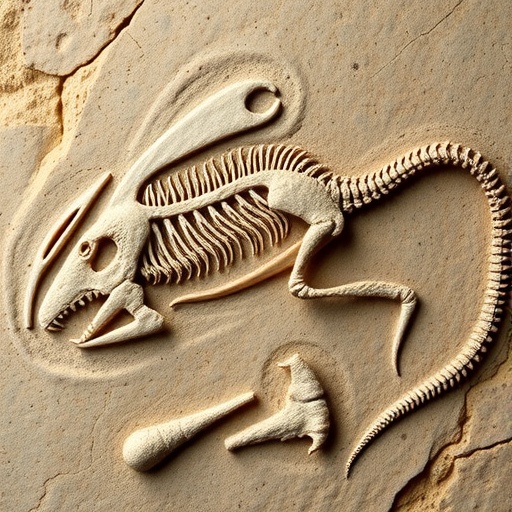
A remarkably preserved fossil from Mongolia’s Gobi Desert is reshaping scientists’ understanding of mammal evolution during the age of dinosaurs. The new species, described today in the journal Nature by a team of scientists from the American Museum of Natural History, Stony Brook University, University of Arizona, and Arcadia University, reveals that a group of extinct mammals known as zhelestids were not close relatives of modern placental mammals as many researchers thought for decades. Instead, they belonged to an entirely different branch of early mammals, overturning a longstanding interpretation based primarily on fossil teeth.
“This discovery illustrates why fieldwork remains indispensable to understanding life’s history,” said the study’s lead author Andres Giallombardo, who found the specimen as a graduate student on a Museum-sponsored expedition in 2004. “It was the thrill of a career to find a new species so completely preserved that also solves a longstanding scientific problem, and a reminder that the Gobi Desert, which is well known for fossils, continues to change science.”
Zhelestids have been known from isolated teeth and fragmentary fossils for nearly 40 years. Their distinctive teeth, which are more specialized for eating plants than the sharp, insect-eating teeth found in many Cretaceous mammals, led paleontologists to suggest that zhelestids represented an unknown group of hoofed mammals. Researchers have debated whether these animals were examples of Cretaceous placental mammals—the group that today includes humans and most living mammals—or a separate lineage that evolved similar features independently. The idea that placental mammals existed during the Cretaceous is supported by molecular clock studies, which suggest that placentals originated long before the end of the Cretaceous.
The fossil described in the new study provides evidence to the contrary.
“Molecular models based on living animals can predict the past, but fossils provide the evidence needed to test those predictions,” said study coauthor Paul Velazco, a comparative biologist at Arcadia University.
Discovered in the eastern Gobi Desert, Tamirkhan balcarceli is the most complete zhelestid found yet and solves the mystery of what this group looked like. Although Tamirkhan possesses the low, rounded teeth characteristic of zhelestids, it also has long, ever-growing incisors and a suite of distinctive skull features found in a group of small, shrew-like insectivore mammals called zalambdalestoids. In addition, “Tamirkhan’s hind legs are long and slender with distinctive ankles, traits that are unmistakably zalambdalestoid,” said study author Shawn Zack, a paleontologist at the University of Arizona.
Based on these findings, the researchers conclude that zhelestids were not placental mammals or particularly placental-like, but a subset of the zalambdalestoid group. The discovery also shows that the mammal species in the Cretaceous were not as anatomically diverse as might have been anticipated based on the teeth alone. Their distinctive rounded teeth—common to plant-eating mammals—is likely a case of convergent evolution, where unrelated animals evolve similar traits because they adapt to similar lifestyles.
“More than 200 years ago, French naturalist Georges Cuvier famously argued that a single tooth could allow scientists to predict the anatomy of an entire animal,” said study coauthor Maureen O’Leary, a paleontologist at Stony Brook University and research associate at the Museum. “While teeth remain among the most informative fossils available, this work demonstrates that teeth cannot always tell us how the whole animal looked.”
Measuring between 6-7 inches from head to tail, Tamirkhan had elongated hind limbs that gave it an almost rabbit-like appearance. Paleontologists have sometimes informally referred to zhelestids as “Cretaceous rabbits,” because they were rabbit mimics despite their distant relationship to modern rabbits.
The specimen itself illustrates the extraordinary scientific importance of the Gobi Desert, which, in addition to Kazakhstan, Kyrgyzstan, Uzbekistan is one of the few fossil locations to preserve zhelestids.
“The Gobi is one of the only places where we routinely recover such remarkably complete Cretaceous mammals,” said coauthor Michael Novacek, a curator in the Museum’s Division of Paleontology who has co-led annual expeditions to the Gobi since 1990 in partnership with the Mongolian Academy of Sciences. “These extraordinary fossils continue to transform our understanding of mammalian evolution.”
The study’s evolutionary conclusions were made possible through a comprehensive mammalian phylogenetic research platform called MorphoBank. First published in 2013, the database has expanded over more than a decade to include an ever-growing number of key fossil species, providing the most comprehensive framework yet assembled for analyzing early mammal relationships.
Other authors on this study include Eva Hoffman from Yale University.
The Gobi Desert field and laboratory research for this study was supported in part by the Margaret and Will Hearst Paleontological Research Fund and the Frick Laboratory Endowment at the Museum. This research was also supported by the U.S. National Science Foundation, grant numbers MRI-R2 0959384, EAR 2506729, and EAR 2506727.
Study DOI: 10.1038/s41586-026-10861-5
ABOUT THE AMERICAN MUSEUM OF NATURAL HISTORY (AMNH)
The American Museum of Natural History in New York City, founded in 1869 with a dual mission of scientific research and science education, is one of the world’s preeminent scientific, educational, and cultural institutions. The Museum encompasses more than 40 permanent exhibition halls, galleries for temporary exhibitions, the Rose Center for Earth and Space including the Hayden Planetarium, and the Richard Gilder Center for Science, Education, and Innovation. The Museum’s scientists draw on a world-class permanent collection of more than 30 million specimens and objects, some of which are billions of years old, and on one of the largest natural history libraries in the world. Through its Richard Gilder Graduate School, the Museum offers two of the only free-standing, degree-granting programs of their kind at any U.S. museum: the Ph.D. program in Comparative Biology and the Master of Arts in Teaching (MAT) Earth Science residency program. Visit amnh.org for more information.
Journal
Nature
Kendra Snyder
American Museum of Natural History
ksnyder@amnh.org
Office: 212-496-3419
Journal
Nature
Tags
Cite Scienmag News
Gavin Prescott. (July 29, 2026). New Gobi fossil rewrites a chapter of mammal evolution. Scienmag. https://scienmag.com/new-gobi-fossil-rewrites-a-chapter-of-mammal-evolution/
Gavin Prescott. "New Gobi fossil rewrites a chapter of mammal evolution." Scienmag, 29 July 2026, https://scienmag.com/new-gobi-fossil-rewrites-a-chapter-of-mammal-evolution/. Accessed 3 September 2026.
Gavin Prescott. "New Gobi fossil rewrites a chapter of mammal evolution." Scienmag. July 29, 2026. https://scienmag.com/new-gobi-fossil-rewrites-a-chapter-of-mammal-evolution/

