

Wednesday, July 29, 2026
Science
No Result
View All Result
  • Login
  • HOME
  • SCIENCE NEWS
  • CONTACT US
  • HOME
  • SCIENCE NEWS
  • CONTACT US
No Result
View All Result
Scienmag
No Result
View All Result
Home Science News Chemistry

Pusan National and Chung-Ang Develop Next-Gen Self-Renewing Air Filter Coating

July 29, 2026
in Chemistry
Reading Time: 2 mins read
0
Pusan National and Chung-Ang Develop Next-Gen Self-Renewing Air Filter Coating

Pusan National and Chung-Ang Develop Next-Gen Self-Renewing Air Filter Coating

65
SHARES
587
VIEWS
Share on FacebookShare on Twitter
ADVERTISEMENT

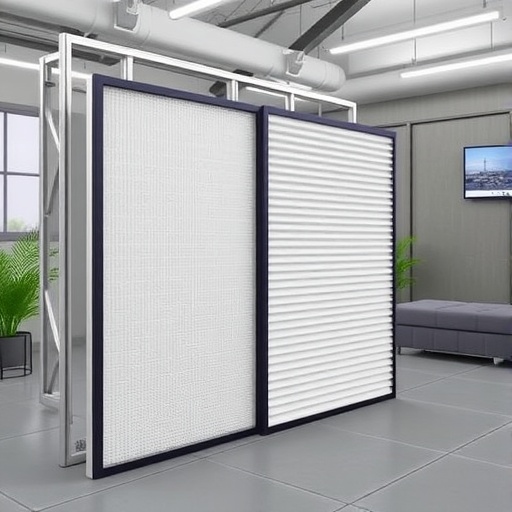
Breathing clean air depends on filters that do more than trap particles—they must hold them. In many conventional systems, captured dust can loosen under airflow and mechanical disturbances, which lowers filtration efficiency, shortens service life, and forces more frequent replacement. The bottleneck is not capture alone, but durable retention of what the filter catches.

A research team led by Professor Sanghyuk Wooh and Professor Chae Bin Kim has introduced a dynamic imine bond adhesive (DIBA) designed to keep airborne particles embedded. The concept is to marry solid-like stability with liquid-like adhesion, so the filter surface can “refresh” itself while working.

The coating is built by crosslinking polydimethylsiloxane (PDMS) via dynamic Schiff base chemistry. This chemistry enables bond exchange at the interface, allowing adhesive sites to reorganize over time rather than degrade into inert residue. The result is a coating that is both mechanically robust and chemically active.

When sprayed onto commercially available filter media, the DIBA layer behaves like an internal reservoir of stickiness. As particles are collected, they are drawn into the adhesive film rather than remaining only on the exterior fibers. Capillary-driven wetting then forms adhesive bridges around individual particulates, increasing the real contact area that governs holding strength.

Performance tests combined chemical, mechanical, and interfacial characterization—rheology, FTIR, atomic force microscopy, and microscopy—with filtration trials. The coating boosted particle adhesion dramatically, approaching a nearly seventy-fold improvement compared with typical behavior. Importantly, the adhesive renewal process helps counteract the gradual loss of attachment that plagues standard filters.

Filtration efficiency improved by roughly 10–30% across multiple commercial materials, without raising pressure drop. The upgrade is significant in practical terms: one reported shift is from MERV 6 toward MERV 11, indicating better capture at the same airflow penalty.

The coated filters also sustained operation under high-speed airflow (up to 20 m/s) and delayed pore clogging. By maintaining effective particulate capture for longer intervals, the DIBA approach extended filter lifespan by nearly a factor of two relative to conventional designs.

Because DIBA is applied through simple spray-coating, it is compatible with existing manufacturing and retrofit workflows. The researchers highlight applications ranging from HVAC and air purifiers to cleanrooms, industrial dust collectors, automotive cabin filters, and personal protective equipment.

More broadly, the work suggests a platform for next-generation filtration where energy use and replacement schedules improve simultaneously. The dynamic adhesive strategy could be adapted to other separations, including water purification and environmental remediation, wherever particles need to be captured and kept immobilized.


Subject of Research: Not applicable
Article Title: A Super-Adhesive Air Filter With Capillarity-Mediated Spontaneous Particle Absorption via Dynamic Bond Exchange
News Publication Date: 22-Apr-2026
Web References: https://doi.org/10.1002/adma.202600006
References: DOI: 10.1002/adma.202600006
Image Credits: Professor Sanghyuk Wooh from Chung-Ang University, Republic of Korea and Professor Chae Bin Kim from Pusan National University, Republic of Korea

Keywords

Air filtration, dynamic adhesive chemistry, Schiff base, PDMS, particle retention, capillarity, MERV, particulate matter, surface engineering, polymers

Tags: advanced coating for air filtersair filter material innovationcapillary wetting in filter designdurable particle retention in air filtrationdynamic imine bond adhesive for filtersfilter lifespan extension through chemical bondinghigh-efficiency particle capturenext-generation air filtration materialspolydimethylsiloxane (PDMS) in filter coatingsSchiff base chemistry in filtrationself-cleaning filter surface technologySelf-renewing air filter coating
Share26Tweet16
Previous Post

CHEST Critical Care Achieves First Ever Impact Factor

Next Post

Bioengineered Approaches to Probe and Modulate the Aging Immune System

Related Posts

New Einstein puzzle variant uncovers surprising physics
Chemistry

New Einstein puzzle variant uncovers surprising physics

July 29, 2026
Framework predicts how temperature affects toxic VOC emissions from paint sludge
Chemistry

Framework predicts how temperature affects toxic VOC emissions from paint sludge

July 29, 2026
Cellulose‑Enabled Hydrovoltaic Energy Generation: Molecular Design to Device Integration
Chemistry

Cellulose‑Enabled Hydrovoltaic Energy Generation: Molecular Design to Device Integration

July 29, 2026
Dynamic Nanopore Breathing Boosts Efficiency for Molecule Separation and Diffusion
Chemistry

Dynamic Nanopore Breathing Boosts Efficiency for Molecule Separation and Diffusion

July 28, 2026
Astronomers Present Strongest Evidence Yet That Betelgeuse Has a Companion
Chemistry

Astronomers Present Strongest Evidence Yet That Betelgeuse Has a Companion

July 28, 2026
Cryogenic environment enables strong strain tuning of excitons in ZrSe3
Chemistry

Cryogenic environment enables strong strain tuning of excitons in ZrSe3

July 28, 2026
Next Post
Bioengineered Approaches to Probe and Modulate the Aging Immune System

Bioengineered Approaches to Probe and Modulate the Aging Immune System

  • Mothers who receive childcare support from maternal grandparents show more

    Mothers who receive childcare support from maternal grandparents show more parental warmth, finds NTU Singapore study

    27656 shares
    Share 11059 Tweet 6912
  • University of Seville Breaks 120-Year-Old Mystery, Revises a Key Einstein Concept

    1061 shares
    Share 424 Tweet 265
  • Bee body mass, pathogens and local climate influence heat tolerance

    682 shares
    Share 273 Tweet 171
  • Researchers record first-ever images and data of a shark experiencing a boat strike

    546 shares
    Share 218 Tweet 137
  • Groundbreaking Clinical Trial Reveals Lubiprostone Enhances Kidney Function

    531 shares
    Share 212 Tweet 133
Science

Embark on a thrilling journey of discovery with Scienmag.com—your ultimate source for cutting-edge breakthroughs. Immerse yourself in a world where curiosity knows no limits and tomorrow’s possibilities become today’s reality!

RECENT NEWS

  • Phage Hijacks Bacterial DNA Phosphorothioate Machinery to Evade Ssp Defenses
  • Study shows experience reorganizes content-specific memory traces in macaques
  • Psychological Research Rises in U.S. Policy Documents on Education, Health, Justice
  • Widespread Tropical Cyclones During the Late Paleozoic Ice Age

Categories

  • Agriculture
  • Anthropology
  • Archaeology
  • Athmospheric
  • Biology
  • Biotechnology
  • Blog
  • Bussines
  • Cancer
  • Chemistry
  • Climate
  • Earth Science
  • Editorial Policy
  • Marine
  • Mathematics
  • Medicine
  • Pediatry
  • Policy
  • Psychology & Psychiatry
  • Science Education
  • Social Science
  • Space
  • Technology and Engineering

Subscribe to Blog via Email

Enter your email address to subscribe to this blog and receive notifications of new posts by email.

Join 5,147 other subscribers

© 2025 Scienmag - Science Magazine

Welcome Back!

Login to your account below

Forgotten Password?

Retrieve your password

Please enter your username or email address to reset your password.

Log In
No Result
View All Result
  • HOME
  • SCIENCE NEWS
  • CONTACT US

© 2025 Scienmag - Science Magazine

Discover more from Science

Subscribe now to keep reading and get access to the full archive.

Continue reading
