


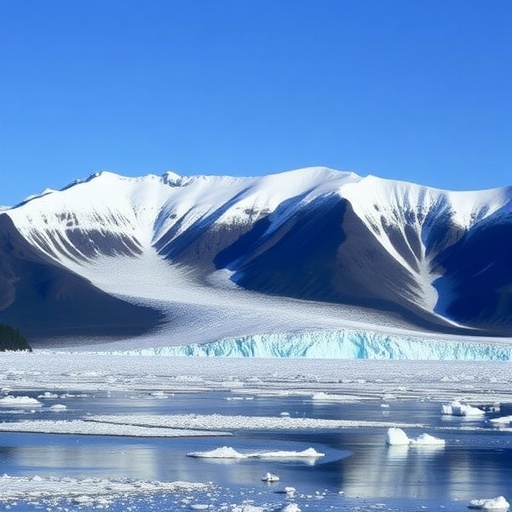
Scientists have reported that Pine Island Glacier in West Antarctica has undergone measurable, long-term changes in response to ice-shelf regrounding—an understudied process in which floating ice intermittently recontacts the seafloor. The new study, published in Nature Communications in 2026, analyzes how this “on-and-off” contact has influenced glacier flow over roughly two decades.
Using satellite observations and a physics-based modeling framework, the team reconstructed the glacier’s evolving velocity patterns and the geometry of the grounding zone. They combine time-variable surface motion with constraints on ice thickness and grounding line behavior, allowing them to separate short-lived perturbations from persistent dynamical adjustments.
A key finding is that intermittent regrounding does not simply pause ice loss. Instead, each grounding event triggers a transient reconfiguration of stress and flow speed, followed by partial recovery. Over repeated cycles, the glacier exhibits a net shift in its dynamic state, indicating that the grounding zone acts like a regulator that can gradually reshape the glacier’s response to ocean forcing.
The researchers describe how basal conditions respond to regrounding: when the ice shelf grounds, it alters the transmission of stress from the floating portion into the grounded ice. That change can temporarily strengthen or weaken the “buttressing” effect, which controls how efficiently the ice shelf restrains inland flow.
Their results also suggest that ocean-driven melting and circulation effects remain critical, but the timing and duration of grounding determine whether the glacier dampens or amplifies those signals. In other words, the ocean provides the energy, while regrounding modulates how that energy propagates inland through ice dynamics.
Importantly, the study frames regrounding as a feedback mechanism rather than a background detail. As grounding zones migrate and re-establish contact, the glacier’s internal stress balance shifts, producing a dynamic response that accumulates across years.
From a forecasting perspective, these findings imply that Antarctic sea-ice and shelf stability assessments should incorporate grounding-zone intermittency. Ignoring this process could lead to underestimating the range of possible glacier behaviors during periods of changing ocean temperatures and tides.
The work highlights Pine Island Glacier as a natural laboratory for understanding stability transitions, especially in regions where ice shelves frequently experience episodic contact with the seabed. With continued observations and improved models, the researchers argue that predictions for sea-level rise will be more reliable when regrounding dynamics are explicitly represented.
Cite Scienmag News
Violet Maxwell. (July 29, 2026). Pine Island Glacier Shows Dynamic Response to Two Decades of Ice Shelf Regrounding. Scienmag. https://scienmag.com/pine-island-glacier-shows-dynamic-response-to-two-decades-of-ice-shelf-regrounding/
Violet Maxwell. "Pine Island Glacier Shows Dynamic Response to Two Decades of Ice Shelf Regrounding." Scienmag, 29 July 2026, https://scienmag.com/pine-island-glacier-shows-dynamic-response-to-two-decades-of-ice-shelf-regrounding/. Accessed 3 September 2026.
Violet Maxwell. "Pine Island Glacier Shows Dynamic Response to Two Decades of Ice Shelf Regrounding." Scienmag. July 29, 2026. https://scienmag.com/pine-island-glacier-shows-dynamic-response-to-two-decades-of-ice-shelf-regrounding/


