

Wednesday, July 29, 2026
Science
No Result
View All Result
  • Login
  • HOME
  • SCIENCE NEWS
  • CONTACT US
  • HOME
  • SCIENCE NEWS
  • CONTACT US
No Result
View All Result
Scienmag
No Result
View All Result
Home Science News Psychology & Psychiatry

Temporal Interference Stimulation Advances Noninvasive Deep Brain Stimulation Paradigm

July 29, 2026
in Psychology & Psychiatry
Reading Time: 2 mins read
0
Temporal Interference Stimulation Advances Noninvasive Deep Brain Stimulation Paradigm

Temporal Interference Stimulation Advances Noninvasive Deep Brain Stimulation Paradigm

65
SHARES
587
VIEWS
Share on FacebookShare on Twitter
ADVERTISEMENT

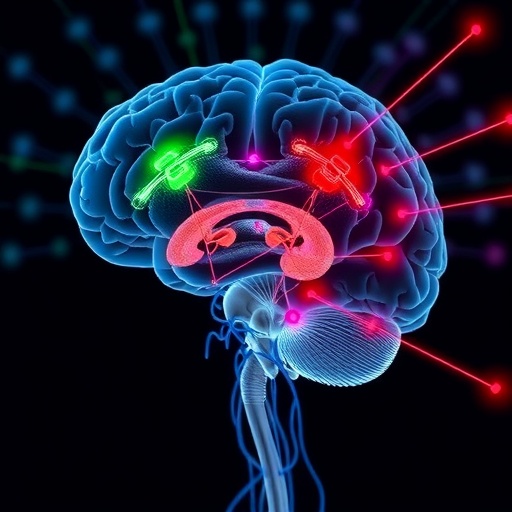
A new wave of research is challenging one of the biggest constraints in deep brain stimulation: the need to invasively implant electrodes. In a 2026 study in Translational Psychiatry, researchers describe “temporal interference stimulation,” a non-invasive approach designed to target deep brain structures using carefully engineered electrical patterns.

The core idea is deceptively simple but technically precise. Two high-frequency electrical currents are delivered through electrodes placed on the scalp. Individually, these rapidly oscillating signals are intended to be relatively ineffective at producing strong neural effects. However, when the two waves overlap inside the head, their timing difference generates a much lower “envelope” frequency only at the intersection region.

Because that envelope frequency emerges at the location where both currents interfere, the method offers a form of spatial focusing. In other words, the brain area where the timing mismatch converges becomes the functional target, potentially allowing stimulation of deep circuits without directly driving activity along the entire current path.

Mechanistic analyses in the paper connect the approach to how neurons integrate inputs and how interference patterns can reshape the effective stimulus perceived by tissue. This framework helps explain why certain parameter choices—such as carrier frequency and amplitude balance—may widen the usable targeting window while limiting off-target activation.

Beyond theory, the study outlines clinical momentum and future direction. The authors emphasize that progress will depend on validating safety across stimulation parameters, confirming reproducibility across individuals, and clarifying how anatomical variability affects the interference hotspot.

Early clinical enthusiasm is tempered by the practical need for rigorous dose mapping. The electrical environment inside the skull is complex, influenced by tissue conductivity and head geometry, meaning that treatment planning must be individualized to reliably place the low-frequency modulation where it matters most.

If these engineering and translational hurdles are met, temporal interference stimulation could become a powerful alternative for patients who are poor candidates for invasive surgery. Potential applications include neuromodulation strategies aimed at circuit-level dysfunction, where precise deep targeting is often critical.

The work also positions temporal interference stimulation within a broader trend: designing stimulation “codes” that separate where energy goes from what brain activity ultimately experiences. With that separation, non-invasive neuromodulation may shift from coarse field effects toward circuit-selective control.

For now, the study’s message is clear: deep brain stimulation may not need implants to reach deep targets. Instead, it may need smarter waveforms—timing, frequency, and interference—programmed to make the brain “listen” only at the intended site.

Subject of Research: Deep brain stimulation; non-invasive neuromodulation; temporal interference stimulation.

Article Title: Temporal interference stimulation: A new paradigm for non-invasive deep brain stimulation—mechanistic insights, clinical advances, and future directions.

Article References: Wang, W., Florian, M., Ling, C. et al. (2026). Translational Psychiatry. https://doi.org/10.1038/s41398-026-04263-4

Image Credits: AI Generated

DOI: https://doi.org/10.1038/s41398-026-04263-4

Tags: advanced neuromodulation methodsbrain circuit modulation techniquesbrain stimulation technologyelectrical brain stimulationhigh-frequency electrical currentsinterference pattern neural targetingneural input integrationnoninvasive deep brain stimulationnoninvasive neural modulationspatial focusing in brain stimulationtargeted deep brain therapytemporal interference stimulation
Share26Tweet16
Previous Post

Continental Inorganic Halogens Shape Global Air Quality Evolution

Next Post

Mizzou Researchers Find Simple Habit to Boost Physical and Mental Health

Related Posts

Cholinergic Basal Forebrain Control of Glymphatic Flow May Affect Depression
Psychology & Psychiatry

Cholinergic Basal Forebrain Control of Glymphatic Flow May Affect Depression

July 28, 2026
Mechanisms Connecting Gut Microbiome to Causality in Psychiatric Disorders
Psychology & Psychiatry

Mechanisms Connecting Gut Microbiome to Causality in Psychiatric Disorders

July 28, 2026
Study Uncovers Neuroinflammation Mechanisms, Biomarkers, and Treatments for Long COVID
Psychology & Psychiatry

Study Uncovers Neuroinflammation Mechanisms, Biomarkers, and Treatments for Long COVID

July 28, 2026
Single-Cell Transcriptomics Reveals Cerebral Cortex Adaptations to High Altitude in Pigs
Psychology & Psychiatry

Single-Cell Transcriptomics Reveals Cerebral Cortex Adaptations to High Altitude in Pigs

July 28, 2026
High IQ and ADHD show separable patterns of inattention and impulsivity
Psychology & Psychiatry

High IQ and ADHD show separable patterns of inattention and impulsivity

July 28, 2026
Meta-analysis Identifies Brain Functional Changes Linked to Suicidal Ideation
Psychology & Psychiatry

Meta-analysis Identifies Brain Functional Changes Linked to Suicidal Ideation

July 28, 2026
Next Post
Mizzou Researchers Find Simple Habit to Boost Physical and Mental Health

Mizzou Researchers Find Simple Habit to Boost Physical and Mental Health

  • Mothers who receive childcare support from maternal grandparents show more

    Mothers who receive childcare support from maternal grandparents show more parental warmth, finds NTU Singapore study

    27656 shares
    Share 11059 Tweet 6912
  • University of Seville Breaks 120-Year-Old Mystery, Revises a Key Einstein Concept

    1061 shares
    Share 424 Tweet 265
  • Bee body mass, pathogens and local climate influence heat tolerance

    682 shares
    Share 273 Tweet 171
  • Researchers record first-ever images and data of a shark experiencing a boat strike

    546 shares
    Share 218 Tweet 137
  • Groundbreaking Clinical Trial Reveals Lubiprostone Enhances Kidney Function

    531 shares
    Share 212 Tweet 133
Science

Embark on a thrilling journey of discovery with Scienmag.com—your ultimate source for cutting-edge breakthroughs. Immerse yourself in a world where curiosity knows no limits and tomorrow’s possibilities become today’s reality!

RECENT NEWS

  • Expert panel issues recommendations for VA to address intimate partner violence
  • Expert Panel Issues Recommendations for VA to Address Intimate Partner Violence
  • Cell Junction Proteins Control Stem Cells Through a New Tissue Homeostasis Mechanism
  • Resistance Training Triggers Muscle Repair Machinery

Categories

  • Agriculture
  • Anthropology
  • Archaeology
  • Athmospheric
  • Biology
  • Biotechnology
  • Blog
  • Bussines
  • Cancer
  • Chemistry
  • Climate
  • Earth Science
  • Editorial Policy
  • Marine
  • Mathematics
  • Medicine
  • Pediatry
  • Policy
  • Psychology & Psychiatry
  • Science Education
  • Social Science
  • Space
  • Technology and Engineering

Subscribe to Blog via Email

Enter your email address to subscribe to this blog and receive notifications of new posts by email.

Join 5,147 other subscribers

© 2025 Scienmag - Science Magazine

Welcome Back!

Login to your account below

Forgotten Password?

Retrieve your password

Please enter your username or email address to reset your password.

Log In
No Result
View All Result
  • HOME
  • SCIENCE NEWS
  • CONTACT US

© 2025 Scienmag - Science Magazine

Discover more from Science

Subscribe now to keep reading and get access to the full archive.

Continue reading
