


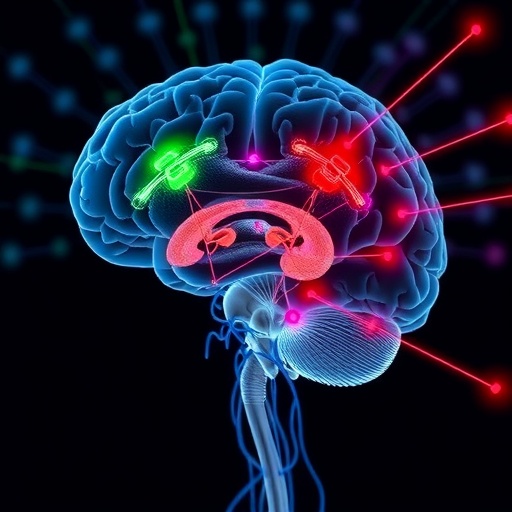
A new wave of research is challenging one of the biggest constraints in deep brain stimulation: the need to invasively implant electrodes. In a 2026 study in Translational Psychiatry, researchers describe “temporal interference stimulation,” a non-invasive approach designed to target deep brain structures using carefully engineered electrical patterns.
The core idea is deceptively simple but technically precise. Two high-frequency electrical currents are delivered through electrodes placed on the scalp. Individually, these rapidly oscillating signals are intended to be relatively ineffective at producing strong neural effects. However, when the two waves overlap inside the head, their timing difference generates a much lower “envelope” frequency only at the intersection region.
Because that envelope frequency emerges at the location where both currents interfere, the method offers a form of spatial focusing. In other words, the brain area where the timing mismatch converges becomes the functional target, potentially allowing stimulation of deep circuits without directly driving activity along the entire current path.
Mechanistic analyses in the paper connect the approach to how neurons integrate inputs and how interference patterns can reshape the effective stimulus perceived by tissue. This framework helps explain why certain parameter choices—such as carrier frequency and amplitude balance—may widen the usable targeting window while limiting off-target activation.
Beyond theory, the study outlines clinical momentum and future direction. The authors emphasize that progress will depend on validating safety across stimulation parameters, confirming reproducibility across individuals, and clarifying how anatomical variability affects the interference hotspot.
Early clinical enthusiasm is tempered by the practical need for rigorous dose mapping. The electrical environment inside the skull is complex, influenced by tissue conductivity and head geometry, meaning that treatment planning must be individualized to reliably place the low-frequency modulation where it matters most.
If these engineering and translational hurdles are met, temporal interference stimulation could become a powerful alternative for patients who are poor candidates for invasive surgery. Potential applications include neuromodulation strategies aimed at circuit-level dysfunction, where precise deep targeting is often critical.
The work also positions temporal interference stimulation within a broader trend: designing stimulation “codes” that separate where energy goes from what brain activity ultimately experiences. With that separation, non-invasive neuromodulation may shift from coarse field effects toward circuit-selective control.
For now, the study’s message is clear: deep brain stimulation may not need implants to reach deep targets. Instead, it may need smarter waveforms—timing, frequency, and interference—programmed to make the brain “listen” only at the intended site.
Cite Scienmag News
Cassandra Pierce. (July 29, 2026). Temporal Interference Stimulation Advances Noninvasive Deep Brain Stimulation Paradigm. Scienmag. https://scienmag.com/temporal-interference-stimulation-advances-noninvasive-deep-brain-stimulation-paradigm/
Cassandra Pierce. "Temporal Interference Stimulation Advances Noninvasive Deep Brain Stimulation Paradigm." Scienmag, 29 July 2026, https://scienmag.com/temporal-interference-stimulation-advances-noninvasive-deep-brain-stimulation-paradigm/. Accessed 3 September 2026.
Cassandra Pierce. "Temporal Interference Stimulation Advances Noninvasive Deep Brain Stimulation Paradigm." Scienmag. July 29, 2026. https://scienmag.com/temporal-interference-stimulation-advances-noninvasive-deep-brain-stimulation-paradigm/


