


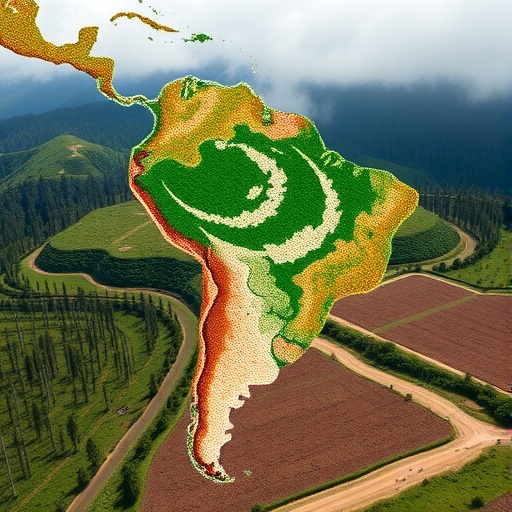
A new study warns that South America’s soil moisture is not governed only by local rainfall. Using satellite observations and model-based diagnostics, researchers show that what happens upstream on land—often far from where drought or wetness is measured—can quietly reshape moisture conditions downstream across entire climate zones. The findings, published in Nature Communications, highlight a large-scale atmospheric “memory” effect tied to terrestrial processes.
The team analyzed spatial patterns of soil moisture variability and traced how atmospheric flow carries moisture-related signals across the continent. Instead of treating soil moisture as an isolated product of local precipitation, they investigated how prevailing winds transport influence from upwind regions. This approach reframes soil moisture dynamics as a networked phenomenon, driven by atmospheric circulation pathways.
Technically, the study links soil moisture anomalies to wind-direction-dependent variability. In many regions, surface wetness or dryness modulates evapotranspiration, which then alters humidity and boundary-layer conditions. As air masses move, these altered conditions can reinforce or dampen subsequent soil moisture swings over distant areas.
To strengthen the causal interpretation, the authors compared variability patterns against expected upwind influence under observed circulation. They report that correlations weaken when wind direction does not align with the hypothesized transport routes, suggesting the signal is not merely coincidental. In other words, the continent’s hydrologic variability is partially “steered” by airflow that carries land-surface impacts.
The work also helps explain why similar rainfall totals can produce different soil moisture outcomes in separate regions. If upstream land conditions change the air’s moisture supply and evaporative demand, downstream soil layers respond in ways that are not captured by precipitation alone. This is especially relevant for ecosystems that rely on soil water stability.
From a forecasting perspective, the results imply that seasonal predictions and drought monitoring could benefit from incorporating upstream terrestrial states. Soil moisture observatories and land-surface models may need to emphasize connectivity—how distant regions collectively set the stage for local extremes.
Importantly, the study’s continental scale means the mechanism may be sensitive to climate-change-driven circulation shifts. If wind patterns shift, the balance of upwind influence could change, producing new “hydrologic teleconnections” across South America.
In short, South America’s soil moisture variability emerges from a travel route: land processes upstream tune the atmosphere, and the atmosphere tunes the land again downstream. It’s a reminder that drought and wetness are rarely purely local—and that the next generation of climate intelligence should follow the winds.
Cite Scienmag News
Violet Maxwell. (July 28, 2026). Upwind Land Effects Drive Soil Moisture Variability Across South America. Scienmag. https://scienmag.com/upwind-land-effects-drive-soil-moisture-variability-across-south-america/
Violet Maxwell. "Upwind Land Effects Drive Soil Moisture Variability Across South America." Scienmag, 28 July 2026, https://scienmag.com/upwind-land-effects-drive-soil-moisture-variability-across-south-america/. Accessed 3 September 2026.
Violet Maxwell. "Upwind Land Effects Drive Soil Moisture Variability Across South America." Scienmag. July 28, 2026. https://scienmag.com/upwind-land-effects-drive-soil-moisture-variability-across-south-america/


