


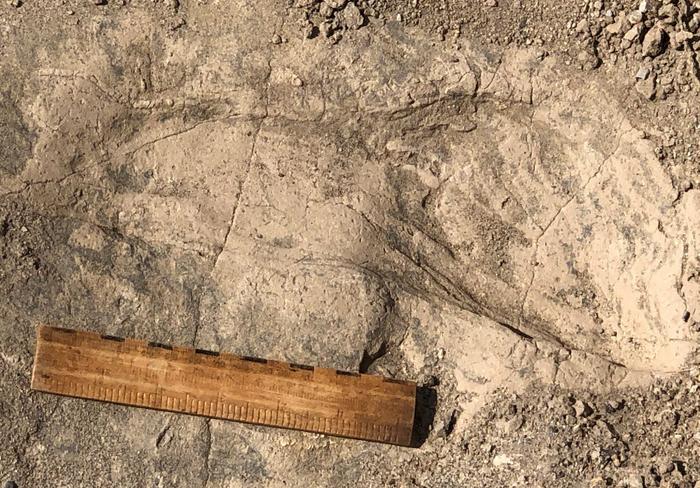
Eight fossil trackways from northern Kenya have been re-read as a rare, moment-by-moment record of how an extinct human relative moved and lived. Researchers report that the prints belong to Paranthropus boisei, a species often known from its massive jaws and teeth—leaving its lower-body anatomy largely uncharted. The new evidence comes from lakeshore deposits dating to roughly 1.4 million years ago, where ancient sediments preserved footprints with unusual clarity.
What makes the discovery stand out is the apparent synchronicity of the group. The trackways indicate that eight individuals were present in the same place and time, and—based on footprint size distributions and trackway geometry—most appear to be adults. Several of the prints are interpreted as belonging to relatively large-bodied animals, implying human-like proportions rather than the smaller stature some earlier reconstructions had suggested from scarce skeletal material.
Using analytical methods developed by the team, the researchers distinguish P. boisei tracks from other potential hominin makers by examining foot anatomy signatures and locomotion patterns. These same approaches let them translate surface traces into estimates of stature and mass. The result is surprising: some individuals may have been up to about 1.8 meters tall and around 75 kilograms, expanding the known range of body size for P. boisei.
The study also treats the trackways as behavioral data. The pattern of overlapping routes suggests the group traveled together rather than as isolated walkers. In particular, the absence of footprints interpreted as smaller individuals leads the authors to propose a group composition dominated by adult males. Such a social arrangement would fit scenarios in which males compete for mates while still tolerating one another in a risky lakeshore environment.
Lakes themselves emerge as more than scenery. Across the East Turkana region, multiple sites preserve hundreds of footprints in similar lake margin settings, separated by tens of kilometers but dated to comparable ages. The recurrence of these depositional environments implies that hominins repeatedly returned to the same kinds of habitats over periods exceeding 100,000 years.
The authors argue that the key is understanding why these particular conditions allowed tracks to last. Rapid fossilization at the margin of ancient water bodies can lock in behavior before erosion wipes it away. With enough sites, researchers can begin to reconstruct not just how hominins walked, but where and why they clustered.
A broader “photo album” of the past is now underway. The team plans further fieldwork in Kenya to expand sample sizes and refine locomotion and anatomy reconstructions from footprint morphology. By integrating new analytical pipelines with exceptional trackway preservation, the work turns the ichnological record into a high-resolution window on Early Pleistocene life.
Ultimately, the findings add a missing dimension to the fossil story of Paranthropus boisei: group dynamics. Instead of a species seen only through skulls, P. boisei appears here as a participant in complex social movement—returning again and again to the lake edge, leaving traces that still speak across deep time.
News Publication Date: 27-Jul-2026
Web References: http://dx.doi.org/10.1073/pnas.2530996123
References: 10.1073/pnas.2530996123
Cite Scienmag News
Courtney Benton. (July 27, 2026). Fossil Footprints Reveal Body Size and Group Behavior of 1.4-Million-Year-Old Human Relative. Scienmag. https://scienmag.com/fossil-footprints-reveal-body-size-and-group-behavior-of-1-4-million-year-old-human-relative/
Courtney Benton. "Fossil Footprints Reveal Body Size and Group Behavior of 1.4-Million-Year-Old Human Relative." Scienmag, 27 July 2026, https://scienmag.com/fossil-footprints-reveal-body-size-and-group-behavior-of-1-4-million-year-old-human-relative/. Accessed 4 September 2026.
Courtney Benton. "Fossil Footprints Reveal Body Size and Group Behavior of 1.4-Million-Year-Old Human Relative." Scienmag. July 27, 2026. https://scienmag.com/fossil-footprints-reveal-body-size-and-group-behavior-of-1-4-million-year-old-human-relative/


