


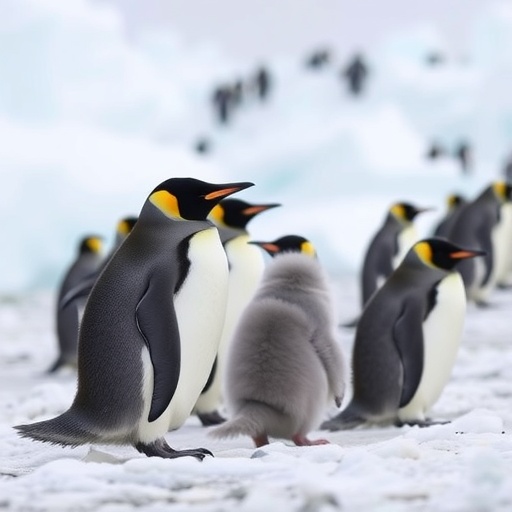
A new study warns that emperor penguin recovery may hinge on factors far beyond food abundance: the movement of icebergs. Researchers examining the Coulman Island colony report that iceberg-driven disruptions can sever the pathways that connect breeding sites to productive foraging zones, translating into sharp reproductive losses.
The team focused on connectivity—the practical link between where chicks are raised and where adults can reliably feed. Using field observations alongside ocean and sea-ice conditions, they identified periods when icebergs and related hazards altered local marine routes, forcing adults to travel farther or wait for safe access.
When connectivity weakened, the consequences were immediate. Chick counts declined severely, consistent with a scenario in which adults could not consistently deliver enough energy-rich prey. Because emperor penguins rely on tightly timed feeding during the chick-rearing phase, even temporary increases in travel time can reduce meal frequency and chick growth.
The authors describe iceberg activity as a physical constraint that reshapes foraging access. Instead of acting only as isolated ice masses, icebergs can reorganize sea-ice structure and influence the availability of open-water patches or prey aggregations used during foraging trips.
Importantly, the study frames these disruptions as a feedback between climate-linked ice dynamics and ecosystem function. As Antarctic ice environments become more variable, iceberg formation and drift may intensify, raising the likelihood of repeated connectivity failures.
The results emphasize that conservation planning cannot treat “sea-ice extent” as the only metric. Even when broader ice conditions appear stable, the presence and trajectory of icebergs can effectively reroute the operational landscape for wildlife.
For emperor penguins, this matters because their breeding strategy depends on predictable access to foraging habitat while chicks are dependent on parental provisioning. Severe chick declines therefore suggest that population trajectories may be sensitive to episodic, connectivity-breaking events.
By tying colony performance to iceberg-driven constraints, the study provides a new lens for interpreting long-term trends in polar breeding success. It also points to the need for monitoring systems that track not just ice coverage but also iceberg behavior and route safety.
Overall, the research highlights how rapidly changing Antarctic physical processes can translate into measurable biological outcomes—underscoring why “viral” attention to polar ice may be warranted for its direct impact on iconic species.
Cite Scienmag News
Violet Maxwell. (July 27, 2026). Iceberg barriers reduce foraging links, causing sharp chick declines in Coulman Island penguins. Scienmag. https://scienmag.com/iceberg-barriers-reduce-foraging-links-causing-sharp-chick-declines-in-coulman-island-penguins/
Violet Maxwell. "Iceberg barriers reduce foraging links, causing sharp chick declines in Coulman Island penguins." Scienmag, 27 July 2026, https://scienmag.com/iceberg-barriers-reduce-foraging-links-causing-sharp-chick-declines-in-coulman-island-penguins/. Accessed 5 September 2026.
Violet Maxwell. "Iceberg barriers reduce foraging links, causing sharp chick declines in Coulman Island penguins." Scienmag. July 27, 2026. https://scienmag.com/iceberg-barriers-reduce-foraging-links-causing-sharp-chick-declines-in-coulman-island-penguins/


