

Monday, July 27, 2026
Science
No Result
View All Result
  • Login
  • HOME
  • SCIENCE NEWS
  • CONTACT US
  • HOME
  • SCIENCE NEWS
  • CONTACT US
No Result
View All Result
Scienmag
No Result
View All Result
Home Science News Chemistry

Tension Builds as Nucleus Escapes Under Pressure

July 27, 2026
in Chemistry
Reading Time: 2 mins read
0
Tension Builds as Nucleus Escapes Under Pressure

Tension Builds as Nucleus Escapes Under Pressure

65
SHARES
587
VIEWS
Share on FacebookShare on Twitter
ADVERTISEMENT

Cells in stretched epithelia don’t simply endure stress—they remodel themselves. In a new study published in Nature Physics, researchers at the Institute for Bioengineering of Catalonia (IBEC) show that prolonged mechanical stretching triggers a dramatic, hours-long reorganization of keratin, the intermediate-filament network that normally fortifies epithelial tissues.

Keratin is known to protect cells from large deformation, but its slow, sustained response to persistent stretching has been unclear. Using engineered epithelial tissue, the team applied controlled long-term stretch with a custom microfluidic device while imaging cells in real time and combining the results with multiscale computational modelling.

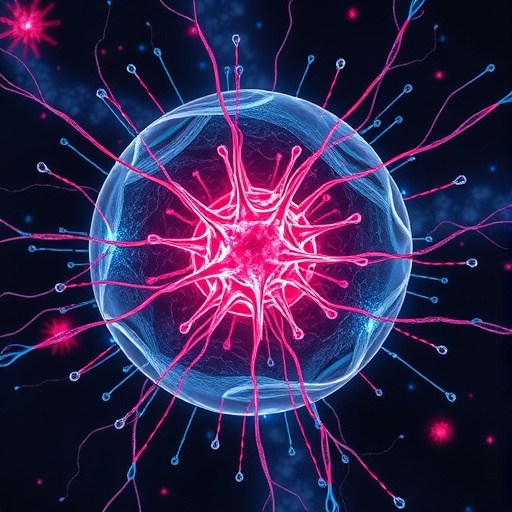
The key discovery is that keratin does not react instantly. Instead, individual keratin filaments gradually transform into thick, star-shaped bundles. These bundles connect neighbouring cells, forming supracellular networks that effectively redistribute stress throughout the tissue rather than isolating it inside single cells.

The structural reorganization begins at cell–cell junctions where three cells meet. There, keratin filaments progressively leave the junctional regions and accumulate into increasingly robust bundles, spreading collectively across the tissue. The process resembles a coordinated “re-braiding” of the cytoskeleton, with initially local changes recruiting surrounding cells into expanding clusters.

Modelling provided the missing link to a second phenomenon: nuclear uncaging. As bundle architecture grows and internal dynamics intensify, forces develop that ultimately push the nucleus out of its protective keratin cage. Live-cell microscopy confirmed the prediction—nuclei detach from the surrounding keratin mesh until separation is complete, leaving only a residual filament connection.

Whether this uncaging protects the nucleus or makes it more vulnerable is a central open question. The study highlights two competing possibilities: exposure to mechanical forces versus reduced force transmission when the nucleus becomes decoupled from an intensely stressed cytoskeletal scaffold.

The work also identifies actin as an important regulator. When molecular links between actin and keratin are weakened, keratin bundling accelerates nearly threefold, indicating that cross-talk between cytoskeletal systems tunes how tissues adapt to sustained stretch.

Taken together, the findings suggest a previously underappreciated adaptation strategy: tissues can preserve resilience not only by stiffening components, but by actively restructuring internal networks and reconfiguring organelle mechanics over long timescales.

Ultimately, this mechanism may help explain how tissues withstand repeated deformation during development and in organs that expand and contract, such as the bladder or mammary gland, and it could inform understanding of diseases where keratin organization is disrupted.

Subject of Research: Cells
Article Title: Dynamics of supracellular keratin bundling and nuclear uncaging in stretched epithelia
News Publication Date: 27-Jul-2026
Web References: https://doi.org/10.1038/s41567-026-03371-8
References: Nature Physics, DOI: 10.1038/s41567-026-03371-8
Image Credits: Institute for Bioengineering of Catalonia (IBEC)

Keywords

Keratin, cytoskeleton, epithelial stretching, supracellular networks, nuclear uncaging, intermediate filaments, mechanobiology, actin-keratin coupling, live-cell imaging, computational modelling

Tags: cell mechanotransductioncell–cell junctions in mechanoprotectioncustom microfluidic devices for tissue stretchingepithelial tissue remodeling under mechanical stressintermediate filament network dynamicskeratin bundle formation and re-braidingkeratin filament reorganizationkeratin-mediated stress distribution in tissueslong-term cellular response to stretchingmultiscale computational modeling of cytoskeletal changesnuclear uncaging in stressed epithelial cellssupracellular stress redistribution
Share26Tweet16
Previous Post

Super Protein Powders Tested for Active Aging Using Artificial Stomach

Next Post

KAIST Develops Antibodies With Cellular “Eyes” to Detect Cancer Mutations

Related Posts

Large-scale crystals may transform next-generation OLED display technology
Chemistry

Large-scale crystals may transform next-generation OLED display technology

July 27, 2026
Ytterbium Thrives as Researchers Celebrate Breakthrough in Science
Chemistry

Ytterbium Thrives as Researchers Celebrate Breakthrough in Science

July 27, 2026
Fabric Enables Multiple Stable Shapes Using Snap-Like Structural Design
Chemistry

Fabric Enables Multiple Stable Shapes Using Snap-Like Structural Design

July 27, 2026
Highly chemoselective access to alkyl-sulfur compounds via N2 extrusion of alkyl hydrazines
Chemistry

Highly chemoselective access to alkyl-sulfur compounds via N2 extrusion of alkyl hydrazines

July 27, 2026
CRISPR Guides Bacteria’s Backup Defenses Like a Commanding Officer
Chemistry

CRISPR Guides Bacteria’s Backup Defenses Like a Commanding Officer

July 27, 2026
KAIST Finds Molecular Switch Activating Cell Growth Signaling for Anticancer Therapy
Chemistry

KAIST Finds Molecular Switch Activating Cell Growth Signaling for Anticancer Therapy

July 26, 2026
Next Post
KAIST Develops Antibodies With Cellular “Eyes” to Detect Cancer Mutations

KAIST Develops Antibodies With Cellular “Eyes” to Detect Cancer Mutations

  • Mothers who receive childcare support from maternal grandparents show more

    Mothers who receive childcare support from maternal grandparents show more parental warmth, finds NTU Singapore study

    27656 shares
    Share 11059 Tweet 6912
  • University of Seville Breaks 120-Year-Old Mystery, Revises a Key Einstein Concept

    1061 shares
    Share 424 Tweet 265
  • Bee body mass, pathogens and local climate influence heat tolerance

    682 shares
    Share 273 Tweet 171
  • Researchers record first-ever images and data of a shark experiencing a boat strike

    546 shares
    Share 218 Tweet 137
  • Groundbreaking Clinical Trial Reveals Lubiprostone Enhances Kidney Function

    531 shares
    Share 212 Tweet 133
Science

Embark on a thrilling journey of discovery with Scienmag.com—your ultimate source for cutting-edge breakthroughs. Immerse yourself in a world where curiosity knows no limits and tomorrow’s possibilities become today’s reality!

RECENT NEWS

  • Engineered Triangular Pockets Efficiently Extract Uranyl Complexes from Water
  • Chlamydomonas chlororibosome reshaped by chloroplast-encoded small subunit extensions
  • Unique sulfatase adaptations enable Akkermansia muciniphila to degrade colonic mucin
  • Hybrid Deep Reconstruction Enables Vignetting-Free Upconversion Imaging Through Scattering

Categories

  • Agriculture
  • Anthropology
  • Archaeology
  • Athmospheric
  • Biology
  • Biotechnology
  • Blog
  • Bussines
  • Cancer
  • Chemistry
  • Climate
  • Earth Science
  • Editorial Policy
  • Marine
  • Mathematics
  • Medicine
  • Pediatry
  • Policy
  • Psychology & Psychiatry
  • Science Education
  • Social Science
  • Space
  • Technology and Engineering

Subscribe to Blog via Email

Enter your email address to subscribe to this blog and receive notifications of new posts by email.

Join 5,146 other subscribers

© 2025 Scienmag - Science Magazine

Welcome Back!

Login to your account below

Forgotten Password?

Retrieve your password

Please enter your username or email address to reset your password.

Log In
No Result
View All Result
  • HOME
  • SCIENCE NEWS
  • CONTACT US

© 2025 Scienmag - Science Magazine

Discover more from Science

Subscribe now to keep reading and get access to the full archive.

Continue reading
