

Monday, July 27, 2026
Science
No Result
View All Result
  • Login
  • HOME
  • SCIENCE NEWS
  • CONTACT US
  • HOME
  • SCIENCE NEWS
  • CONTACT US
No Result
View All Result
Scienmag
No Result
View All Result
Home Science News Cancer

How cells locate their ideal matching partners

July 27, 2026
in Cancer
Reading Time: 2 mins read
0
How cells locate their ideal matching partners

How cells locate their ideal matching partners

65
SHARES
587
VIEWS
Share on FacebookShare on Twitter
ADVERTISEMENT

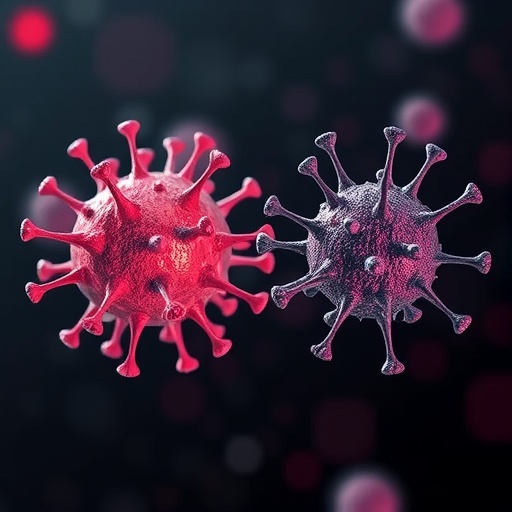
Cells communicate and advertise their identity using extracellular vesicles—microscopic cargo carriers released into bodily fluids. Detecting vesicle signatures from specific cell types, especially cancer, has been a central challenge for liquid biopsies because target particles are scarce and often drowned by background noise.

A team led by researchers at the University of Tokyo reports a strategy to strengthen the “self recognition” behavior of vesicles. Instead of relying on natural surface interactions, they engineered vesicle membranes by decorating them with lanthanide metal ions. This modification creates additional binding interfaces that enhance affinity beyond what cells would typically achieve.

Lanthanides such as europium and terbium form strong associations with sialic acid, a sugar motif abundant on many cancer cell surfaces. By tuning vesicle chemistry to display complementary grip points, the researchers enabled engineered vesicles and matching cells to bind rapidly and selectively, even when vesicles originating from many other cell types are present simultaneously.

The practical outcome is speed and sensitivity. A capture process that previously required more than two days was compressed to roughly three hours, while maintaining high selectivity. In experiments, the enhanced interactions were associated with a large signal boost, supporting detection of extremely low-abundance cancer-related vesicle signals.

To translate the approach beyond cell culture, the team tested their platform in mice and then evaluated it using human triple-negative breast cancer samples. They demonstrated two complementary assay modes: a detector that captures cancer-associated vesicles and a probe vesicle that homes to cancer cells to amplify the readout.

According to the study, the signal amplification can reach on the order of 10,000-fold. With that boost, the method aims to make it feasible to identify even a single cancer cell within complex samples using equipment common to standard laboratory workflows, rather than relying on specialized, high-throughput instrumentation.

Beyond diagnostics, the work suggests a modular design principle for extracellular vesicle engineering. Because the platform modifies vesicles’ surface recognition properties, it could be adapted to improve targeted delivery of therapeutics, investigate cell behavior, or support future biomaterial systems aimed at controlled “cell–vesicle” interactions.

Subject of Research: Cells; extracellular vesicles; cancer detection
Article Title: Super homotypic targeting by surface engineering of extracellular vesicles
News Publication Date: 23-Jul-2026
Web References: https://www.nature.com/articles/s41551-026-01743-2
References: DOI: 10.1038/s41551-026-01743-2; Nature Biomedical Engineering
Image Credits: ©2026 Goda et al. CC-BY-ND

Keywords: extracellular vesicles, lanthanide ions, sialic acid, liquid biopsy, cancer diagnostics, homotypic targeting, signal amplification, Nature Biomedical Engineering, targeted drug delivery

Tags: bioengineering for diagnosticscancer biomarker detectioncell membrane modificationenhanced vesicle binding affinityExtracellular vesicle engineeringlanthanide metal ion decorationliquid biopsy cancer detectionlow-abundance cancer detectionnanoparticle surface chemistryrapid vesicle targetingselectivity in cell communicationvesicle-cell recognition
Share26Tweet16
Previous Post

Large-scale crystals may transform next-generation OLED display technology

Next Post

Thin Films Adaptively Move on Substrates That Are No Longer Inert

Related Posts

KAIST Develops Antibodies With Cellular “Eyes” to Detect Cancer Mutations
Cancer

KAIST Develops Antibodies With Cellular “Eyes” to Detect Cancer Mutations

July 27, 2026
APOBEC3 deficiency reshapes macrophage lipid metabolism, boosting anti-tumor immunity
Cancer

APOBEC3 deficiency reshapes macrophage lipid metabolism, boosting anti-tumor immunity

July 27, 2026
Brain Metabolism Forecasts Survival in Advanced Non–Small Cell Lung Cancer
Cancer

Brain Metabolism Forecasts Survival in Advanced Non–Small Cell Lung Cancer

July 27, 2026
Two Cancer Signaling Pathways Enable More Personalized Treatment for Papillary Thyroid Cancer
Cancer

Two Cancer Signaling Pathways Enable More Personalized Treatment for Papillary Thyroid Cancer

July 27, 2026
Romiplostim Shows Promise for Chemotherapy-Related Thrombocytopenia in Children
Cancer

Romiplostim Shows Promise for Chemotherapy-Related Thrombocytopenia in Children

July 27, 2026
Synthetic glabridin derivative restores salivary function by regulating metabolism and immunity in Sjögren’s
Cancer

Synthetic glabridin derivative restores salivary function by regulating metabolism and immunity in Sjögren’s

July 27, 2026
Next Post
Thin Films Adaptively Move on Substrates That Are No Longer Inert

Thin Films Adaptively Move on Substrates That Are No Longer Inert

  • Mothers who receive childcare support from maternal grandparents show more

    Mothers who receive childcare support from maternal grandparents show more parental warmth, finds NTU Singapore study

    27656 shares
    Share 11059 Tweet 6912
  • University of Seville Breaks 120-Year-Old Mystery, Revises a Key Einstein Concept

    1061 shares
    Share 424 Tweet 265
  • Bee body mass, pathogens and local climate influence heat tolerance

    682 shares
    Share 273 Tweet 171
  • Researchers record first-ever images and data of a shark experiencing a boat strike

    546 shares
    Share 218 Tweet 137
  • Groundbreaking Clinical Trial Reveals Lubiprostone Enhances Kidney Function

    531 shares
    Share 212 Tweet 133
Science

Embark on a thrilling journey of discovery with Scienmag.com—your ultimate source for cutting-edge breakthroughs. Immerse yourself in a world where curiosity knows no limits and tomorrow’s possibilities become today’s reality!

RECENT NEWS

  • KAIST Develops Antibodies With Cellular “Eyes” to Detect Cancer Mutations
  • Tension Builds as Nucleus Escapes Under Pressure
  • Super Protein Powders Tested for Active Aging Using Artificial Stomach
  • Study Reveals New Insights Into Texas Hill Country Floods

Categories

  • Agriculture
  • Anthropology
  • Archaeology
  • Athmospheric
  • Biology
  • Biotechnology
  • Blog
  • Bussines
  • Cancer
  • Chemistry
  • Climate
  • Earth Science
  • Editorial Policy
  • Marine
  • Mathematics
  • Medicine
  • Pediatry
  • Policy
  • Psychology & Psychiatry
  • Science Education
  • Social Science
  • Space
  • Technology and Engineering

Subscribe to Blog via Email

Enter your email address to subscribe to this blog and receive notifications of new posts by email.

Join 5,146 other subscribers

© 2025 Scienmag - Science Magazine

Welcome Back!

Login to your account below

Forgotten Password?

Retrieve your password

Please enter your username or email address to reset your password.

Log In
No Result
View All Result
  • HOME
  • SCIENCE NEWS
  • CONTACT US

© 2025 Scienmag - Science Magazine

Discover more from Science

Subscribe now to keep reading and get access to the full archive.

Continue reading
