


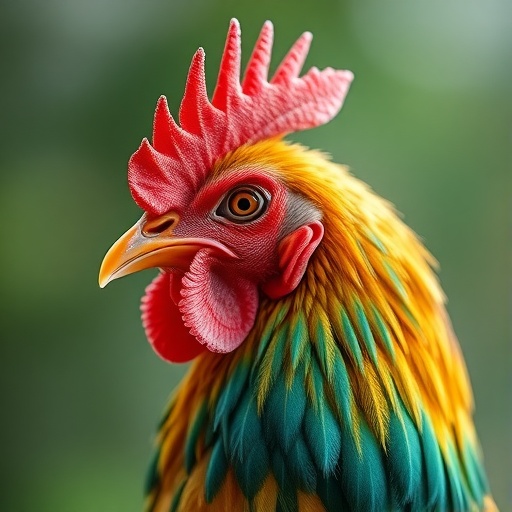
Domestic chickens have long fascinated biologists with their feather diversity—ranging from barred and speckled patterns to uniform black and crisp snowy white. For centuries, selective breeding has rapidly expanded these visible traits. Yet scientists have struggled to explain how such rich variation can arise so quickly from underlying genetic change.
A new analysis by researchers at Texas A&M University’s College of Veterinary Medicine and Biomedical Sciences points to an unexpectedly fast evolutionary mechanism centered on pigmentation. By examining more than 10,000 chicken genomes, the team detected ultrarapid evolution in MC1R, a gene known to control pigment production across vertebrates, including humans.
Rather than a single mutation mapping neatly onto a single phenotype, the study shows that multiple MC1R variants with distinct effects on protein function interact to generate color outcomes. The key insight is that evolutionary novelty can emerge through combinations of mutations, not only through isolated changes.
The researchers cataloged nine mutations within the MC1R locus. Through recombination, these variants were reshuffled into 18 distinct gene versions. Each gene combination altered MC1R activity in ways that corresponded to specific feather colors and pattern classes, expanding the phenotypic spectrum far beyond what would be expected from one-to-one mutation effects.
This combinatorial model reframes “fast evolution” as a process of accumulation plus rearrangement. In other words, selection can quickly enrich multiple mutations in a population, while recombination continually constructs new functional alleles by mixing them across the same gene.
As Dr. Leif Andersson of Texas A&M explains, the result is like moving from simple arithmetic to multiplicative outcomes: if two mutation sites contribute variation, recombination can generate more combinations than adding mutations would suggest. Here, multiple interacting sites effectively amplify diversity over short evolutionary windows.
The work also highlights the power of large genomic datasets. A broad survey of MC1R diversity makes it possible to infer evolutionary dynamics that would remain hidden in smaller samples, providing a “complete picture” of variation at that locus.
Beyond feather plumage, the findings offer a general lesson about how biodiversity may evolve throughout the animal kingdom. The next step, the authors suggest, is to test how common this reshuffling mechanism is across genomes and species—whether in different genomic regions or under different evolutionary regimes.
Cite Scienmag News
Juliet Wilcox. (July 27, 2026). Study uncovers ultrafast gene evolution driving chicken feather color diversity. Scienmag. https://scienmag.com/study-uncovers-ultrafast-gene-evolution-driving-chicken-feather-color-diversity/
Juliet Wilcox. "Study uncovers ultrafast gene evolution driving chicken feather color diversity." Scienmag, 27 July 2026, https://scienmag.com/study-uncovers-ultrafast-gene-evolution-driving-chicken-feather-color-diversity/. Accessed 4 September 2026.
Juliet Wilcox. "Study uncovers ultrafast gene evolution driving chicken feather color diversity." Scienmag. July 27, 2026. https://scienmag.com/study-uncovers-ultrafast-gene-evolution-driving-chicken-feather-color-diversity/


