

Sunday, July 26, 2026
Science
No Result
View All Result
  • Login
  • HOME
  • SCIENCE NEWS
  • CONTACT US
  • HOME
  • SCIENCE NEWS
  • CONTACT US
No Result
View All Result
Scienmag
No Result
View All Result
Home Science News Science Education

Could a Robot Tutor Provide Too Much Help?

July 26, 2026
in Science Education
Reading Time: 2 mins read
0
Could a Robot Tutor Provide Too Much Help?

Could a Robot Tutor Provide Too Much Help?

65
SHARES
587
VIEWS
Share on FacebookShare on Twitter
ADVERTISEMENT

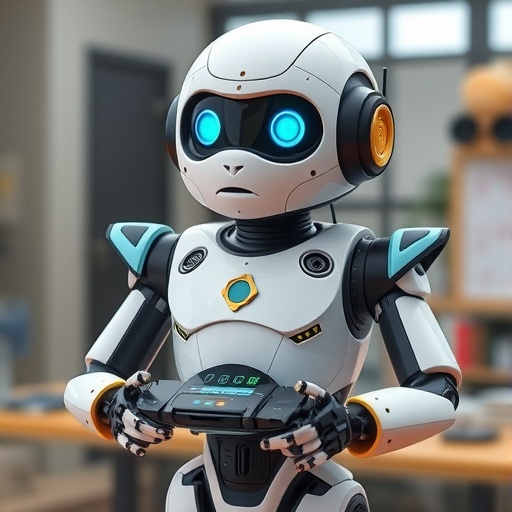
A humanoid robot is often imagined as a future classroom assistant—an ever-patient guide that can personalize learning at scale. But a new experiment from Berlin challenges a popular assumption: that “more targeted” feedback is automatically better, especially right after someone gets something wrong.

In the study, 90 adult learners worked through a step-by-step placement puzzle. A robot tutor delivered instructions in Swahili, a language the participants did not know, forcing them to infer meaning over repeated attempts. After each placement, the robot responded when mistakes occurred—sometimes with brief “wrong” feedback, sometimes with additional hints, and sometimes with reflection prompts.

The researchers compared three feedback strategies that differed in timing and specificity. In one condition, extra information appeared after every error without regard for what the learner needed at that moment. In another, the amount of help was adjusted using recent performance and learners’ self-reported enjoyment. In the most detailed condition, feedback was further personalized to a learner’s error patterns and recent task steps.

The key result was not simply that personalization helps. Detailed, error-specific hints improved overall performance across the entire task, suggesting that accumulated understanding benefits from richer explanations. Yet the same personalized messages reduced effectiveness for the very next response after an error.

The team argues that cognitive load is central. Highly specific feedback tends to be longer and more information-dense. Immediately after failing, learners may have limited capacity to process extra details before attempting the next move. In other words, the “right” information can arrive at the “wrong” moment.

Robot support also depended on who was learning. Learners with higher cognitive ability showed smaller gains from task-focused hints, possibly because they could recover independently. Meanwhile, learners who reported feeling more bored benefited more from additional task-focused guidance, implying that certain kinds of help can re-engage attention.

Overall, the findings point to a dynamic design principle for AI tutors: effective feedback must align with both cognitive and emotional states in real time. Personalization should be paired with an assessment of situational readiness—when a learner can absorb details, and when they need something simpler.

The most intelligent tutor may not be the one that speaks the most, but the one that knows when to say less.

Subject of Research: People
Article Title: Real-time cognitive-affective dynamics of failure feedback in a technology-based learning task
News Publication Date: 12-Jun-2026
Web References: http://dx.doi.org/10.1038/s44271-026-00487-8
References: 10.1038/s44271-026-00487-8
Image Credits: ©SCIoI/Zappner

Keywords: educational robots; AI tutoring; cognitive robotics; failure feedback; personalization; cognitive load; adaptive learning; affective computing; human-robot interaction

Tags: adaptive learning strategiesAI in educationAI-driven educational toolseffects of over-help in tutoringerror-specific hints in tutoringHuman-Robot Interaction in educationhumanoid robot classroom assistantimpact of feedback timinglanguage learning with robotslearner engagement and enjoymentpersonalized feedback in learningrobot tutor
Share26Tweet16
Previous Post

From Cuts and Folds to New Linkages in Science Breakthrough

Next Post

Biochar Assessment Should Focus on Soil Performance, Not Lab Appearance

Related Posts

Chinese Graduate Students Reshape Japanese Universities as Active Partners
Science Education

Chinese Graduate Students Reshape Japanese Universities as Active Partners

July 26, 2026
UL Research Institutes Appoints Elena Zinchenko as Chief Program Development Officer
Science Education

UL Research Institutes Appoints Elena Zinchenko as Chief Program Development Officer

July 17, 2026
E-Nose Diagnostics, Rare Disease Research, and AI Medical Education Tools Emerge
Science Education

E-Nose Diagnostics, Rare Disease Research, and AI Medical Education Tools Emerge

July 17, 2026
Tips for Teachers Adapting to 21st-Century Classrooms
Science Education

Tips for Teachers Adapting to 21st-Century Classrooms

July 17, 2026
Researchers Test Tiny Molecules to Slow Lung Cancer Progression
Science Education

Researchers Test Tiny Molecules to Slow Lung Cancer Progression

July 16, 2026
Study suggests dropping SAT/ACT requirements could boost access, but hinder admissions
Science Education

Study suggests dropping SAT/ACT requirements could boost access, but hinder admissions

July 16, 2026
Next Post
Biochar Assessment Should Focus on Soil Performance, Not Lab Appearance

Biochar Assessment Should Focus on Soil Performance, Not Lab Appearance

  • Mothers who receive childcare support from maternal grandparents show more

    Mothers who receive childcare support from maternal grandparents show more parental warmth, finds NTU Singapore study

    27656 shares
    Share 11059 Tweet 6912
  • University of Seville Breaks 120-Year-Old Mystery, Revises a Key Einstein Concept

    1061 shares
    Share 424 Tweet 265
  • Bee body mass, pathogens and local climate influence heat tolerance

    682 shares
    Share 273 Tweet 171
  • Researchers record first-ever images and data of a shark experiencing a boat strike

    546 shares
    Share 218 Tweet 137
  • Groundbreaking Clinical Trial Reveals Lubiprostone Enhances Kidney Function

    531 shares
    Share 212 Tweet 133
Science

Embark on a thrilling journey of discovery with Scienmag.com—your ultimate source for cutting-edge breakthroughs. Immerse yourself in a world where curiosity knows no limits and tomorrow’s possibilities become today’s reality!

RECENT NEWS

  • Mitochondrial tRNA Biogenesis and Modifications Linked to Human Disease
  • Enantioselective Biosensors Guide the Evolution of Asymmetric Biocatalysts
  • Study Charts rAAV Dose Costs by Indication and Identifies Cost-Cutting Strategies
  • Magnetic Signals in Nuclei Reveal How Stars Build Chemical Elements

Categories

  • Agriculture
  • Anthropology
  • Archaeology
  • Athmospheric
  • Biology
  • Biotechnology
  • Blog
  • Bussines
  • Cancer
  • Chemistry
  • Climate
  • Earth Science
  • Editorial Policy
  • Marine
  • Mathematics
  • Medicine
  • Pediatry
  • Policy
  • Psychology & Psychiatry
  • Science Education
  • Social Science
  • Space
  • Technology and Engineering

Subscribe to Blog via Email

Enter your email address to subscribe to this blog and receive notifications of new posts by email.

Join 5,146 other subscribers

© 2025 Scienmag - Science Magazine

Welcome Back!

Login to your account below

Forgotten Password?

Retrieve your password

Please enter your username or email address to reset your password.

Log In
No Result
View All Result
  • HOME
  • SCIENCE NEWS
  • CONTACT US

© 2025 Scienmag - Science Magazine

Discover more from Science

Subscribe now to keep reading and get access to the full archive.

Continue reading
