


WASHINGTON, Aug. 13, 2024 – Mars has a notoriously inhospitable environment, with temperatures that fluctuate dramatically over the course of a Martian day and average minus 80 degrees Fahrenheit. Its surface is mostly covered in red dust, with terrain typified by craters, canyons, and volcanoes. And its atmosphere is extremely thin, comprising only about 1% of the density of Earth’s.

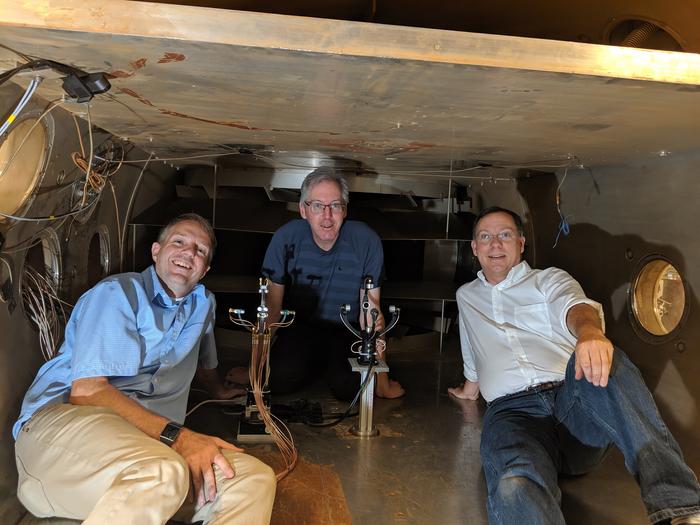
Credit: White, Neeson, and Banfield
WASHINGTON, Aug. 13, 2024 – Mars has a notoriously inhospitable environment, with temperatures that fluctuate dramatically over the course of a Martian day and average minus 80 degrees Fahrenheit. Its surface is mostly covered in red dust, with terrain typified by craters, canyons, and volcanoes. And its atmosphere is extremely thin, comprising only about 1% of the density of Earth’s.
Needless to say, measuring wind speeds on the red planet is challenging. Martian landers have been able capture measurements — some gauging the cooling rate of heated materials when winds blow over them, others using cameras to image “tell-tales” that blow in the wind. Both anemometric methods have yielded valuable insight into the planet’s climate and atmosphere.
But there’s still room for improvement in the astronomical toolshed, especially as plans to send astronauts to Mars unfold in the coming years.
In JASA, published on behalf of the Acoustical Society of America by AIP Publishing, researchers from Canada and the U.S. demonstrated a novel sonic anemometric system featuring a pair of narrowband piezoelectric transducers to measure the travel time of sound pulses through Martian air. The study accounted for variables including transducer diffraction effects and wind direction.
“By measuring sound travel time differences both forward and backward, we can accurately measure wind in three dimensions,” said author Robert White. “The two major advantages of this method are that it’s fast and it works well at low speeds.”
The researchers hope to be able to measure up to 100 wind speeds per second and at speeds as low as 1 cm/s, a remarkable contrast to previous methods that could register only about 1 wind speed per second and struggled to track speeds below 50 cm/s.
“By measuring quickly and accurately, we hope to be able to measure not only mean winds, but also turbulence and fluctuating winds,” said White. “This is important for understanding atmospheric variables that could be problematic for small vehicles such as the Ingenuity helicopter that flew on Mars recently.”
The researchers characterized ultrasonic transducers and sensors over a wide range of temperatures and a narrow range of pressures in carbon dioxide, the primary atmospheric gas on Mars. With their selections, they showed only nominal error rates would result from temperature and pressure changes.
“The system we’re developing will be 10 times faster and 10 times more accurate than anything previously used,” said White. “We hope it will produce more valuable data as future missions to Mars are considered and provide useful information on the Martian climate, perhaps also with implications for better understanding the climate of our own planet.”
###
The article “Modeling and characterization of gas coupled ultrasonic transducers at low pressures and temperatures and implications for sonic anemometry on Mars” is authored by Robert D. White, Rishabh Chaudhary, Zijia Zhao, Luisa Chiesa, Ian Neeson, and Don Banfield. The article will appear in the Journal of the Acoustical Society of America (JASA) on Aug. 13, 2024 (DOI: 10.1121/10.0028008). After that date, it can be accessed at https://doi.org/10.1121/10.0028008.
ABOUT THE JOURNAL
The Journal of the Acoustical Society of America (JASA) is published on behalf of the Acoustical Society of America. Since 1929, the journal has been the leading source of theoretical and experimental research results in the broad interdisciplinary subject of sound. JASA serves physical scientists, life scientists, engineers, psychologists, physiologists, architects, musicians, and speech communication specialists. See
ABOUT ACOUSTICAL SOCIETY OF AMERICA
The Acoustical Society of America (ASA) is the premier international scientific society in acoustics devoted to the science and technology of sound. Its 7,000 members worldwide represent a broad spectrum of the study of acoustics. ASA publications include The Journal of the Acoustical Society of America (the world’s leading journal on acoustics), JASA Express Letters, Proceedings of Meetings on Acoustics, Acoustics Today magazine, books, and standards on acoustics. The society also holds two major scientific meetings each year. See
###
Journal
The Journal of the Acoustical Society of America
Article Title
Modeling and characterization of gas coupled ultrasonic transducers at low pressures and temperatures and implications for sonic anemometry on Mars
Article Publication Date
13-Aug-2024
Cite Scienmag News
Russell Cooper. (August 13, 2024). Measuring Martian winds with sound. Scienmag. https://scienmag.com/measuring-martian-winds-with-sound/
Russell Cooper. "Measuring Martian winds with sound." Scienmag, 13 August 2024, https://scienmag.com/measuring-martian-winds-with-sound/. Accessed 5 September 2026.
Russell Cooper. "Measuring Martian winds with sound." Scienmag. August 13, 2024. https://scienmag.com/measuring-martian-winds-with-sound/

