


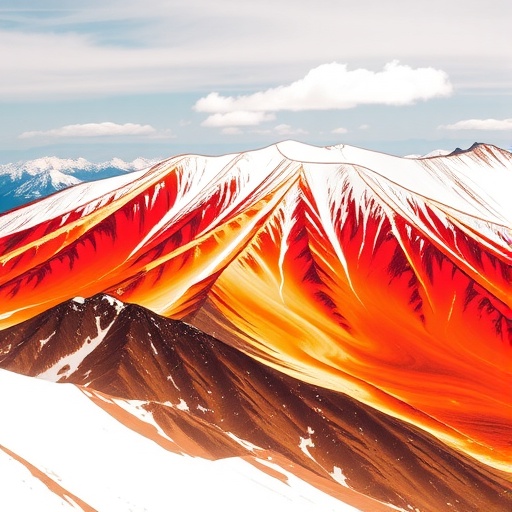
Rising temperatures are no longer uniform across the globe. A new study reports that high-altitude regions of the Tibetan Plateau are warming in a way that depends strongly on elevation—an effect amplified in areas shaped by the Westerlies. The findings, published in Communications Earth & Environment, offer fresh clues to why mountain climates can change faster than nearby lowlands and how atmospheric circulation modulates that transformation.
Using a combination of observational records and elevation-resolved analysis, the researchers focused on the Plateau’s high elevations, where thin air, complex terrain, and shifting weather systems can magnify climate signals. Their results show that the rate of warming is not constant with height; instead, temperature increases grow or intensify as elevation rises, especially where mid-latitude air flows dominate.
The study highlights that the Plateau is not simply “getting warmer,” but warming under a distinct dynamical regime. Westerlies-driven transport influences cloud formation, precipitation efficiency, and surface energy balance. Those changes can alter how much solar radiation is absorbed, how quickly heat is removed by the atmosphere, and how snow and ice respond to warmer conditions.
Elevation-dependent warming matters because it can reshape the water cycle in mountain ecosystems. Warmer high altitudes can shift the timing of melt and runoff, affecting downstream water availability for agriculture and cities. Even small changes in the fraction of precipitation falling as snow versus rain can translate into major seasonal impacts when multiplied across large basins.
The work also points to feedbacks tied to snow cover and land-surface properties. When snow persists for shorter periods, darker ground is exposed sooner, lowering surface albedo and increasing absorption of sunlight. Over time, such processes can reinforce warming at the very elevations where temperatures are already increasing rapidly.
Beyond hydrology, the study has implications for atmospheric chemistry and ecosystem stability. As climate zones shift upward, alpine habitats can compress, leaving less room for species adapted to cold conditions. Meanwhile, heat and dryness can influence dust mobilization and aerosol pathways, which in turn feed back on regional radiation and clouds.
Importantly for forecasting, the results suggest that climate models must capture how circulation patterns interact with altitude to reproduce the observed temperature gradients. Accounting for these details could improve projections for the Plateau and other mountains governed by similar weather systems.
Overall, the research frames elevation-dependent warming as a circulation-linked phenomenon rather than a simple thermodynamic trend. With the Tibetan Plateau often called a climate “switchboard” for Asia, understanding how Westerlies-dominated regions amplify warming may help anticipate wider environmental consequences across the continent.
Cite Scienmag News
Violet Maxwell. (July 17, 2026). Elevation-Driven Warming at High Altitudes Across the Westerly Tibetan Plateau. Scienmag. https://scienmag.com/elevation-driven-warming-at-high-altitudes-across-the-westerly-tibetan-plateau/
Violet Maxwell. "Elevation-Driven Warming at High Altitudes Across the Westerly Tibetan Plateau." Scienmag, 17 July 2026, https://scienmag.com/elevation-driven-warming-at-high-altitudes-across-the-westerly-tibetan-plateau/. Accessed 4 September 2026.
Violet Maxwell. "Elevation-Driven Warming at High Altitudes Across the Westerly Tibetan Plateau." Scienmag. July 17, 2026. https://scienmag.com/elevation-driven-warming-at-high-altitudes-across-the-westerly-tibetan-plateau/


