


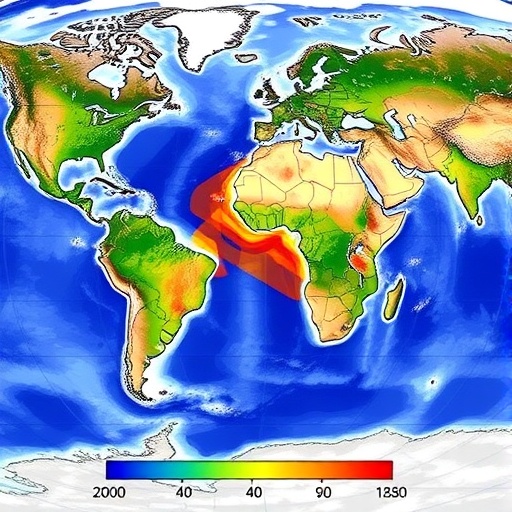
A new study published in Communications Earth & Environment reports that the El Niño–Southern Oscillation (ENSO) leaves a distinct, asymmetric imprint on global water storage—an effect that conventional, symmetric views of climate variability may miss. By focusing on how water stored across Earth’s land, snow, ice, and groundwater responds to ENSO phases, the researchers show that “water gains” and “water losses” do not mirror each other across warm and cool events.
Using a global hydrological framework that assimilates observed constraints, the team quantified how ENSO alters total water storage anomalies on a planetary scale. The analysis reveals that the transition from one ENSO phase to the next is not simply a scaled repetition of the reverse phase. Instead, the magnitude, timing, and spatial distribution of hydrological responses differ between El Niño and La Niña conditions.
The work emphasizes that the hydrological signal is not limited to surface runoff or precipitation alone. It propagates through land-atmosphere processes and storage compartments, creating an integrated fingerprint detectable in the total water budget. Crucially, the researchers identify a directional imbalance: the planet’s storage response during one ENSO phase is stronger or more persistent than the opposite phase, yielding a measurable asymmetry.
Technically, the study evaluates anomalies against a baseline climatology and tracks how storage changes correlate with ENSO indices. By comparing response patterns across events, the authors demonstrate that asymmetric behavior emerges in the coupled system—where atmospheric forcing, soil moisture dynamics, and groundwater contributions interact under differing thermodynamic and circulation regimes.
The result matters because ENSO is one of the most influential sources of seasonal to interannual variability. If water storage anomalies are asymmetric, then forecasting and risk planning for droughts and floods require models that can represent phase-dependent hydrology rather than assuming linear, symmetric reactions.
For climate scientists and water managers, the findings offer a clearer diagnostic pathway: ENSO-linked extremes may be better anticipated by monitoring not only rainfall and temperature anomalies, but also the direction-specific behavior of total storage. In short, the hydrological cycle responds to ENSO with an imbalance—one that could reshape how global water risk is projected during upcoming climate swings.
The study also suggests broader implications for data interpretation. Remote sensing and model intercomparisons that treat ENSO as a symmetric driver may under- or overestimate storage shifts. Incorporating asymmetry could improve attribution of hydrological extremes and refine ensemble predictions.
Finally, the research positions ENSO as more than a statistical pattern: it is a test case for how Earth’s storage system absorbs and releases water under contrasting atmospheric states. The authors’ results make the case for “phase-aware” hydrological modeling—an approach likely to become central as observational records lengthen and forecasting demands intensify.
Cite Scienmag News
Violet Maxwell. (July 17, 2026). El Niño Impacts Global Water Storage Through Asymmetric Hydrological Patterns. Scienmag. https://scienmag.com/el-nino-impacts-global-water-storage-through-asymmetric-hydrological-patterns/
Violet Maxwell. "El Niño Impacts Global Water Storage Through Asymmetric Hydrological Patterns." Scienmag, 17 July 2026, https://scienmag.com/el-nino-impacts-global-water-storage-through-asymmetric-hydrological-patterns/. Accessed 3 September 2026.
Violet Maxwell. "El Niño Impacts Global Water Storage Through Asymmetric Hydrological Patterns." Scienmag. July 17, 2026. https://scienmag.com/el-nino-impacts-global-water-storage-through-asymmetric-hydrological-patterns/


