


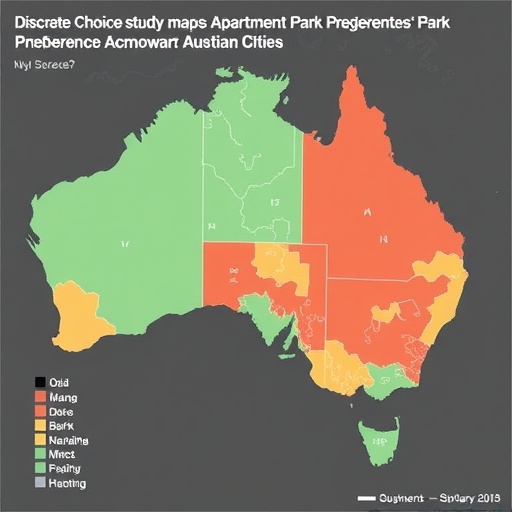
Australian city apartments are getting greener—but exactly what kinds of park features do residents actually value? A new study in npj Urban Sustainability applies discrete choice modeling to quantify how apartment dwellers in Australia trade off amenities such as park access, landscape quality, safety cues, and nearby facilities. Rather than asking people to rate “parks” in general, the researchers modeled realistic decision-making: when choosing where to live—or how to use local green space—what mix of attributes drives preference?
Using survey data from residents across multiple Australian cities, the team treated each park-related scenario as a bundle of attributes. Participants were presented with alternative options that differed systematically, then their choices were analyzed to estimate the relative weight of each feature. This approach is designed to reveal substitution patterns—how one attribute can compensate for another—without relying on overly simplistic average ratings.
Technically, the analysis centers on discrete choice models, which estimate the probability that a respondent selects a given option based on the perceived utility of its attributes. Utility functions were parameterized to capture both the direction and strength of preference effects. The study also tests for heterogeneity, recognizing that residents are not a uniform group: preferences can vary by household context, travel patterns, and likely perceptions of convenience and comfort.
The results suggest that park attributes linked to everyday usability—such as proximity and features that reduce friction to visiting—tend to matter strongly. Safety-related signals and the quality of the surrounding environment also influence choice, indicating that “green” alone is insufficient if residents do not feel secure or comfortable. Meanwhile, attributes that improve experiential value, like landscaping and perceived maintenance, show measurable preference gradients.
For urban planners, the findings translate into a practical message: design investment should target the attribute combinations that meaningfully shift choice probabilities, not just the headline presence of green space. If the goal is to increase park use among apartment residents, planners may achieve more by aligning interventions with the attribute trade-offs revealed by the model.
The study’s significance extends beyond Australia. Discrete choice analysis offers a policy-friendly framework for comparing scenarios before construction or renewal budgets are committed. By turning qualitative preferences into estimated decision rules, it becomes easier to anticipate where limited funding will generate the biggest behavioral payoff.
As viral science news, the headline is clear: apartment residents are not simply “pro-park.” They are attribute-driven decision-makers. This research reframes urban greening as a measurable optimization problem—one where safety, access, and experience jointly determine whether parks become part of daily life.
Cite Scienmag News
Courtney Benton. (July 17, 2026). Discrete Choice Study Maps Apartment Residents’ Park Preferences Across Australian Cities. Scienmag. https://scienmag.com/discrete-choice-study-maps-apartment-residents-park-preferences-across-australian-cities/
Courtney Benton. "Discrete Choice Study Maps Apartment Residents’ Park Preferences Across Australian Cities." Scienmag, 17 July 2026, https://scienmag.com/discrete-choice-study-maps-apartment-residents-park-preferences-across-australian-cities/. Accessed 3 September 2026.
Courtney Benton. "Discrete Choice Study Maps Apartment Residents’ Park Preferences Across Australian Cities." Scienmag. July 17, 2026. https://scienmag.com/discrete-choice-study-maps-apartment-residents-park-preferences-across-australian-cities/


