


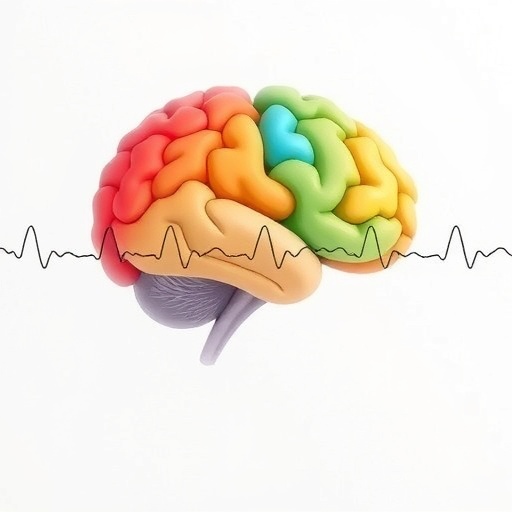
Some children with autism communicate more easily than others, even when they understand and hear the same spoken words. A new study from the University of Virginia (UVA) suggests that part of this variation may be written into the brain’s electrical dynamics—subtle patterns that current behavioral tests may miss.
The researchers focused on how autistic and typically developing youths process speech. By recording brain activity while participants listened to streams of spoken nonsense syllables, the team isolated neural responses related to speech processing rather than language knowledge or vocabulary.
High-density electroencephalography (EEG) was used with 128 sensors. In total, 306 participants aged 7 to 18 took part: 162 autistic youths and 144 typically developing peers. This large dataset allowed the team to look beyond classic EEG wave features and examine a more recent metric of brain activity.
Instead of concentrating on traditional oscillatory rhythms alone, the study analyzed the brain’s “aperiodic” signal—a component reflecting the balance between neural excitation and inhibition. In practical terms, it provides a window into how much of the recorded activity behaves like structured signal versus background “noise.”
The results showed that autistic participants exhibited altered aperiodic patterns, consistent with increased neural noise during speech listening. Importantly, the degree of noisier activity correlated with poorer performance on measures of everyday verbal communication.
Crucially, these EEG-derived markers were not tied to standard language competencies such as grammar or vocabulary. That pattern suggests the neural difference is linked more to real-world communicative processing than to learned linguistic rules.
The authors emphasize that this work is not a diagnostic test for autism. However, it may point to objective biological markers that could help track communication changes over time or evaluate whether therapies genuinely shift underlying brain function.
The study also highlights the growing role of advanced data science in neuroscience, showing how modern computational methods can separate meaningful neural structure from complex electrophysiological background.
Still, generalization remains an open question. Many participants had average or above-average verbal abilities, and future research must test whether the same neural signals appear in minimally verbal autistic individuals.
Cite Scienmag News
Cassandra Pierce. (July 16, 2026). Brain Signal Associated with Communication Difficulties in Autism. Scienmag. https://scienmag.com/brain-signal-associated-with-communication-difficulties-in-autism/
Cassandra Pierce. "Brain Signal Associated with Communication Difficulties in Autism." Scienmag, 16 July 2026, https://scienmag.com/brain-signal-associated-with-communication-difficulties-in-autism/. Accessed 3 September 2026.
Cassandra Pierce. "Brain Signal Associated with Communication Difficulties in Autism." Scienmag. July 16, 2026. https://scienmag.com/brain-signal-associated-with-communication-difficulties-in-autism/


